Music, dance and storytellingSouth AsiaHindu
Burra katha
A Telugu three-person storytelling show of song, dance, jokes and social comment
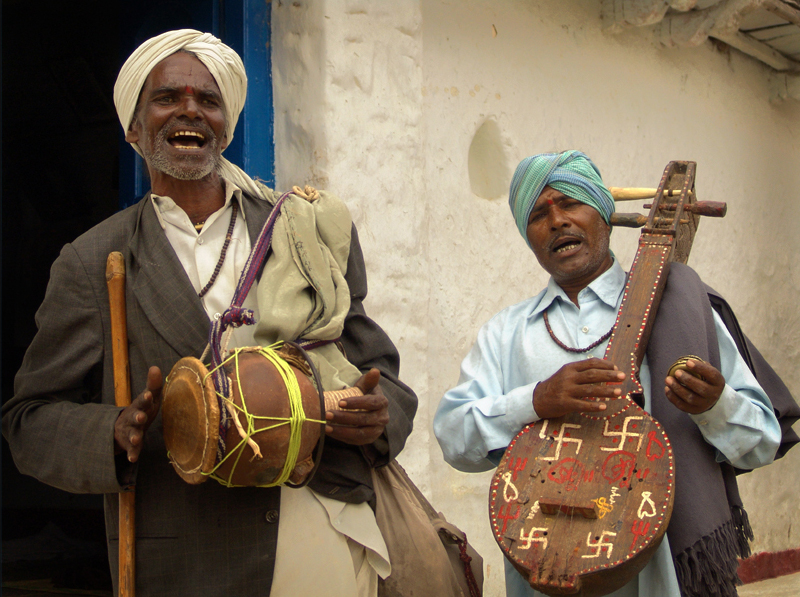
Burra katha is an oral storytelling art of Telugu-speaking India, kept by a three-person troupe: one lead narrator who sings and dances, and two companions who answer with jokes, questions and comment. It grew from the devotional songs of Jangam and Lingayat minstrels and today is performed at Dussehra and Sankranti and on radio and television.
When is Burra katha marked?
Burra katha is kept as part of Dussehra, which is on Tuesday, 20 October 2026.
Burra katha is a Telugu storytelling performance from India. A small troupe sings, dances and acts out a tale, mixing poems, jokes and argument. One lead narrator carries the story while two partners answer, interrupt and tease. Audiences hear either a devotional Hindu story or a sharp comment on present-day social and political life. It grew from the songs of wandering minstrels and became a recognised stage and broadcast art.
What it is
Burra katha is a way of telling a story out loud, using the whole body. It belongs to the Jangam Katha current of narrative performance found among Telugu communities. A troupe is small: usually three people, one leading and two supporting. The performance mixes prayer, song, dance, solo acting, recited verse and comedy, so the audience hears the tale and watches it at the same time. The subject is either a Hindu story drawn from the epics or a question the village is living with, such as a social or political problem. It has no fixed stage. It can be performed in a hall, a field or a studio.
Origins and history
By the account usually given, the show started as devotional singing by wandering people known as Jangams or Lingayats, who travelled and sang in praise of Lord Siva. In that early version it was called Jangam Katha and only two people took part, a storyteller and his wife. As village life and culture changed, secular subjects entered the form, and the cast opened up to three performers of any gender. The modern shape of the art is traced to Guntur, where it is said to have been put together about 1942 to carry political messages to villagers who could not read. It then spread widely during the Telangana Rebellion between the 1930s and 1950s.
How a show runs
The lead storyteller, called the kathakudu, carries the tale: singing, speaking, dancing and playing the tambura at the same time. On the right sits the hasyaka, or joker, who mocks and comments. On the left sits the rajakiya, or politician, who speaks as a knowing character about public and social matters. The three talk to one another throughout, and the companions break in with questions or doubts, or shout to underline a key moment. Every song opens with a line the lead sings, and the others answer with a refrain, which is why the form is also called tandana katha.
Music and objects
Two kinds of instrument carry the rhythm. The first is the burra itself, a string instrument with a hollow body, which gives the art its name: in Telugu, burra can mean brain, because the round shell is said to look like a human skull. Baked clay, a dried pumpkin, brass or copper can all serve as the shell. The player pulls and presses the strings to change the sound, much as a veena is played. The second is a pair of small earthen two-headed drums, the gummeta, also known as dakki or budike, played by the companions. The lead performer wears a metal ring, the andelu, on the right thumb and strikes it against a ring held in the other hand. Anklets, the gajjelu, sound as the performers dance.
Today and change
Once a common village entertainment, burra katha now has less of a hold on daily life. Still, it is broadcast regularly on radio and television in Andhra Pradesh, and troupes take it to festivals and to gatherings with a message to deliver. In the Dussehra and Sankranti seasons it is performed for crowds, telling epic stories such as the Ramayana and the Mahabharata, along with moral tales like kambojaraju katha, chinnamma katha and muggurumoratila katha. One name stands out in its recent story: Shaik Nazar, who took up current affairs as his subject and is remembered as the Father of Burrakatha.
How Burra katha is kept
A troupe of three takes the floor. The kathakudu leads, playing the tambura and dancing while narrating. To the right the hasyaka cracks jokes and satirical remarks, to the left the rajakiya speaks about politics and social questions. All three address one another, and the companions interrupt the lead with doubts or underline a high point with a shout. Songs begin with the lead's opening line, answered by the others' refrain. The companions beat the gummeta drums, and the lead clashes a pair of metal andelu rings for percussion. Anklets sound as they move. The story is either a Hindu epic or a present-day social subject.
When and where
The art does not have one fixed date. Its main performances cluster in the Dussehra and Sankranti festival seasons, when troupes tell epic and moral stories to festival crowds. Radio and television broadcasts in Andhra Pradesh run through the year as well.
It is kept by Telugu-speaking people in India, above all in the states of Andhra Pradesh and Telangana. There troupes perform it, radio and television carry it, and festival-season shows are held. Its modern form is traced to Guntur.
What Burra katha means
To those who keep it, burra katha is more than amusement. It carries memory: the epics, the moral tales, the sayings a village passes on. Because the joker and the politician stand on either side of the storyteller, the form makes room for laughter and argument inside a single telling, and it has long been used to speak to people who do not read. Its devotional roots in the songs of Siva's wandering singers still shape how performers open a show.

Days Burra katha is marked
Questions people ask about Burra katha
When is Burra katha marked?
Burra katha is kept as part of Dussehra, which is on Tuesday, 20 October 2026.
What is burra katha?
It is a Telugu oral storytelling performance from India. A lead narrator sings, dances and plays a string instrument called the burra, while two companions answer with jokes, questions and comment. A show tells either a Hindu epic story or a story about a social problem.
Who performs it?
A troupe of three. The kathakudu is the main storyteller. The hasyaka, or joker, sits on the right, and the rajakiya, or politician, sits on the left. In the older Jangam Katha form only two people took part, the storyteller and his wife.
What is the ring the performer wears?
The andelu is a metal ring worn on the right thumb of the main storyteller, who also holds a second ring in the other hand. Striking the two together gives a percussion beat that goes with the drums and the anklets.
Is it still performed today?
Yes, though it is less common than it once was as a village pastime. It is broadcast on radio and television in Andhra Pradesh, and troupes still perform it during the Dussehra and Sankranti festival seasons for crowds.
See also
 PulikaliPainted tigers and leopards dance through Thrissur on the fourth day of Onam
 BhangraA Punjabi harvest dance, first kept by farmers and now performed worldwide
 GhazalA short rhyming poem of love and parting, recited and sung from Arabia to South Asia
 QawwaliDevotional Sufi singing from South Asia, led by hereditary parties at shrines
Good reading and sources
- Burra katha on WikipediaEncyclopedia
- More photos on Wikimedia CommonsPhotos and video
- Wikidata recordOpen data
The facts on this page come from the Wikipedia article "Burra katha", written by its contributors and used under the CC BY-SA 4.0 licence, and from its Wikidata record (CC0). EveryParampara rewrote the text in its own words, with AI assistance, and compares every page with the article to make sure no passage is copied. It may be reused under the same CC BY-SA 4.0 licence with a link back.
It may contain mistakes. Traditions differ from one family, village and community to the next, and the people who keep them know them best. If something is wrong, tell us. Last refreshed 2026-10-12.
More from India
All the traditions of India
🇮🇳 Thrissur, IndiaPulikaliപുലിക്കളി
Painted tigers and leopards dance through Thrissur on the fourth day of OnamPerformance
🇮🇳 Jammu, IndiaBhangra
A Punjabi harvest dance, first kept by farmers and now performed worldwidePerformance
🇮🇳 India and 5 moreGhazalغَزَل
A short rhyming poem of love and parting, recited and sung from Arabia to South AsiaPerformance
🇵🇰 Islamabad, Pakistan and 2 moreQawwaliقَوّالی
Devotional Sufi singing from South Asia, led by hereditary parties at shrinesPerformance
The same idea elsewhere
All of this kind 🇵🇭 Philippines and 1 morePangalay
A traditional fingernail dance of the Tausūg and Bajau peoples in the Sulu Archipelago and Sabah.Performance
🇦🇴 Luanda, Angola and 2 moreKuduro
An energetic Angolan music and dance style born in Luanda that mixes African rhythms with electronic beats.Performance
🇵🇭 Philippines and 1 morePangalay
A traditional fingernail dance of the Tausūg and Bajau peoples in the Sulu Archipelago and Sabah.Performance
🇦🇴 Luanda, Angola and 2 moreKuduro
An energetic Angolan music and dance style born in Luanda that mixes African rhythms with electronic beats.Performance
 🇺🇦 Kyiv, UkraineBanduraБандура
A Ukrainian plucked string instrument played to accompany epic songs and folk balladsPerformance
🇺🇦 Kyiv, UkraineBanduraБандура
A Ukrainian plucked string instrument played to accompany epic songs and folk balladsPerformance
 🇱🇧 Lebanon and 5 moreZajalزجل
Half-sung Arabic poetry in colloquial speech, traded as a duel between improvising poetsPerformance
🇱🇧 Lebanon and 5 moreZajalزجل
Half-sung Arabic poetry in colloquial speech, traded as a duel between improvising poetsPerformance