Music, dance and storytellingSouth AsiaMuslim
Qawwali
In its own language: قَوّالی
Devotional Sufi singing from South Asia, led by hereditary parties at shrines

Qawwali is a form of Sufi devotional singing from South Asia, performed by hereditary parties at shrines and in concert halls. Its poetry, in Persian, Urdu, Hindi and regional languages, seeks remembrance of God, divine love and spiritual ecstasy, and it remains popular in Pakistan, India and Bangladesh.
When is Qawwali kept?
Qawwali is kept on through the year, above all at a shrine's Urs, and at concerts today.
Qawwali is devotional singing kept by Sufi Muslims in South Asia. A party of singers performs poetry of divine love, often through the night at a saint's shrine. Listeners come for remembrance of God, and some are moved to ecstatic absorption. The same songs now fill concert halls around the world, while the old hereditary families carry on at the shrines.
What it is
Qawwali is sung devotion in the Sufi tradition. The name comes from qawl, an Arabic word for a saying, because the earliest songs set sayings attributed to the Prophet Muhammad. A performance is a meeting for listening, where a line of poetry is repeated and drawn out until it lodges in the heart. Singers and listeners alike treat the occasion as worship rather than entertainment. Its themes are love, separation and the wish to be near the Divine. Qawwals say their own part is not the centre of the evening; the remembrance of God is.
Origins and history
Qawwali took shape in the Delhi Sultanate, and its beginnings are widely credited to Amir Khusrau, a thirteenth-century poet and musician. He was a disciple of the Chishti saint Nizamuddin Auliya, and he brought Persian and Indian poetry and music together for gatherings called mehfil-e-sama, assemblies for listening, held at the saint's lodge in Delhi. In the Chishti order, listening itself was accepted as a spiritual practice. Instruments were argued over later. Some masters called them forbidden, yet the harmonium, tabla and dholak became usual in qawwali parties.
Songs and poetry
The words matter as much as the tune. A classical programme opens with a qaul, a song of Prophetic sayings, then a hamd praising God, then a na'at in honour of the Prophet, then a manqabat for Imam Ali or a saint. A ghazal, built from couplets that stand on their own, is the form heard most often; its repetitions let a singer dwell on one line, which is itself a kind of remembrance. Poets write of wine and longing as images for the soul's search. Other pieces include the Punjabi, Seraiki and Sindhi kafi, and the munajaat, a night prayer often credited to Rumi.
The performers
A qawwali party, called a humnawa in Urdu, usually brings together eight or nine men: a main voice, further singers, harmonium and drums. Where two drummers play, one keeps the tabla and the other the dholak; a single drummer may handle both. Most qawwals learn through family lines attached to a particular shrine, and they serve its formal occasions, above all the Urs, the death anniversary of a saint. Others learn inside Sufi teaching circles. Training covers music and Sufi thought, and it takes literacy, since so much rests on poetry.
Today and change
Until the late twentieth century qawwali was little known outside South Asia. Recordings and festival appearances by Nusrat Fateh Ali Khan, the Sabri Brothers and Aziz Mian carried it far beyond the shrines. A long line of other qawwals, among them Fareed Ayaz and Abu Muhammad, Rahat Fateh Ali Khan, Amjad Sabri and the Rizwan-Muazzam Qawwali Group, work both the concert stage and the shrine repertoire. Scholars note that it still rests on Sufi mysticism even when the audience is not religious. Regional styles differ; one Bengali singer's qawwali sounds closer to Baul music than to the Pakistani mainstream.
How Qawwali is kept
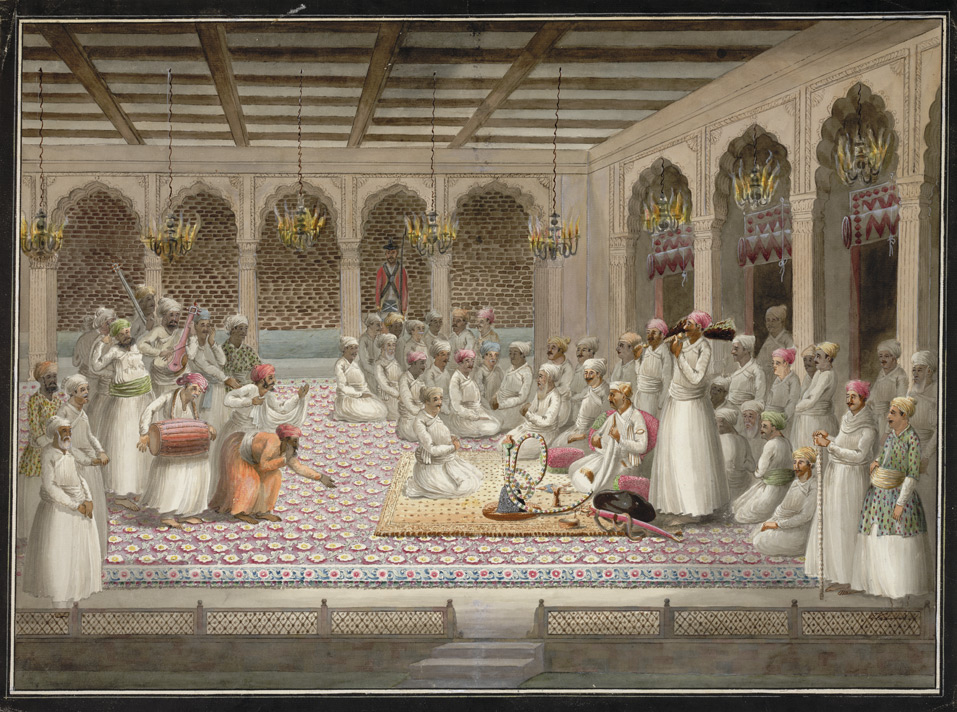
A qawwali occasion gathers a party of singers before listeners seated on the floor. The lead voice begins, the others answer, and a harmonium and drums carry the pulse. Songs follow a rough order, from praise of God and the Prophet to verses for a saint. A phrase is repeated, the tempo rises, and some listeners enter wajd, an absorbed state. The evening may last hours, commonly through the night at a shrine. Qawwals see themselves as servants of the gathering, present to help others remember God rather than to perform for applause.
When and where
Qawwali has no single date. It is heard right through the year, most often at a shrine's Urs, the yearly commemoration of a saint's death, and at other Sufi gatherings. In concert halls it is scheduled like any other music. Some evenings run from late night until dawn, which many consider the best time for listening.
The tradition belongs to South Asia. It is strongest in Pakistan and India, and it is widely heard in Bangladesh. Its historic home is the Chishti shrine of Nizamuddin Auliya in Delhi, where the early listening assemblies took place. Today it also travels: qawwals appear at festivals and in concert halls in many parts of the world, while the shrine circuit continues alongside.
What Qawwali means
For those who keep it, qawwali is a way of remembering God and of opening the heart to love of the Divine. The poetry is not meant literally: wine, drunkenness and romantic longing stand for spiritual states, and the scorned lover stands for the soul parted from God. Singers hold responsibility for keeping the mood reverent, so that a worldly image does not pull listeners away from worship. Sama, the act of listening, is understood as a practice that can awaken love and draw a person nearer to the Divine.

Questions people ask about Qawwali
When is Qawwali kept?
Qawwali is kept on through the year, above all at a shrine's Urs, and at concerts today.
What is qawwali?
It is Sufi devotional singing from South Asia. A party of singers performs poetry about divine love, usually at a saint's shrine, with the aim of remembering God and drawing listeners closer to the Divine. It is treated as worship rather than entertainment, though it is also performed in concert halls today.
Where does it come from?
It developed in the Delhi Sultanate and is widely credited to Amir Khusrau, a thirteenth-century poet and disciple of the Chishti saint Nizamuddin Auliya. Today qawwali is kept in Pakistan, India and Bangladesh, and it is heard in many other countries as well.
Who performs it?
Qawwals, who have usually learned the art within families attached to a shrine. A party of eight or nine men typically includes a lead voice, other singers, harmonium and drums. They are trained in music and in Sufi teaching, and they see themselves as servants of the gathering.
What are the songs about?
Themes of love, devotion and longing for the Divine, drawn from the Qur'an, hadith and Sufi poetry in Persian, Urdu, Hindi and regional languages. Programmes move from praise of God to praise of the Prophet and of saints. Worldly images such as wine are used as metaphors for mystical states.
See also
 GhazalA short rhyming poem of love and parting, recited and sung from Arabia to South Asia
 PulikaliPainted tigers and leopards dance through Thrissur on the fourth day of Onam
 BhangraA Punjabi harvest dance, first kept by farmers and now performed worldwide
 Dandiya RaasA stick dance from Gujarat performed in pairs during the festival of Navaratri
Good reading and sources
- Encyclopaedia BritannicaArticle
- BBC Radio 3 - World Routes, Songs of the Sufi Mystics, The Nizamuddin shrine in DelhiBBC, Article
- Nusrat Fateh Ali Khan, Womad 1985: the qawwali star invokes raptureThe Guardian, Article
- BBC Radio 3 - World Routes, Songs of the Sufi Mystics, The Nizamuddin shrine in DelhiBBC, Article
- Nusrat Fateh Ali Khan, Womad 1985: the qawwali star invokes raptureThe Guardian, Article
- Qawwali on WikipediaEncyclopedia
- More photos on Wikimedia CommonsPhotos and video
- Wikidata recordOpen data
The facts on this page come from the Wikipedia article "Qawwali", written by its contributors and used under the CC BY-SA 4.0 licence, and from its Wikidata record (CC0). EveryParampara rewrote the text in its own words, with AI assistance, and compares every page with the article to make sure no passage is copied. It may be reused under the same CC BY-SA 4.0 licence with a link back.
It may contain mistakes. Traditions differ from one family, village and community to the next, and the people who keep them know them best. If something is wrong, tell us. Last refreshed 2026-10-05.
More from Pakistan
All the traditions of Pakistan 🇮🇳 Amritsar, India and 1 moreGatkaਗੱਤਕਾ (Gurmukhi) / گَتّکا (Shahmukhi)
A Sikh martial art of stick-fighting and sword dance from the Punjab region.Performance
🇦🇫 Kabul, Afghanistan and 1 moreAttanاتڼ
A Pashtun circle dance of drums and clapping, kept at weddings and gatherings.Performance
🇮🇳 Gwalior, India and 1 moreDhrupadध्रुवपद
The foundational vocal and instrumental classical music tradition of northern IndiaPerformance
🇮🇳 Amritsar, India and 1 moreGatkaਗੱਤਕਾ (Gurmukhi) / گَتّکا (Shahmukhi)
A Sikh martial art of stick-fighting and sword dance from the Punjab region.Performance
🇦🇫 Kabul, Afghanistan and 1 moreAttanاتڼ
A Pashtun circle dance of drums and clapping, kept at weddings and gatherings.Performance
🇮🇳 Gwalior, India and 1 moreDhrupadध्रुवपद
The foundational vocal and instrumental classical music tradition of northern IndiaPerformance
 🇮🇳 India and 2 moreGiddhaਗਿੱਧਾ
A lively circle dance of women from the Punjab region, performed with clapping and call-and-response songs.Performance
🇮🇳 India and 2 moreGiddhaਗਿੱਧਾ
A lively circle dance of women from the Punjab region, performed with clapping and call-and-response songs.Performance
The same idea elsewhere
All of this kind 🇹🇷 Kayseri, Turkey and 4 moreHalay
A traditional line and circle folk dance kept across Turkey, Azerbaijan, Armenia, Iran, and Syria.Performance
🇧🇷 BrazilBaião
A syncopated folk rhythm and partnered dance from northeastern BrazilPerformance
🇹🇷 Kayseri, Turkey and 4 moreHalay
A traditional line and circle folk dance kept across Turkey, Azerbaijan, Armenia, Iran, and Syria.Performance
🇧🇷 BrazilBaião
A syncopated folk rhythm and partnered dance from northeastern BrazilPerformance
 🇺🇦 Kyiv, UkraineBanduraБандура
A Ukrainian plucked string instrument played to accompany epic songs and folk balladsPerformance
🇺🇦 Kyiv, UkraineBanduraБандура
A Ukrainian plucked string instrument played to accompany epic songs and folk balladsPerformance
 🇳🇿 Auckland, New ZealandPoi
A Māori performing art of swinging tethered weights in rhythmical patterns.Performance
🇳🇿 Auckland, New ZealandPoi
A Māori performing art of swinging tethered weights in rhythmical patterns.Performance