Festivals and celebrationsEuropeChristianSecular and civic
Maltese Carnival
In its own language: il-Karnival ta' Malta
A lively week of costumed parades, dancing, satirical floats and sweets across Malta.

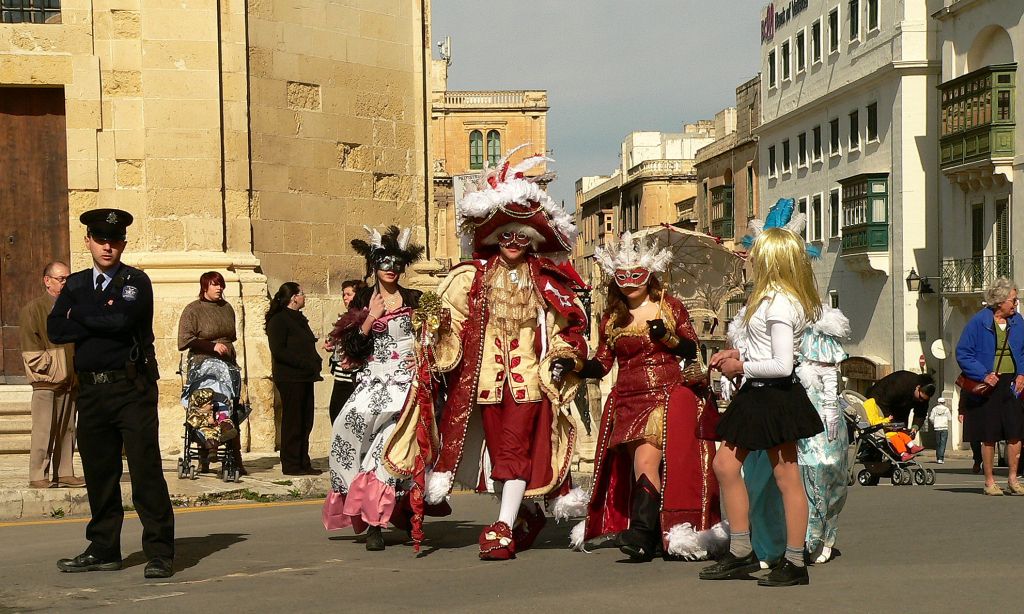
Maltese Carnival is an annual festival celebrated in the days before Ash Wednesday across Malta and Gozo. In towns such as Valletta and Nadur, local communities mark the occasion with colourful floats, masked balls, mock battles, and sweet pastries like prinjolata.
When is Maltese Carnival marked?
Maltese Carnival is kept as part of Ash Wednesday, which is on Wednesday, 10 February 2027.
Maltese Carnival brings colourful street processions, masquerade balls, and exuberant community gatherings to the Mediterranean archipelago. Held during the days before Ash Wednesday, the celebration has taken place since the fifteenth century. Today, revellers fill town squares with elaborate allegorical floats, spontaneous costumes, dramatic mock battles, and traditional sweet almond confections, offering a lively burst of shared celebration before the solemn season of Christian fasting begins.
Origins and history
People in Malta have celebrated Carnival since at least the mid-fifteenth century. The festivities grew in scale after the Order of Saint John arrived, starting officially in Birgu in 1535 under Grand Master Piero de Ponte with tournaments and knightly pageants. Successive Grand Masters often clashed with revellers over wild behaviour. Jean Parisot de Valette allowed masks in public in 1560, while Giovanni Paolo Lascaris tried to ban devil costumes and forbid women from masked balls in 1639. The latter ban provoked riots against the Jesuits, giving rise to the Maltese idiom for a gloomy face, Wiċċ Laskri.
Parata and traditional rituals
Carnival formally opened with the Parata, a ritual of great significance. Dancers gathered beneath the Grandmaster's Palace in Valletta to receive official permission for the festivities. Once proclaimed, troupes staged mock battles between Christians and Turks to commemorate the 1565 Great Siege, while carrying a child with a flag through the streets. A hanging stone at the Palace of Justice signalled that regular law was suspended for three days. In 1721, Grand Master Marc'Antonio Zondadari added the kukkanja, a contest where crowds scrambled to seize provisions hidden beneath leafy boughs in the square.
Modern floats and customs
Valletta and neighbouring Floriana host the largest modern spectacles, presided over by King Carnival. Parades feature marching bands, grotesque mask contests, and massive allegorical floats decorated with ticker tape. In contrast, smaller localities hold spontaneous, unscripted gatherings. The village of Nadur in Gozo is famous for its darker, eccentric themes, including ghost disguises and satirical depictions of public figures. In Għaxaq, residents assemble impromptu costumes using vintage clothing pulled from their wardrobes, maintaining a grassroots atmosphere alongside the capital's organised pageants.
Traditional festival sweets
Sweet foods are an essential part of the Carnival season across the islands. Two confections stand out during the celebrations: perlini, which are colourful sugar-coated almonds, and prinjolata. The prinjolata is a towering dessert composed of sponge, biscuits, citrus fruits, and almonds, finished with a layer of cream and pine nuts. Revellers enjoy these rich sweets throughout the week of festivities before the arrival of Ash Wednesday and the dietary restraints of Lent.
How Maltese Carnival is kept
Carnival begins in the week before Ash Wednesday. In Valletta, celebrations feature organised parades led by King Carnival, accompanied by marching bands, costumed dancers, and large allegorical floats. Participants compete in grotesque mask contests and attend late-night masked balls. Meanwhile, village streets in places like Nadur and Għaxaq fill with spontaneous revellers wearing eccentric disguises, vintage attire, or satirical costumes. Throughout the week, families gather to watch the processions and share seasonal sweets such as perlini and prinjolata.
When and where
Carnival takes place every year during the week before Ash Wednesday. Because its timing is tied to the Christian liturgical calendar and the start of Lent, the exact dates shift between February and March.
Celebrations happen across the Maltese islands. The largest organised events take place in the capital city of Valletta and nearby Floriana, while distinctive spontaneous street carnivals are held in villages like Nadur on Gozo and Għaxaq in southern Malta.
What Maltese Carnival means
Historically, Carnival represented a brief release from civic and religious constraints, symbolised by hanging a stone outside the court to indicate that justice was temporarily suspended. The traditional Parata dance reaffirmed collective memory by re-enacting the 1565 Great Siege through mock combat, while satirical floats have long served as a popular commentary on political figures and societal rules.



Days Maltese Carnival is marked
Questions people ask about Maltese Carnival
When is Maltese Carnival marked?
Maltese Carnival is kept as part of Ash Wednesday, which is on Wednesday, 10 February 2027.
What is Maltese Carnival?
Maltese Carnival is an annual festival celebrated with costumed street parades, grotesque masks, allegorical floats, masked balls, and traditional treats. It dates back to at least the fifteenth century and is held before the Christian season of Lent begins.
Where does the festival take place?
The largest official parades and float competitions are held in Valletta and Floriana. Other localities across Malta and Gozo host spontaneous street carnivals, with Nadur and Għaxaq being particularly well known for their grassroots celebrations.
What is the Parata?
The Parata is an old ceremonial dance that opens Carnival. Historically, dancers requested formal permission to celebrate from the Grandmaster's Palace, then performed a mock battle between Christians and Turks to commemorate the Great Siege of 1565.
What traditional sweets are eaten during Carnival?
Revellers eat perlini, which are sugar-coated almonds dyed in various colours, as well as prinjolata, a tall dessert built from sponge cake, biscuits, almonds, and citrus, topped with cream and pine nuts.
See also
 Nadur CarnivalAn unscripted five-day costume festival filling the streets of Nadur before Lent
 Good FridayA solemn Christian holy day commemorating the crucifixion and death of Jesus Christ.
 Holy WeekThe solemn seven days leading to Easter, recalling the final week and Passion of Jesus
 Valentine's DayA Christian feast day and cultural celebration of love kept on February 14 in many countries.
Good reading and sources
- Maltese Carnival on WikipediaEncyclopedia
- More photos on Wikimedia CommonsPhotos and video
- Wikidata recordOpen data
The facts on this page come from the Wikipedia article "Maltese Carnival", written by its contributors and used under the CC BY-SA 4.0 licence, and from its Wikidata record (CC0). EveryParampara rewrote the text in its own words, with AI assistance, and compares every page with the article to make sure no passage is copied. It may be reused under the same CC BY-SA 4.0 licence with a link back.
It may contain mistakes. Traditions differ from one family, village and community to the next, and the people who keep them know them best. If something is wrong, tell us. Last refreshed 2026-10-04.
More from Malta
All the traditions of Malta
🇲🇹 Nadur, MaltaNadur Carnival
An unscripted five-day costume festival filling the streets of Nadur before LentFestival
🇬🇧 United Kingdom and 4 moreValentine's Day
A Christian feast day and cultural celebration of love kept on February 14 in many countries.Festival
 🇵🇱 Poland and 5 moreGrandparents' Day
A single-day holiday kept on different dates in many countries to honour grandparentsFestival
🇵🇱 Poland and 5 moreGrandparents' Day
A single-day holiday kept on different dates in many countries to honour grandparentsFestival
 🇲🇹 Floriana, MaltaIsle of MTV
A major free summer open-air pop and electronic music gathering held in MaltaFestival
🇲🇹 Floriana, MaltaIsle of MTV
A major free summer open-air pop and electronic music gathering held in MaltaFestival
The same idea elsewhere
Fasting and feasting compared 🇹🇷 Turkey and 5 moreEid al-Fitrعيد الفطر
The feast that ends Ramadan, opened with morning prayers, sweets and visits homeFestival · Feasts and festival meals
🇦🇺 Australia and 5 moreGood Friday
A solemn Christian holy day commemorating the crucifixion and death of Jesus Christ.Spiritual · Fasting and breaking the fast
🇹🇷 Turkey and 5 moreEid al-Fitrعيد الفطر
The feast that ends Ramadan, opened with morning prayers, sweets and visits homeFestival · Feasts and festival meals
🇦🇺 Australia and 5 moreGood Friday
A solemn Christian holy day commemorating the crucifixion and death of Jesus Christ.Spiritual · Fasting and breaking the fast
 🇮🇳 Ayodhya, India and 7 moreDiwaliदीपावली (Dīpāvalī)
A five-day festival of lights celebrated across India and its diaspora to mark the victory of light over darkness.Festival · Feasts and festival meals
🇵🇭 Philippines and 5 moreHoly WeekἉγία καὶ Μεγάλη Ἑβδομάς
The solemn seven days leading to Easter, recalling the final week and Passion of JesusSpiritual · Fasting and breaking the fast
🇮🇳 Ayodhya, India and 7 moreDiwaliदीपावली (Dīpāvalī)
A five-day festival of lights celebrated across India and its diaspora to mark the victory of light over darkness.Festival · Feasts and festival meals
🇵🇭 Philippines and 5 moreHoly WeekἉγία καὶ Μεγάλη Ἑβδομάς
The solemn seven days leading to Easter, recalling the final week and Passion of JesusSpiritual · Fasting and breaking the fast