Music, dance and storytellingSouth AsiaHindu
Manipuri dance
In its own language: Jagoi Raas, Raas Jagoi
A classical dance from Manipur, danced as an offering to Radha and Krishna

Manipuri dance is a classical dance form from the state of Manipur in India, kept by the Meitei people and shaped by Vaishnavism. Its best-known form, the Raas Leela, tells of the love of Radha and Krishna and is performed on full moon nights, three times in autumn and once in spring.
When is Manipuri dance marked?
Manipuri dance is kept as part of Holi, which runs from 22 to 23 March 2027.
Manipuri dance is a classical dance of Manipur, in north-east India, and the Meitei people count it among their heritage. Its identity grew from older ritual arts and from Vaishnavism, the worship of Krishna. Dancers treat it as prayer as much as performance, and its Raas Leela tells of Krishna's love with Radha and the cowherd women of Vrindavan.
What it is
Manipuri dance is one of the classical dance forms of India, and it belongs to the state of Manipur. The Meitei people keep it, and count it among their heritage. The name Raas Leela often stands for the whole form, though drum dances and other pieces belong to it as well. Its mood is gentle: soft eyes, calm limbs, faces at peace, showing bhakti rasa, the flavour of devotion. A dancer need not be Hindu, the sources note, but the dance rests on Vaishnava scripture and on episodes from Krishna's life.
Origins and history
The earliest written descriptions of the dance date from the early 1700s. Earlier history rests on spoken tradition, finds, and passing mentions in manuscripts from elsewhere. A Meitei text called Bamon Khunthok says a king of Manipur took up Vaishnavism in the 15th century, and further Vaishnava and Buddhist arrivals came from Assam and Bengal later on. In 1704 King Pitambar Charairongba made Vaishnavism the state religion. In 1717 King Pamheiba turned to the devotional style of Chaitanya. King Rajarshi Bhagyachandra, who ruled from 1759 to 1798, codified the dance and is credited with three of the five Raas Leelas.
How it is kept
The Raas Leelas are danced at night under a full moon. Three fall in autumn, between August and November, and one in spring, in March or April. Basanta Raas keeps company with Holi, the festival of colours, while the rest follow post-harvest festivals such as Diwali. Cymbals called kartal or manjira keep time with a double-headed drum, the pung. The basic step is the chali. Singers and drummers carry the Vaishnava padavalis, and the words are held to have a plain meaning and a deeper one. Radha and Krishna take the longest passage, with the gopis around them.
Dress and objects
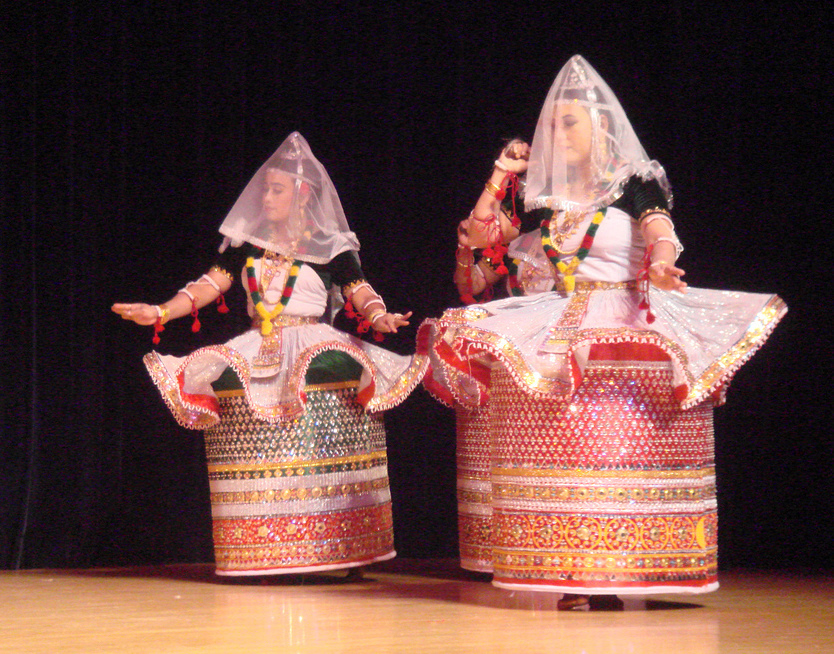
The women wear the Potloi, a costume that makes them seem to glide. Rajarshi Bhagyachandra is said to have seen it in a dream, with his own daughter dancing inside it. The skirt, the Kumin, is barrel-shaped and stiffened, decorated with gold and silver thread, mirrors, and borders of lotus and the Kwaklei orchid. Dancers wear anklets and foot ornaments but no bells, along with the kolu necklace and garlands. A Gaudiya Vaishnava tilak marks the forehead, with Gopi dots of sandalwood above the brows. Men wear the dhoti, a golden headdress called Leittreng, and a Chura of peacock feathers on the head.
Today and change
After the British annexed Manipur in 1891, the dance was mocked and survived mainly in temples such as the Shree Govindajee temple in Imphal. Supporters of Indian independence helped bring it back. Rabindranath Tagore saw a Goshtha Lila in Sylhet in 1919 and later invited Manipuri teachers to Shantiniketan, among them Guru Budhimantra Singh and, in 1926, Guru Naba Kumar. India's Sangeet Natak Akademi counts the dance among the country's classical forms and gives a yearly award in its name. It also travelled on a joint India and Armenia postage stamp, where it was called the national dance.
How Manipuri dance is kept
Dancers begin with the chali, the basic step, in which the body traces a circle or an oval. Men play the pung and clash the kartal while the singing carries the story. The piece follows the season: Basanta Raas with Holi, the others with post-harvest festivals. Each gopi has her own song and sequence. The dancer as Krishna shows feeling, and the gopis answer with their eyes, hands, and the set of the body, showing longing, low spirits, or gladness. Some plays move faster, with jumps, squats, and turns, and boys dance the Gopa Ras in unison.
When and where
The Raas Leelas are held on full moon nights: three in autumn, from August to November, and one in spring, in March or April. Basanta Raas falls with Holi, and the autumn ones fall with post-harvest festivals such as Diwali. Manipuri tradition holds that the first Raas was danced in 1779, on the full moon of Kartik.
The dance belongs to Manipur, in north-east India, and the Meitei are its keepers. It is strongest in Imphal, where temples such as the Shree Govindajee temple kept it alive. It spread to Bengal in the 20th century through Shantiniketan, and it is kept in Bangladesh too, where Banglapedia describes its place in Meitei life.
What Manipuri dance means
For those who keep it, the dance is worship rather than mere entertainment. It is called the highest spiritual expression of devotion to Krishna, and dancers treat the stage as a place of prayer. The stories come from Krishna's life and from his meeting with Radha, read as the meeting of the human soul with the divine. The songs are understood on two levels, one literal and one spiritual. The stillness and calm of the dancing carry the feeling of bhakti, the love a devotee offers.



Days Manipuri dance is marked
Questions people ask about Manipuri dance
When is Manipuri dance marked?
Manipuri dance is kept as part of Holi, which runs from 22 to 23 March 2027.
What is Manipuri dance?
It is one of the classical dance forms of India, coming from the state of Manipur, and the Meitei people keep it. Its best-known form is the Raas Leela, a devotional dance drama about Radha and Krishna, with soft movement, calm faces, and a mood of devotion.
Who shaped it?
The earliest dated written records are from the early 1700s. King Rajarshi Bhagyachandra of Manipur, who ruled from 1759 to 1798, is credited with codifying the style and with three of the five Raas Leelas. Later kings added drum dances and other pieces.
Which instruments accompany it?
Cymbals called kartal or manjira keep time, together with the pung, a double-headed drum also called the Manipuri mrdanga. Singers perform the Vaishnava padavalis. The song words are said to carry two meanings, one literal and one spiritual.
Must a dancer be Hindu?
The sources say the face keeps its peaceful, devotional expression whether or not the dancer is Hindu. The dance itself is founded on Vaishnava scripture and on the worship of Radha and Krishna.
See also
 PulikaliPainted tigers and leopards dance through Thrissur on the fourth day of Onam
 BhangraA Punjabi harvest dance, first kept by farmers and now performed worldwide
 Bihu danceA folk dance from Assam that celebrates spring, fertility and the new year with energetic movement and music.
Good reading and sources
- Encyclopaedia BritannicaArticle
- Gem of a journeyThe Hindu, Article
- On International Dance Day, a look at some of India’s famous dance forms and their exponentsThe Indian Express, Article
- Gem of a journeyThe Hindu, Article
- On International Dance Day, a look at some of India’s famous dance forms and their exponentsThe Indian Express, Article
- Manipuri dance on WikipediaEncyclopedia
- More photos on Wikimedia CommonsPhotos and video
- Wikidata recordOpen data
The facts on this page come from the Wikipedia article "Manipuri dance", written by its contributors and used under the CC BY-SA 4.0 licence, and from its Wikidata record (CC0). EveryParampara rewrote the text in its own words, with AI assistance, and compares every page with the article to make sure no passage is copied. It may be reused under the same CC BY-SA 4.0 licence with a link back.
It may contain mistakes. Traditions differ from one family, village and community to the next, and the people who keep them know them best. If something is wrong, tell us. Last refreshed 2026-10-05.
More from India
All the traditions of India
🇮🇳 Jammu, IndiaBhangra
A Punjabi harvest dance, first kept by farmers and now performed worldwidePerformance
🇮🇳 Thrissur, IndiaPulikaliപുലിക്കളി
Painted tigers and leopards dance through Thrissur on the fourth day of OnamPerformance
🇮🇳 Guwahati, IndiaBihu dance
A folk dance from Assam that celebrates spring, fertility and the new year with energetic movement and music.Performance
The same idea elsewhere
Spring and renewal compared 🇮🇱 Jerusalem, IsraelPassoverפסח
A Jewish spring festival celebrating freedom from slavery with ritual mealsSpiritual · Dinner
🇮🇱 Jerusalem, IsraelPassoverפסח
A Jewish spring festival celebrating freedom from slavery with ritual mealsSpiritual · Dinner
 🇪🇬 Cairo, EgyptSham Ennessimشم النسيم
An Egyptian spring festival of picnics, salted fish, green onions and painted eggsSeasonal
🇪🇬 Cairo, EgyptSham Ennessimشم النسيم
An Egyptian spring festival of picnics, salted fish, green onions and painted eggsSeasonal
 🇧🇬 Kazanlak, BulgariaRose FestivalФестивал на розата
An annual harvest celebration of damask roses across the Rose Valley of BulgariaFestival
🇧🇬 Kazanlak, BulgariaRose FestivalФестивал на розата
An annual harvest celebration of damask roses across the Rose Valley of BulgariaFestival
 🇨🇳 Dali, ChinaThird Month Fair三月街
A mountain-foot bazaar, festival, and sports gathering among the Bai in YunnanFestival
🇨🇳 Dali, ChinaThird Month Fair三月街
A mountain-foot bazaar, festival, and sports gathering among the Bai in YunnanFestival