Royal, civic and national ceremonyNorth AmericaSecular and civic
United States presidential inauguration
The formal swearing-in ceremony and celebrations for a new United States president

Every four years, the United States formally installs its head of state through a swearing-in ceremony in Washington, D.C. The event takes place on January 20 at the Capitol, followed by speeches, parades, and inaugural balls.
When is United States presidential inauguration kept?
United States presidential inauguration is kept every four years on January 20.
The United States presidential inauguration is the formal rite that marks the start of a new four-year term for the American president. Held roughly ten to eleven weeks after the national election, the gathering centres on the constitutional oath of office. Over more than two centuries, the occasion has grown from a brief legal swearing-in into a major civic observance featuring musical ensembles, military salutes, a festive procession, and evening parties.
The swearing-in ceremony
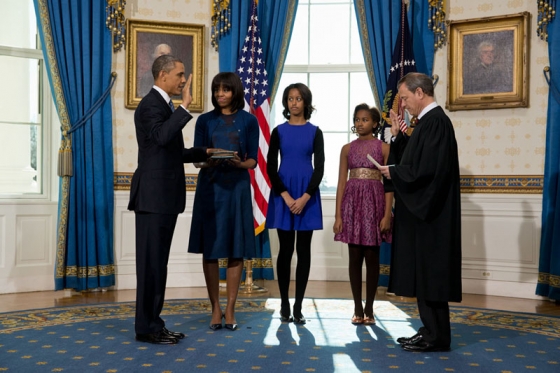
The core requirement set by the United States Constitution is the formal pledge taken by the incoming leader. By custom, the nation's top judicial officer leads the recitation of this constitutional text, though other judges have done so across American history. Today, the event takes place on the western steps of the Capitol in Washington, looking out over the National Mall. Five prominent banners frame the platform: the modern fifty-star national flag in the middle, flanked by historic thirteen-star flags and earlier emblems honoring the new leader's home state. In cases of severe frost or winter storms, officials have relocated the proceedings inside the Capitol Rotunda.
History and schedule
George Washington took the first oath in New York City on April 30, 1789, followed by ceremonies in Philadelphia before the government moved to Washington. For well over a century, public inaugurations took place on March 4. Following a constitutional revision, the date shifted in 1937 to noon on January 20. Whenever that date coincides with a Sunday, the incoming executive recites the legal pledge in private, repeating it before the public on Monday. Extraordinary transitions have also occurred without festive fanfare nine times in the nation's history, when a leader assumed office mid-term following a death or resignation.
Organizers and military honors
Two main groups coordinate the celebrations. A congressional committee consisting of three senators and three representatives oversees the swearing-in platform and hosts a traditional luncheon in the Capitol. Meanwhile, a committee appointed by the incoming leader manages private fundraising, public parades, and evening galas. Armed forces personnel have escorted presidents on this day since 1789, providing honor guards, artillery salutes, and marching bands. Their ceremonial participation recognizes the head of state as the commander-in-chief while honoring the principle of civilian governance.
Public reach and participants
Audiences gather on the National Mall alongside lawmakers, Supreme Court justices, former leaders, and medal recipients. Although outgoing executives traditionally share the platform to show a peaceful transfer of power, several past presidents chose not to attend. Technological changes have transformed public access across the centuries. The inaugural speech was first circulated by telegraph and newspaper extras in the nineteenth century, followed by photography, film reels, and sound radio. In modern times, television broadcasts and live digital streams bring the proceedings to millions of viewers worldwide.
How United States presidential inauguration is kept
On Inauguration Day, political leaders, court justices, and citizens assemble at the United States Capitol. The president-elect recites the constitutional pledge, traditionally guided by the highest-ranking federal judge, and delivers an inaugural address outlining goals for the term. Following the outdoor ceremony, congressional leaders host a luncheon inside the building. The new head of state then travels down Pennsylvania Avenue in a parade accompanied by military bands and color guards, before concluding the celebration with official evening balls.
When and where
The ceremony occurs every four years at noon Eastern time on January 20, following the presidential election by roughly eleven weeks. If January 20 falls on a Sunday, the official public events move to Monday, January 21, after a private ceremony on Sunday.
Most ceremonies take place on the west terrace of the United States Capitol in Washington, D.C., overlooking the National Mall. Earlier swearing-in ceremonies were held in New York City, Philadelphia, inside Capitol chambers, or at the White House.
What United States presidential inauguration means
The ceremony demonstrates the peaceful transfer of power and the continuity of constitutional government. Military escorts and salutes highlight civilian control of the armed forces, while the presence of outgoing and incoming leaders signifies democratic unity across political transitions.


Questions people ask about United States presidential inauguration
When is United States presidential inauguration kept?
United States presidential inauguration is kept every four years on January 20.
What is the United States presidential inauguration?
It is the formal ceremony where the president-elect takes the constitutional oath to begin a four-year term, followed by an address, parade, and festive gatherings.
Where is the ceremony held?
The main ceremony takes place on the western steps of the United States Capitol in Washington, D.C., looking across the National Mall. In extreme cold or bad weather, it has occasionally moved inside the building.
Who administers the oath to the incoming president?
The head of the Supreme Court, known as the chief justice, traditionally oversees the swearing-in, although other federal and state judges have done so during past regular or sudden transitions.
See also
 Independence DayThe United States' national day of parades, barbecues and fireworks, kept each July 4
 Bastille DayFrance's national day marking the storming of the Bastille and the unity of the people on 14 July.
 Martin Luther King Jr. DayAn American federal holiday honouring the civil rights leader with service and remembrance
 Labor DayA national American holiday honouring the working class with parades and picnics
Good reading and sources
- Research Guides: U.S. Presidential Inaugurations: A Resource Guide: IntroductionLibrary of Congress, Article
- Gerald R. Ford Presidential Inaugural MedalSmithsonian, Article
- Research Guides: U.S. Presidential Inaugurations: A Resource Guide: IntroductionLibrary of Congress, Article
- Gerald R. Ford Presidential Inaugural MedalSmithsonian, Article
- United States presidential inauguration on WikipediaEncyclopedia
- More photos on Wikimedia CommonsPhotos and video
- Wikidata recordOpen data
The facts on this page come from the Wikipedia article "United States presidential inauguration", written by its contributors and used under the CC BY-SA 4.0 licence, and from its Wikidata record (CC0). EveryParampara rewrote the text in its own words, with AI assistance, and compares every page with the article to make sure no passage is copied. It may be reused under the same CC BY-SA 4.0 licence with a link back.
It may contain mistakes. Traditions differ from one family, village and community to the next, and the people who keep them know them best. If something is wrong, tell us. Last refreshed 2026-10-04.
More from the United States
All the traditions of the United States
🇺🇸 Philadelphia, United States and 1 moreIndependence Day
The United States' national day of parades, barbecues and fireworks, kept each July 4Ceremony
 🇺🇸 New York, United StatesFlag Day
An annual American observance marking the 1777 adoption of the national flagCeremony
🇺🇸 New York, United StatesFlag Day
An annual American observance marking the 1777 adoption of the national flagCeremony
 🇺🇸 Washington, United StatesState of the Union address
The US president's yearly report to Congress and the nation, given in the House chamberCeremony
🇺🇸 Washington, United StatesState of the Union address
The US president's yearly report to Congress and the nation, given in the House chamberCeremony
 🇺🇸 United StatesTalking stick
A carved staff that shows who may speak at a Northwest Coast gatheringCeremony
🇺🇸 United StatesTalking stick
A carved staff that shows who may speak at a Northwest Coast gatheringCeremony
The same idea elsewhere
All of this kind 🇬🇷 Olympia, Greece and 1 moreOlympic torch relay
The ceremonial journey of the flame from Olympia to each host city of the Olympic GamesCeremony
🇬🇷 Olympia, Greece and 1 moreOlympic torch relay
The ceremonial journey of the flame from Olympia to each host city of the Olympic GamesCeremony
 🇮🇳 Kolkata, IndiaJana Gana Mana
India's national anthem, from a Bengali hymn of 1911, sung at civic occasionsCeremony
🇮🇳 Kolkata, IndiaJana Gana Mana
India's national anthem, from a Bengali hymn of 1911, sung at civic occasionsCeremony
 🇵🇱 Auschwitz-Birkenau, Poland and 1 moreMarch of the LivingMarsz Żywych (Polish) · מצעד החיים (Hebrew)
An annual two-week journey to Poland ending in a silent walk from Auschwitz to BirkenauCeremony
🇵🇱 Auschwitz-Birkenau, Poland and 1 moreMarch of the LivingMarsz Żywych (Polish) · מצעד החיים (Hebrew)
An annual two-week journey to Poland ending in a silent walk from Auschwitz to BirkenauCeremony
 🇳🇴 Bergen, NorwayBuekorps
Youth marching groups of Bergen's neighbourhoods, with drums, banners and a May paradeCeremony
🇳🇴 Bergen, NorwayBuekorps
Youth marching groups of Bergen's neighbourhoods, with drums, banners and a May paradeCeremony