Royal, civic and national ceremonySouth AsiaHinduSecular and civic
Jana Gana Mana
India's national anthem, from a Bengali hymn of 1911, sung at civic occasions

"Jana Gana Mana" is the anthem of India, drawn from a Bengali hymn that Rabindranath Tagore wrote in 1911. The Constituent Assembly adopted its first stanza as the national anthem on 24 January 1950, and it is sung or played at civic and national occasions across India.
When is Jana Gana Mana kept?
Jana Gana Mana is kept at national and civic occasions, when it is played or sung.
"Jana Gana Mana" is India's national anthem. Its words and music come from a hymn Rabindranath Tagore wrote in Bengali in 1911, and the Constituent Assembly took its opening stanza as the country's anthem in 1950. Indians sing or hear it at official gatherings, in schools and at ceremonies, standing in respect. The title is often given in English as The Minds of All People.
What it is
Jana Gana Mana is the song that serves as India's national anthem. Its words come from a longer Bengali hymn, Bharoto Bhagyo Bidhata, which Tagore finished in December 1911. The parent hymn has five verses, and only the opening one was taken for the anthem. Tagore wrote in Sadhu Bhasha, a literary Bengali full of Sanskrit words. In English the title is often rendered as The Minds of All People, from jana, people, gana, group, and mana, mind. A full performance takes about 52 seconds; a shorter rendering of the first and last lines takes roughly 20.
Writing and first singing
The words and melody were ready on 11 December 1911. Tagore set the tune in the Alhaiya Bilaval raga, as a hymn for the Brahmo Samaj, a monotheistic movement that the sources treat as Hindu. His grand-nephew, the musician Dinendranath Tagore, may have given some assistance. The verses were printed in the Bengali journal Tatwabodhini Patrika, with Tagore then its editor. The first public singing came on 27 December 1911, on the second day of the Congress meeting in Calcutta, when Tagore's niece sang it at her school assembly. Gatherings of the Adi Brahmo Samaj followed in January 1912.
Madanapalle and after
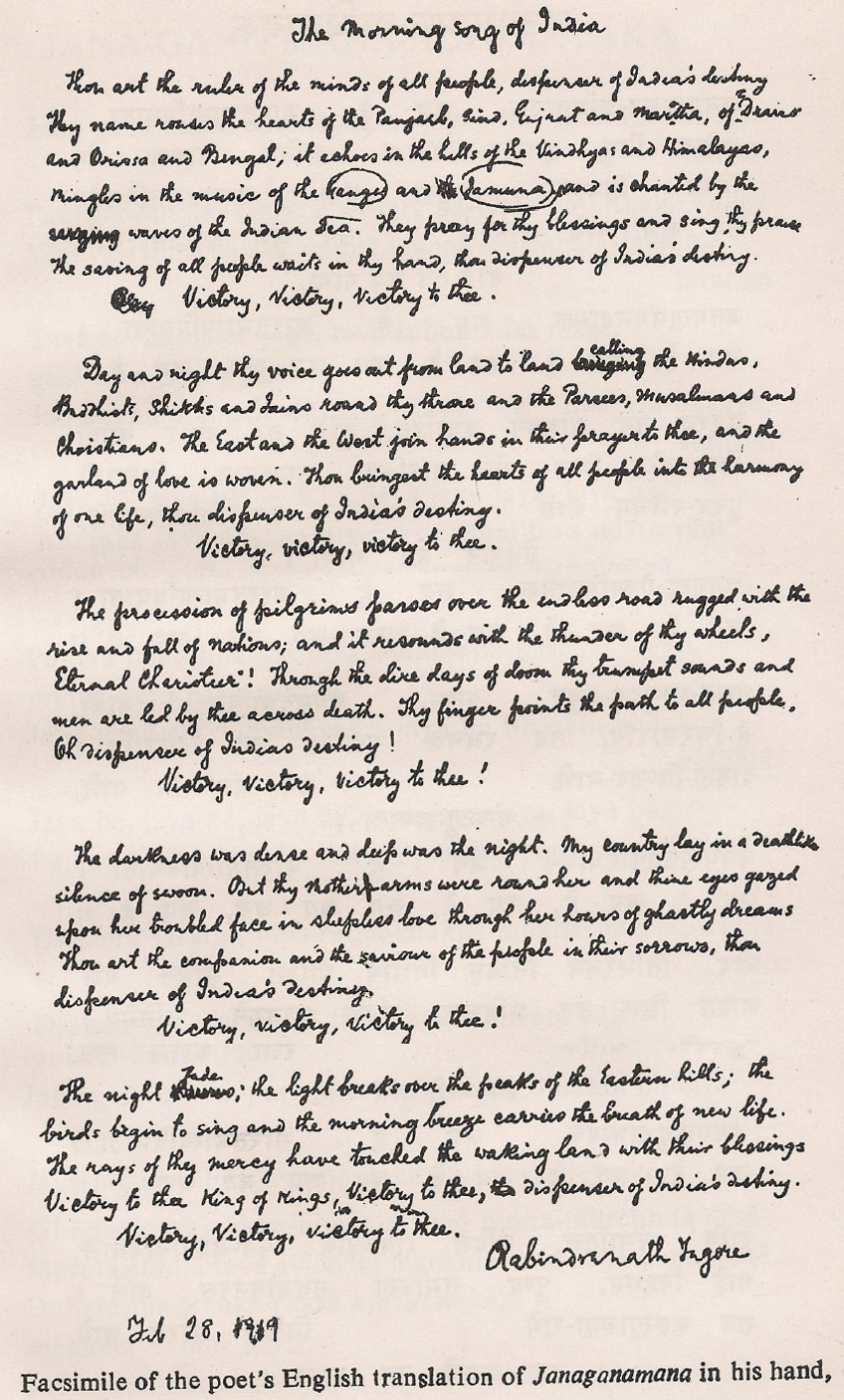
In February 1919 Tagore sang the song at Besant Theosophical College in Madanapalle, in what is now Andhra Pradesh. Margaret Cousins, its vice-principal, wrote his notes down in Western notation so the tune would be kept accurately; her husband was the Irish poet James Cousins. Tagore made an English version there, calling it The Morning Song of India. The Doon School in Dehradun had taken it as a school song in 1935. Later, while in Germany, Subhas Chandra Bose chose it as India's anthem, and in 1942 the Hamburg Radio Symphony Orchestra played it at the founding meeting of the German-Indian Society.
A king, or no king
When the song was sung at the Congress in 1911, some Indian newspapers in English described it as a welcome to Emperor George V. Historians today say those reports confused two things from the same meeting: Tagore's hymn and a separate welcome song. Nationalist papers of the day and the record of the session itself set out the order of events, with praise of God first and a greeting to the King later. Tagore denied any royal flattery. In letters of 1937 and 1939 he explained that his hymn praises the Bhagya Bidhata, the God of Destiny, the guide of India down the ages, and never a king.
Singing and respect
The anthem is sung or played on public occasions, and government guidance issued over the years covers the approved versions, the occasions for each, and the respect expected of those present. The full version lasts about 52 seconds; the short one about 20. In a case from Kerala, students who were Jehovah's Witnesses were expelled for refusing to sing on religious grounds, though they stood. The Kerala High Court upheld the expulsion, and in 1986 the Supreme Court of India set that aside, holding that no law requires anyone to sing, and that a court should not weigh the truth of a sincerely held belief.
How Jana Gana Mana is kept
The anthem belongs to public life rather than to one community. At official gatherings, school assemblies and ceremonies it is played or sung while those present stand in respect. The full version runs about 52 seconds. A shorter one, made of the first and last lines, lasts about 20 seconds and is used on some occasions. Government instructions describe which version fits which occasion and what behaviour is expected. In a 1986 judgment the Supreme Court noted that no law compels anyone to sing it.
When and where
There is no fixed date. The anthem is used when an occasion calls for it, at national and civic events. Its words were finished on 11 December 1911, and it was first sung in public on 27 December 1911. On 24 January 1950 the Constituent Assembly adopted the first stanza as the national anthem of the new republic.
It is kept across India, and strongest in national and civic settings. Calcutta, now Kolkata, is where the first public performance took place in 1911. At Madanapalle in Andhra Pradesh it was written into Western notation in 1919. Outside India, Hamburg is remembered for a 1942 performance, and a recording was carried to the United Nations gathering in New York in 1947.
What Jana Gana Mana means
The title is read as The Minds of All People, and the hymn names the land, its rivers, mountains and people rather than a ruler. Tagore said he wrote it for the Bhagya Bidhata, the God of Destiny, who guides India through its changes. For many Indians the anthem is a short, shared statement of who belongs together. Its place in schools and at ceremonies makes it one of the few texts almost every Indian knows by heart.



Questions people ask about Jana Gana Mana
When is Jana Gana Mana kept?
Jana Gana Mana is kept at national and civic occasions, when it is played or sung.
What is Jana Gana Mana?
It is the national anthem of India. Its words come from a Bengali hymn written by Rabindranath Tagore in 1911, and the Constituent Assembly adopted the first stanza as the anthem in January 1950.
Was it written for King George V?
No. Some newspapers in 1911 said it welcomed the Emperor, but Tagore and the nationalist press said a different song did that. Tagore later wrote that his hymn addressed the God of Destiny, not any king.
How long does it take?
A full rendition lasts about 52 seconds. A shortened version, using only the first and last lines, runs for roughly 20 seconds and is played on certain occasions.
Must everyone sing it?
In 1986 the Supreme Court of India held that no law obliges anyone to sing the anthem, and that a belief held sincerely as part of religious practice is not for a court to judge.
See also
 Beating RetreatA military ceremony of music and drill held at sunset to mark the end of a day or a festival.
 Wagah Border CeremonyA daily flag-lowering ritual at the India-Pakistan border featuring high kicks and synchronized drills.
 Royal Ploughing CeremonyA royal agricultural rite opening the rice season across mainland Southeast Asia
 DiwaliA five-day festival of lights celebrated across India and its diaspora to mark the victory of light over darkness.
Good reading and sources
- Does India's national anthem extol the British?BBC, Article
- To sing or not to sing Vande MataramThe Indian Express, Article
- India national anthem no longer compulsory in cinemasBBC, Article
- Muslim clerics in Jharkhand oppose govt move on national anthem in madrasasHindustan Times, Article
- Does India's national anthem extol the British?BBC, Article
- To sing or not to sing Vande MataramThe Indian Express, Article
- India national anthem no longer compulsory in cinemasBBC, Article
- Muslim clerics in Jharkhand oppose govt move on national anthem in madrasasHindustan Times, Article
- Jana Gana Mana on WikipediaEncyclopedia
- More photos on Wikimedia CommonsPhotos and video
- Wikidata recordOpen data
The facts on this page come from the Wikipedia article "Jana Gana Mana", written by its contributors and used under the CC BY-SA 4.0 licence, and from its Wikidata record (CC0). EveryParampara rewrote the text in its own words, with AI assistance, and compares every page with the article to make sure no passage is copied. It may be reused under the same CC BY-SA 4.0 licence with a link back.
It may contain mistakes. Traditions differ from one family, village and community to the next, and the people who keep them know them best. If something is wrong, tell us. Last refreshed 2026-10-05.
More from India
All the traditions of India
🇬🇧 United Kingdom and 5 moreBeating Retreat
A military ceremony of music and drill held at sunset to mark the end of a day or a festival.Ceremony
 🇫🇷 Paris, France and 5 moreBastille DayFête nationale française
France's national day marking the storming of the Bastille and the unity of the people on 14 July.Ceremony
🇮🇳 India and 1 moreWagah Border Ceremony
A daily flag-lowering ritual at the India-Pakistan border featuring high kicks and synchronized drills.Ceremony
🇰🇭 Cambodia and 4 moreRoyal Ploughing Ceremonyព្រះរាជពិធីបុណ្យច្រត់ព្រះនង្គ័ល
A royal agricultural rite opening the rice season across mainland Southeast AsiaCeremony
🇫🇷 Paris, France and 5 moreBastille DayFête nationale française
France's national day marking the storming of the Bastille and the unity of the people on 14 July.Ceremony
🇮🇳 India and 1 moreWagah Border Ceremony
A daily flag-lowering ritual at the India-Pakistan border featuring high kicks and synchronized drills.Ceremony
🇰🇭 Cambodia and 4 moreRoyal Ploughing Ceremonyព្រះរាជពិធីបុណ្យច្រត់ព្រះនង្គ័ល
A royal agricultural rite opening the rice season across mainland Southeast AsiaCeremony
The same idea elsewhere
All of this kind 🇺🇸 Philadelphia, United States and 1 moreIndependence Day
The United States' national day of parades, barbecues and fireworks, kept each July 4Ceremony
🇺🇸 Philadelphia, United States and 1 moreIndependence Day
The United States' national day of parades, barbecues and fireworks, kept each July 4Ceremony
 🇺🇸 Washington, United StatesState of the Union address
The US president's yearly report to Congress and the nation, given in the House chamberCeremony
🇺🇸 Washington, United StatesState of the Union address
The US president's yearly report to Congress and the nation, given in the House chamberCeremony
 🇺🇸 United StatesTalking stick
A carved staff that shows who may speak at a Northwest Coast gatheringCeremony
🇺🇸 United StatesTalking stick
A carved staff that shows who may speak at a Northwest Coast gatheringCeremony
 🇵🇱 Auschwitz-Birkenau, Poland and 1 moreMarch of the LivingMarsz Żywych (Polish) · מצעד החיים (Hebrew)
An annual two-week journey to Poland ending in a silent walk from Auschwitz to BirkenauCeremony
🇵🇱 Auschwitz-Birkenau, Poland and 1 moreMarch of the LivingMarsz Żywych (Polish) · מצעד החיים (Hebrew)
An annual two-week journey to Poland ending in a silent walk from Auschwitz to BirkenauCeremony