Music, dance and storytellingSouth AsiaHindu
Bharatanatyam
A South Indian temple dance of set poses, hand gestures and rhythm, now danced on stage

Bharatanatyam is a classical dance of Tamil Nadu in South India. Dancers hold the chest still, bend the legs and tell stories with their hands, eyes and face, to music led by a singer and their own teacher, and it moved from Hindu temple grounds to public stages during the 20th century.
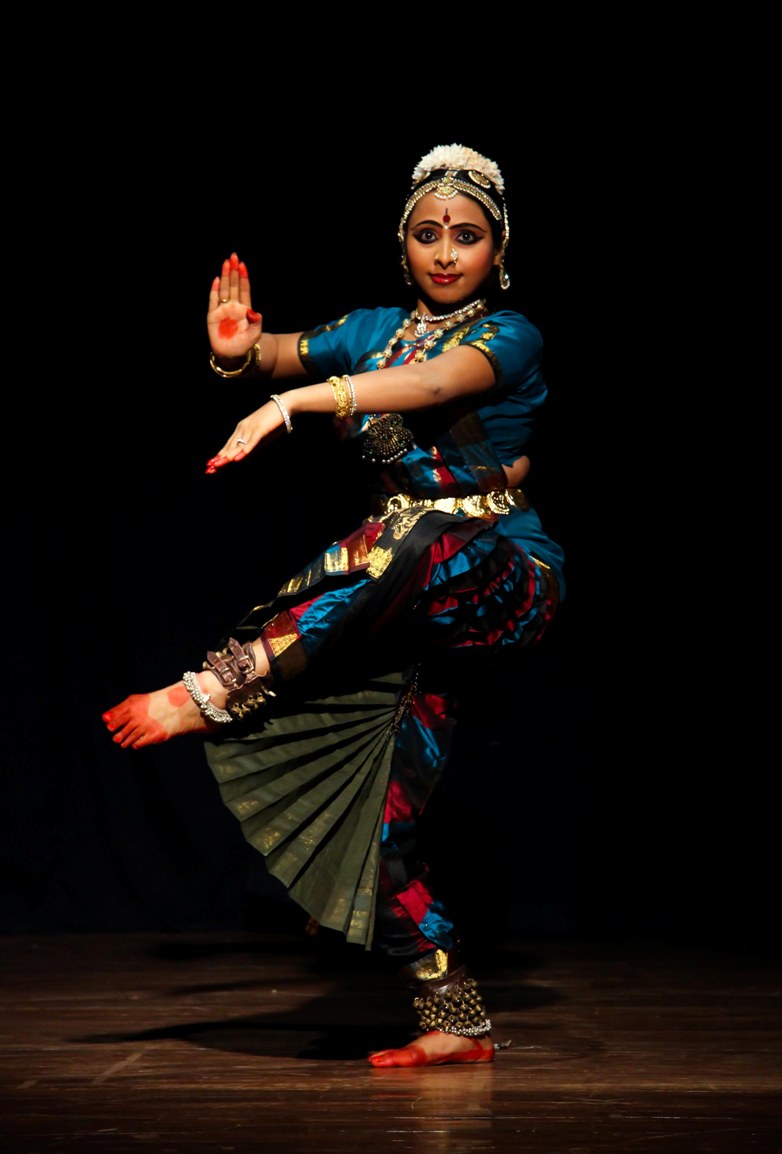
Bharatanatyam is a classical dance from Tamil Nadu, in South India, shaped by Hindu temple worship and by texts on performance that are many centuries old. A single dancer holds a still upper body and bent knees, and speaks with hand shapes, glances and small face movements. Its old name was Sadiraattam. Dancers keep it today as a discipline of training, rhythm and devotion.
What it is
The form belongs to the classical dance family recognised in India, and the Sangeet Natak Akademi counts it among them. Its home is Tamil Nadu, and its themes come mostly from Shaiva worship and from Hindu thought more widely. Teachers pass on their own way of dancing, called a bani, and each bani is often named for the village a guru came from. The body stays still in the chest, the legs are bent, the knees flexed, and the feet keep time. A dictionary of signs, made with hands, eyes and facial muscles, carries the meaning.
Origins and texts
Performances are described in the Natya Shastra, a Sanskrit work on theatre and dance whose layers are dated between about 500 BCE and 500 CE. A Tamil epic, the Silappatikaram, tells of a dancing girl named Madhavi and her training, in verses put near the 2nd century CE. Stone carvings help too: figures in a Shiva temple at Kanchipuram from the 6th to 9th centuries, and 108 dance poses cut into the southern gateway at Chidambaram in the 12th. The name itself is read as a joining of bhavam, ragam and talam, feeling, melody and rhythm.
The temple ban
Into the 19th century the form belonged to Tamil Hindu temples and was known as Sadiraattam. Colonial writers claimed it descended from temple women called devadasis and put that origin between 300 BCE and 300 CE. Later scholars doubt the claim, noting that no text or dig shows it directly, and one historian places courtesan dancing in the Nayaka period of the late 16th or 17th century. From 1892 an anti-dance campaign attacked the practice. In 1910 the Madras Presidency banned dancing in temples, and dancers and the communities around them objected.
The modern stage
Revival came with the freedom movement, when many Indians wanted their arts back. E. Krishna Iyer, a lawyer who had trained with traditional Sadir dancers, asked why a vice would need years of training. He was jailed for nationalist activity and won support for the dance among fellow prisoners. An American dancer who settled in India in 1930 and took the name Ragini Devi joined the effort. Rukmini Devi Arundale is credited with carrying the dance to a new public and with developing the Kalakshetra style. Books based on old texts followed.
How a recital runs
A full recital lasts around two hours and does not pause. One dancer performs the whole of it, following a fixed order of items, and never leaves the stage or changes costume. The pieces move from nrita, pure movement, through nritya, where gestures carry a meaning, to natya, which brings in drama. Musicians sit at the back of the stage: drummers, a drone, and a singer, often led by the dancer's own teacher as nattuvanar. Modern productions also include pure dance items and themes with no religious content.
How Bharatanatyam is kept
Training comes first, usually from a guru, who also shapes the bani, the particular style of a school. In performance one dancer carries the whole programme while a nattuvanar, often the guru, leads the musicians at the back of the stage: drummers, a drone player and a singer. The evening opens with pure dance, then moves through pieces where the hands, eyes and face tell a story, and on to passages with a dramatic element. A recital runs about two hours without a break, in a set order, with the dancer staying on stage throughout.
When and where
The dance has no fixed date in the year. It is performed when a temple or a stage hosts it, and a full recital is built to run about two hours without a break, moving through its set order of items.
The dance began in Tamil Nadu and stayed within Tamil Hindu temples into the 20th century. Colonial law pushed it out of them, and it was rebuilt on public stages. Today it is taught and performed across India, with Tamil Nadu as its strongest home and temple sites such as Chidambaram and Kanchipuram tied to its story.
What Bharatanatyam means
For those who keep it, the dance is worship as much as art. The hand shapes and body postures carry prayer, story and feeling, and the poses echo the images of Shiva in stone. A dancer aims to join bhavam, ragam and talam, feeling, melody and rhythm, so that the audience receives a meaning rather than only movement. Carvings of the karanas are treated as proof that the practice is old and sacred, and revivalists spoke of guarding its spirit.



Questions people ask about Bharatanatyam
What is Bharatanatyam?
It is a classical dance from Tamil Nadu in South India. One dancer performs a fixed programme of about two hours, holding the upper body still with bent knees, and using hand shapes, glances and facial expressions to carry meaning. Hindu temple worship, especially Shaiva devotion, shapes its themes.
Where is it performed?
It began in Tamil Nadu and was danced in Hindu temples under the name Sadiraattam. After the 1910 ban on temple dancing it moved to public stages and spread across India. Temple sites such as Chidambaram and Kanchipuram, where old carvings of dance poses survive, remain important to its story.
When did it begin?
Its texts are old. Dance is described in the Natya Shastra, dated by scholars to somewhere between 500 BCE and 500 CE, and a Tamil epic near the 2nd century CE tells of a trained dancing girl. Stone carvings from the 6th to 9th centuries show the art was already refined.
Why was it banned?
From 1892 an anti-dance campaign, led largely by missionaries and colonial officials, called temple dancing immoral and claimed it hid prostitution. In 1910 the Madras Presidency outlawed it in temples. Indian dancers and their supporters fought the ban, and the dance was rebuilt outside temples in the 20th century.
What is a bani?
A bani is the style and technique of one teacher or school, often named after the guru's village. Dancers train within a bani, so two performers can share the same repertoire and still differ in the way they hold a pose, take a step or shape a gesture.
See also
 PulikaliPainted tigers and leopards dance through Thrissur on the fourth day of Onam
 BhangraA Punjabi harvest dance, first kept by farmers and now performed worldwide
 GhazalA short rhyming poem of love and parting, recited and sung from Arabia to South Asia
 QawwaliDevotional Sufi singing from South Asia, led by hereditary parties at shrines
Good reading and sources
- Encyclopaedia BritannicaArticle
- How arangetrams have become lavish affairsThe Hindu, Article
- How arangetrams have become lavish affairsThe Hindu, Article
- Bharatanatyam on WikipediaEncyclopedia
- More photos on Wikimedia CommonsPhotos and video
- Wikidata recordOpen data
The facts on this page come from the Wikipedia article "Bharatanatyam", written by its contributors and used under the CC BY-SA 4.0 licence, and from its Wikidata record (CC0). EveryParampara rewrote the text in its own words, with AI assistance, and compares every page with the article to make sure no passage is copied. It may be reused under the same CC BY-SA 4.0 licence with a link back.
It may contain mistakes. Traditions differ from one family, village and community to the next, and the people who keep them know them best. If something is wrong, tell us. Last refreshed 2026-10-05.
More from India
All the traditions of India
🇮🇳 Thrissur, IndiaPulikaliപുലിക്കളി
Painted tigers and leopards dance through Thrissur on the fourth day of OnamPerformance
🇮🇳 Jammu, IndiaBhangra
A Punjabi harvest dance, first kept by farmers and now performed worldwidePerformance
🇮🇳 India and 5 moreGhazalغَزَل
A short rhyming poem of love and parting, recited and sung from Arabia to South AsiaPerformance
🇵🇰 Islamabad, Pakistan and 2 moreQawwaliقَوّالی
Devotional Sufi singing from South Asia, led by hereditary parties at shrinesPerformance
The same idea elsewhere
All of this kind 🇹🇷 Kayseri, Turkey and 4 moreHalay
A traditional line and circle folk dance kept across Turkey, Azerbaijan, Armenia, Iran, and Syria.Performance
🇧🇷 BrazilBaião
A syncopated folk rhythm and partnered dance from northeastern BrazilPerformance
🇹🇷 Kayseri, Turkey and 4 moreHalay
A traditional line and circle folk dance kept across Turkey, Azerbaijan, Armenia, Iran, and Syria.Performance
🇧🇷 BrazilBaião
A syncopated folk rhythm and partnered dance from northeastern BrazilPerformance
 🇺🇦 Kyiv, UkraineBanduraБандура
A Ukrainian plucked string instrument played to accompany epic songs and folk balladsPerformance
🇺🇦 Kyiv, UkraineBanduraБандура
A Ukrainian plucked string instrument played to accompany epic songs and folk balladsPerformance
 🇳🇿 Auckland, New ZealandPoi
A Māori performing art of swinging tethered weights in rhythmical patterns.Performance
🇳🇿 Auckland, New ZealandPoi
A Māori performing art of swinging tethered weights in rhythmical patterns.Performance