Music, dance and storytellingEuropeChristian
Faroese chain dance
In its own language: Føroyskur dansur
A living medieval chain dance guided by sung ballads in the Faroe Islands

The Faroese chain dance is a traditional medieval circle dance accompanied by sung ballads rather than musical instruments. Practised across the Faroe Islands and in Denmark during winter evenings and summer holidays, participants join hands in a winding ring led by a lead singer.
When is Faroese chain dance kept?
Faroese chain dance is kept from autumn until Lent, after Easter to early summer, and during Ólavsøka on 29 July.
The Faroese chain dance is the traditional folk circle dance found across the Faroe Islands. Dancers hold hands in an unbroken line, stepping rhythmically to narrative songs known as kvæði without any musical instruments. Performed primarily during the dark winter months and at major holidays, the dance unites the community as participants sing along, express the story through their movements, and wind through the room.
Steps and singing
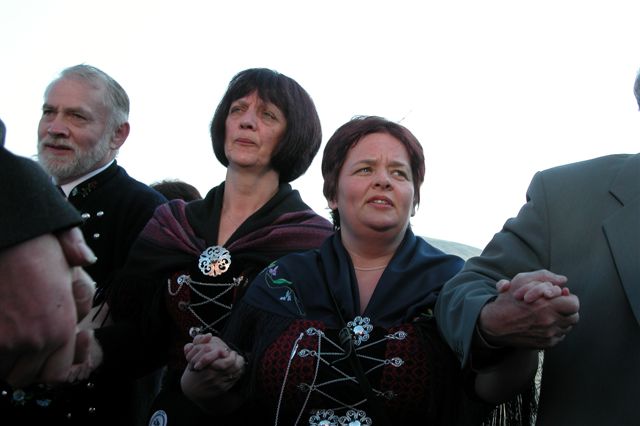
The basic dance relies on a steady rhythm of footsteps rather than instruments. Participants hold hands so that each dancer's right hand overlaps the neighbour's left hand. In the standard style, dancers take two steps to the left followed by one step backwards. A lead singer, known as the skipari, must know every verse by heart and sings the main narrative. The surrounding dancers join in powerfully for the refrain. As the line grows, the unbroken circle curves inward to create loops, letting participants face one another across the room as they move.
Regional styles and games
Dancers practice distinct variations across different islands. In the southern islands such as Suðuroy, dancers show more expressive motion than in the north, where foot stamping remains the central focus. The crowding style, or trokingarstev, involves dancers stepping backwards during verses and surging forward for the chorus. Another version, the ribbon dance or bandadansur, arranges couples in two opposing rows holding lengths of ribbon. During the refrain, couples duck beneath the raised ribbons in an energetic sequence. Historical dance games also accompany specific folk tunes.
Winter evenings and Ólavsøka
Chain dancing belongs mainly to the long winter evenings. Local dance associations begin regular sessions in autumn, usually starting in September or October. Dancing pauses completely during the Christian season of Lent, a pause traced back to the Catholic Middle Ages, before resuming after Easter until early summer. During the bright summer nights indoor dancing largely stops, except for the national holiday of Ólavsøka. In late July, crowds gather in Tórshavn to sing at midnight and continue dancing the chain dance through the night.
How Faroese chain dance is kept
Dancers link hands in a continuous circle, overlapping right hands over left hands. A leader called the skipari sings the narrative verses of a ballad while everyone steps to a steady cadence. When the chorus arrives, the entire ring sings the refrain together. As new people enter, the chain bends into inner concentric loops within the room. Dancers adjust their gestures to the story, clenching hands during tales of combat or showing joy when victories are recounted.
When and where
The dancing season begins in September or October and runs through winter until Carnival in February. Following a pause for Lent, sessions resume after Easter and continue into May or June. A major gathering also takes place during the national holiday of Ólavsøka at midnight on 29 July.
The dance is practised throughout the Faroe Islands, from Suðuroy and Sandoy to Streymoy, Eysturoy, Vágar, and the northern isles. Dedicated dance associations also organize evenings in Copenhagen, Denmark, and public events take place at Sjónleikarhúsið in Tórshavn.
What Faroese chain dance means
The dance connects participants directly to the stories within the ballads. Dancers share the mood of the kvæði through physical gestures, clenching their hands during scenes of battle or moving jubilantly during triumph. Because the winding circle turns dancers face to face, the shared singing fosters a strong sense of fellowship.

Questions people ask about Faroese chain dance
When is Faroese chain dance kept?
Faroese chain dance is kept from autumn until Lent, after Easter to early summer, and during Ólavsøka on 29 July.
What is the Faroese chain dance?
It is a traditional medieval circle dance from the Faroe Islands. Dancers link hands in a winding ring, moving in rhythm while singing narrative ballads without instrumental backing.
What role does the skipari play?
The skipari is the lead singer of the dance. This person is responsible for knowing all the verses of the ballad by memory and leading the narrative while the other dancers join in for the refrain.
What musical instruments are used in the dance?
No musical instruments are used during the Faroese chain dance. The dancers provide all the music themselves by singing kvæði, which are traditional ballads sung in Faroese or Danish, accompanied by rhythmic foot stamping.
See also
 Independence DayThe United States' national day of parades, barbecues and fireworks, kept each July 4
 Advent calendarA daily countdown to Christmas using doors, images, or small gifts.
 St John's EveBonfires, feasting and worship on the short night before John the Baptist's feast
 St. Martin's DayA November feast of lantern walks, bonfires, roast goose and new wine
Good reading and sources
- Faroese chain dance on WikipediaEncyclopedia
- More photos on Wikimedia CommonsPhotos and video
- Wikidata recordOpen data
The facts on this page come from the Wikipedia article "Faroese chain dance", written by its contributors and used under the CC BY-SA 4.0 licence, and from its Wikidata record (CC0). EveryParampara rewrote the text in its own words, with AI assistance, and compares every page with the article to make sure no passage is copied. It may be reused under the same CC BY-SA 4.0 licence with a link back.
It may contain mistakes. Traditions differ from one family, village and community to the next, and the people who keep them know them best. If something is wrong, tell us. Last refreshed 2026-10-04.
More from Denmark
All the traditions of Denmark 🇲🇦 Marrakesh, Morocco and 5 moreGnawa musicڭْناوة or كْناوة
A spiritual musical tradition of Morocco that blends West African rhythms with Islamic ritual to heal and connect communPerformance
🇩🇰 Copenhagen, DenmarkNatFilm Festival
An annual Danish cinema gathering held around Easter from 1990 to 2008Performance
🇺🇸 Philadelphia, United States and 1 moreIndependence Day
The United States' national day of parades, barbecues and fireworks, kept each July 4Ceremony
🇲🇦 Marrakesh, Morocco and 5 moreGnawa musicڭْناوة or كْناوة
A spiritual musical tradition of Morocco that blends West African rhythms with Islamic ritual to heal and connect communPerformance
🇩🇰 Copenhagen, DenmarkNatFilm Festival
An annual Danish cinema gathering held around Easter from 1990 to 2008Performance
🇺🇸 Philadelphia, United States and 1 moreIndependence Day
The United States' national day of parades, barbecues and fireworks, kept each July 4Ceremony
The same idea elsewhere
All of this kind 🇹🇷 Kayseri, Turkey and 4 moreHalay
A traditional line and circle folk dance kept across Turkey, Azerbaijan, Armenia, Iran, and Syria.Performance
🇹🇷 Kayseri, Turkey and 4 moreHalay
A traditional line and circle folk dance kept across Turkey, Azerbaijan, Armenia, Iran, and Syria.Performance
 🇳🇿 Auckland, New ZealandPoi
A Māori performing art of swinging tethered weights in rhythmical patterns.Performance
🇳🇿 Auckland, New ZealandPoi
A Māori performing art of swinging tethered weights in rhythmical patterns.Performance
 🇵🇭 Philippines and 1 morePangalay
A traditional fingernail dance of the Tausūg and Bajau peoples in the Sulu Archipelago and Sabah.Performance
🇵🇭 Philippines and 1 morePangalay
A traditional fingernail dance of the Tausūg and Bajau peoples in the Sulu Archipelago and Sabah.Performance