Festivals and celebrationsEuropeChristian
George's Day in Autumn
In its own language: Егорий Осенний (Yegoriy Osenniy), Юрьев день (Yuriev den); Serbian: Ђурђиц (Đurđic)
The autumn feast of Saint George, kept at harvest's end in Slavic lands

George's Day in Autumn is one of the two Orthodox feasts of Saint George, kept in late autumn by the Russian, Serbian and Georgian churches. In Serbia it is called Đurđic and is a major Slava day. In Muscovy it once marked the fortnight when people working the land could move between estates.
When is George's Day in Autumn kept?
George's Day in Autumn is kept on once a year, on a fixed date: 16 November in Serbia, 23 November in Georgia, 9 December in Russia.
George's Day in Autumn is the second of the two yearly feasts of Saint George in the Orthodox calendar, kept in late autumn instead of spring. Russian, Serbian and Georgian churches each give it a date of their own. In Russia it once closed the farming year and carried legal weight, and in Serbia it is a household Slava, a family's feast for its patron saint.
What it is
Saint George has two feasts in the Orthodox year, one in spring and one in autumn. This page is about the autumn one. Three churches keep it: the Russian Orthodox Church, the Serbian Orthodox Church and the Georgian Orthodox Church. Each has its own date, from 16 November for the Serbs to 9 December for the Russians. Serbs call the day Đurđic, and it is one of their major Slava days. The feast lasts a single day and returns on the same date each year. In Russian it is Yuriev den, or Yegoriy Osenniy.
Harvest and serfdom
The feast came at the end of the farming year, once the harvest had been brought in, and for Russian peasants that placed it at a turning point in the calendar while serfdom was taking shape. The arrangement is usually dated to the middle of the fifteenth century. A law code, the Sudebnik of 1497, fixed a fortnight around the day, a week on either side. In that window, and nowhere else in the year, people who worked the land could move to a different estate if their duties were met and their debts paid. Later the state pulled the right back. In 1597, with Boris Godunov as regent, owners were allowed to reclaim workers who had gone.
Sayings and words
Two Russian expressions remember the lost fortnight. The first is a saying, "вот тебе, бабушка, и Юрьев день", which means something like "so much for Yuri's Day, Granny". People use it when a promise has been broken, or when an expectation fails. The second is the verb "объегорить", to deceive or fool someone. Its literal sense is "to go around Yegor", and Yegor is another Russian form of the name George, so the word carries the saint's name inside it. Both survive in everyday speech long after the law that gave them their point.
In painting and icon
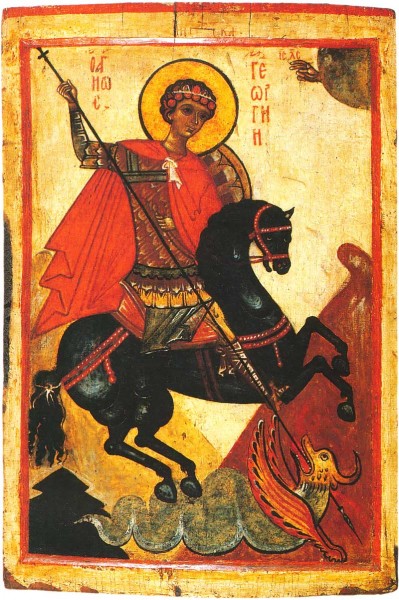
The day has drawn artists as well as worshippers. A well-known Russian icon of Saint George, painted in Novgorod in the middle of the fourteenth century, is one of the images linked with him. Much later, in 1908, the painter Sergey Ivanov made a picture called Yuri's Day in the Autumn, with the subtitle A Peasant Leaving His Landlord on Yuri's Day. It shows the moment the old law allowed: a worker walking away from the estate he had worked on. The subject gives the feast a place in Russian painting as well as in the church calendar.
How George's Day in Autumn is kept
Three Orthodox churches hold the feast, each on its own fixed date, and each keeps it for a single day. In Serbia the day is known as Đurđic and ranks among the major Slava days, the household feasts that honour a family's patron saint, so Serbian families whose patron is George keep it at home. In Russia and Georgia it is a church feast. The date does not move from year to year within a church. The work that surrounds it is the harvest, which is in by the time the feast comes.
When and where
Each church keeps its own date. The Serbian Orthodox Church holds it on 16 November, which is 3 November on the old calendar. The Russian Orthodox Church keeps 9 December, or 26 November old style. The Georgian Orthodox Church marks 23 November, 10 November old style. It falls once a year, on the same date every year, and lasts a single day.
The feast belongs to the Orthodox churches of Russia, Serbia and Georgia, and Belarus also counts it among its own. Russia is where it carries the deepest history, because of the legal weight it once had for the farming population, and Serbia is where it is a household Slava. It is a church and calendar observance rather than a public holiday.
What George's Day in Autumn means
For those who keep it, the day sits at the close of the farming year, when the harvest is done and the darker half of the year begins. In Serbia it means the honouring of a patron saint at home. In Russian memory it stands for a right that was granted and then withdrawn, which is why the name became a byword for a promise that does not hold.
Questions people ask about George's Day in Autumn
When is George's Day in Autumn kept?
George's Day in Autumn is kept on once a year, on a fixed date: 16 November in Serbia, 23 November in Georgia, 9 December in Russia.
What is George's Day in Autumn?
It is one of the two Orthodox feasts of Saint George, kept in late autumn rather than in spring. The Russian, Serbian and Georgian Orthodox churches each celebrate it. In Serbia the day is called Đurđic and is one of the major Slava days, when a household honours its patron saint.
Why did the day matter to Russian peasants?
The feast closed the farming year and the harvest. Around the middle of the fifteenth century a fortnight centred on it became the period when people who worked the land could move to another estate, provided they had paid what they owed. The right was later taken away.
Is it the same as Saint George's Day in spring?
No. There are two feasts of Saint George in the Orthodox year. The spring one falls on 6 May, or 23 April on the old calendar. George's Day in Autumn is the second and comes in November or December, depending on which church is keeping it.
Where is it kept?
In the Orthodox churches of Russia, Serbia and Georgia, and in Belarus. Russia is where its history runs deepest, because of the old law about moving between estates, and Serbia is where it is a family Slava.
See also
 MaslenitsaA seven-day Eastern Slavic festival of pancakes and bonfires marking the end of winter before Lent.
 SabantuyA summer festival of folk sports and feasting celebrated by Tatar, Bashkir, Chuvash, and Kazakh communities.
 RtveliA Georgian harvest festival marking the grape picking season with feasts and folk songs.
 VardavarAn Armenian midsummer festival where people playfully douse each other with water
Good reading and sources
- George's Day in Autumn on WikipediaEncyclopedia
- More photos on Wikimedia CommonsPhotos and video
- Wikidata recordOpen data
The facts on this page come from the Wikipedia article "George's Day in Autumn", written by its contributors and used under the CC BY-SA 4.0 licence, and from its Wikidata record (CC0). EveryParampara rewrote the text in its own words, with AI assistance, and compares every page with the article to make sure no passage is copied. It may be reused under the same CC BY-SA 4.0 licence with a link back.
It may contain mistakes. Traditions differ from one family, village and community to the next, and the people who keep them know them best. If something is wrong, tell us. Last refreshed 2026-10-10.
More from Russia
All the traditions of Russia
🇷🇺 Russia and 2 moreMaslenitsaМасленица
A seven-day Eastern Slavic festival of pancakes and bonfires marking the end of winter before Lent.Festival · Breakfast
🇷🇺 Kazan, Russia and 2 moreSabantuyСабан туе (Saban tuyı)
A summer festival of folk sports and feasting celebrated by Tatar, Bashkir, Chuvash, and Kazakh communities.Festival · Feasts and festival meals
🇦🇲 Armenia and 2 moreVardavarՎարդավառ
An Armenian midsummer festival where people playfully douse each other with waterFestival
 🇲🇳 Ulaanbaatar, Mongolia and 1 moreNaadamнаадам
A midsummer festival of wrestling, horse racing, and archery kept by Mongols in Mongolia and neighboring regions.Festival · Feasts and festival meals
🇲🇳 Ulaanbaatar, Mongolia and 1 moreNaadamнаадам
A midsummer festival of wrestling, horse racing, and archery kept by Mongols in Mongolia and neighboring regions.Festival · Feasts and festival meals
The same idea elsewhere
Harvest and thanksgiving compared 🇮🇳 Ayodhya, India and 7 moreDiwaliदीपावली (Dīpāvalī)
A five-day festival of lights celebrated across India and its diaspora to mark the victory of light over darkness.Festival · Feasts and festival meals
🇮🇳 Ayodhya, India and 7 moreDiwaliदीपावली (Dīpāvalī)
A five-day festival of lights celebrated across India and its diaspora to mark the victory of light over darkness.Festival · Feasts and festival meals
 🇮🇱 Jerusalem, IsraelPassoverפסח
A Jewish spring festival celebrating freedom from slavery with ritual mealsSpiritual · Dinner
🇮🇱 Jerusalem, IsraelPassoverפסח
A Jewish spring festival celebrating freedom from slavery with ritual mealsSpiritual · Dinner
 🇮🇱 Jerusalem, IsraelSukkotסוכות
A seven-day autumn Jewish festival of temporary booths, harvest prayers and hospitalitySpiritual
🇮🇱 Jerusalem, IsraelSukkotסוכות
A seven-day autumn Jewish festival of temporary booths, harvest prayers and hospitalitySpiritual
 🇵🇪 Cusco, Peru and 4 moreIntiinti (Quechua)
The Inca sun deity, honoured with temples, offerings and the June festival Inti RaymiSpiritual
🇵🇪 Cusco, Peru and 4 moreIntiinti (Quechua)
The Inca sun deity, honoured with temples, offerings and the June festival Inti RaymiSpiritual