Festivals and celebrationsEurope
Giostra della Quintana
A June and September joust in Foligno, where ten knights spear rings
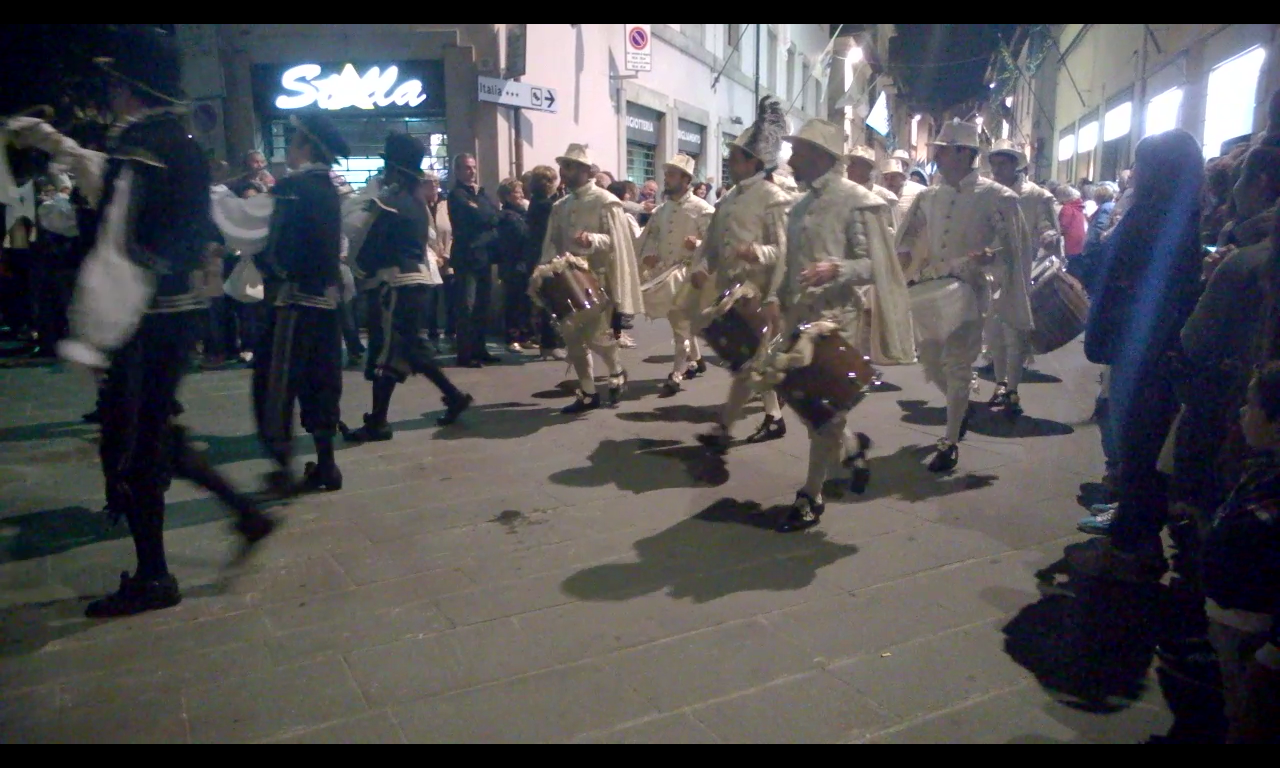
The Giostra della Quintana is a jousting contest and costumed festival in Foligno, in central Italy. A Quintana joust is documented from 1448 and the present contest was revived in 1946, with ten knights, one per quarter of the town, spearing rings from horseback on a figure-of-eight course.
When is Giostra della Quintana kept?
Giostra della Quintana is kept in June, on a Saturday night, and in September, on the second or third Sunday.
The Giostra della Quintana is a jousting contest and costumed festival in Foligno, a town in central Italy. Ten knights, one for each quarter of Foligno, ride at speed around a figure-of-eight track and try to spear rings hanging from an oak statue. The contest is held twice a year, in June and September, and the town keeps it as a living revival of a tournament first written down in the fifteenth century.
What it is
The contest is a test of horsemanship. Ten knights ride for the quarters of Foligno, and every quarter has its own flag. They gallop at high speed around a track shaped like a figure of eight. From the centre of the stadium a statue turns, and each knight must spear three rings that hang from it. The rings are changed as the rounds go on and become smaller, so later rounds ask for steadier hands. The oak statue was carved in 1613 and shows Mars, the god of war, holding a shield with the symbol of Foligno.
Origins and history
The name Quintana comes from the fifth road of a Roman military camp, where soldiers trained for fighting with the lance. Their exercise was to run at a dummy soldier and catch a ring hanging from one of its arms. That old training gave the tournament its name. The first Quintana documented as a knights' jousting contest held during a festival belongs to 1448. By 1613 the build-up to the tournament already included carnival festivals of the kind seen today. The Giostra as it is known now was reborn in 1946.
The two challenges
The Giostra is run twice in the year. The first challenge falls in June, on a Saturday night. The counter-challenge is held in September, on the second or the third Sunday of the month. A festival comes before each of the two contests, so the event fills more than a single day. The whole town takes part in the festivities over the Quintana weekend. On the day before the Ring Joust, a parade brings out 800 people dressed in seventeenth-century costume.
Costume and the town
The quarters of Foligno are the centre of the modern contest. Each of the ten knights rides for one quarter, and every quarter has a flag to tell it apart. On the day before the joust the town puts on seventeenth-century dress: a parade of 800 costumed figures walks through Foligno. The same period shapes the look of the contest, which the town dates to the carnival build-up of 1613. Around the two challenges, the whole town joins in, so the Giostra is as much a public festival as a sporting contest.
How Giostra della Quintana is kept
Ten knights, one for each quarter of Foligno, take part. Before the joust, the town holds a costumed parade; on the day before the Ring Joust, 800 people walk in seventeenth-century dress. On the field, the knights ride one after another around a figure-of-eight track at high speed. A rotating statue stands at the centre, with three rings on an outstretched arm. The knight must spear the rings. As the rounds go on the rings become smaller, so the contest asks for more precision each time. The June challenge and the September counter-challenge are run in the same way.
When and where
The Giostra is kept twice a year. The first challenge falls in June, on a Saturday night. The counter-challenge comes in September, on the second or third Sunday of the month. Each contest is preceded by a festival, and the parade in seventeenth-century costume takes place on the day before the Ring Joust.
It is kept in Foligno, a town in the centre of Italy. The whole town takes part, and the ten knights ride for its quarters. The contest itself is run on a figure-of-eight track in the stadium, around the oak statue of Mars. Foligno is where the tournament was documented in the fifteenth century and where it was brought back in 1946.
What Giostra della Quintana means
The rings and the lance recall the old training of soldiers, from which the name Quintana is said to come. Spearing a ring from a galloping horse takes a steady hand, and the rings grow smaller as the rounds go on, so the later passes ask the most. Each knight rides for a quarter of Foligno, so the contest is also a meeting of the town's parts. The statue at the centre holds a shield bearing the symbol of Foligno.


Questions people ask about Giostra della Quintana
When is Giostra della Quintana kept?
Giostra della Quintana is kept in June, on a Saturday night, and in September, on the second or third Sunday.
What is the Giostra della Quintana?
It is a jousting contest and festival in Foligno, in central Italy. Ten knights, each riding for a quarter of the town, gallop around a figure-of-eight track and try to spear three rings hanging from a rotating statue. The modern festival was revived in 1946.
Where is it held?
In Foligno, a town in central Italy. The town takes part as a whole, and the knights represent its quarters. The joust itself runs on a figure-of-eight track around an oak statue of Mars that dates to 1613.
How old is the tradition?
The earliest Quintana documented as a knights' jousting tournament during a festival is from 1448. The build-up by 1613 included carnival festivals. The contest as it is run today was reborn in 1946.
What is the statue in the middle?
It is an oak statue made in 1613. It turns in the centre of the stadium and shows Mars, the god of war, with a shield bearing the symbol of Foligno. A ring hangs from its outstretched arm for the knights to spear.
See also
 ChristmasA festival of Jesus's birth, kept on 25 December with gifts, lights and shared meals
 Valentine's DayA Christian feast day and cultural celebration of love kept on February 14 in many countries.
 Christmas treeA decorated evergreen or artificial tree placed indoors to mark the Christmas season.
 April Fools' DayAn annual day of lighthearted pranks, hoaxes and teasing kept on the first of April
Good reading and sources
- Giostra della Quintana on WikipediaEncyclopedia
- More photos on Wikimedia CommonsPhotos and video
- Wikidata recordOpen data
The facts on this page come from the Wikipedia article "Giostra della Quintana", written by its contributors and used under the CC BY-SA 4.0 licence, and from its Wikidata record (CC0). EveryParampara rewrote the text in its own words, with AI assistance, and compares every page with the article to make sure no passage is copied. It may be reused under the same CC BY-SA 4.0 licence with a link back.
It may contain mistakes. Traditions differ from one family, village and community to the next, and the people who keep them know them best. If something is wrong, tell us. Last refreshed 2026-10-05.
More from Italy
All the traditions of Italy
🇮🇹 Rome, Italy and 4 moreChristmas
A festival of Jesus's birth, kept on 25 December with gifts, lights and shared mealsFestival
🇬🇧 United Kingdom and 4 moreValentine's Day
A Christian feast day and cultural celebration of love kept on February 14 in many countries.Festival
🇩🇪 Germany and 5 moreChristmas tree
A decorated evergreen or artificial tree placed indoors to mark the Christmas season.Festival
🇬🇧 United Kingdom and 5 moreApril Fools' Day
An annual day of lighthearted pranks, hoaxes and teasing kept on the first of AprilFestival
The same idea elsewhere
All of this kind 🇹🇷 Turkey and 5 moreEid al-Fitrعيد الفطر
The feast that ends Ramadan, opened with morning prayers, sweets and visits homeFestival · Feasts and festival meals
🇹🇷 Turkey and 5 moreEid al-Fitrعيد الفطر
The feast that ends Ramadan, opened with morning prayers, sweets and visits homeFestival · Feasts and festival meals
 🇮🇳 Ayodhya, India and 7 moreDiwaliदीपावली (Dīpāvalī)
A five-day festival of lights celebrated across India and its diaspora to mark the victory of light over darkness.Festival · Feasts and festival meals
🇮🇳 Ayodhya, India and 7 moreDiwaliदीपावली (Dīpāvalī)
A five-day festival of lights celebrated across India and its diaspora to mark the victory of light over darkness.Festival · Feasts and festival meals
 🇮🇱 Jerusalem, Israel and 1 moreHanukkahחֲנֻכָּה
An eight-day Jewish festival marking the rededication of the Second Temple in Jerusalem and the miracle of a single day'Festival
🇮🇱 Jerusalem, Israel and 1 moreHanukkahחֲנֻכָּה
An eight-day Jewish festival marking the rededication of the Second Temple in Jerusalem and the miracle of a single day'Festival
 🇪🇬 Egypt and 5 moreMawlidمولد (Mawlid)
An annual festival marking the birth of the Prophet Muhammad, marked by poetry, processions and feasts.Festival · Feasts and festival meals
🇪🇬 Egypt and 5 moreMawlidمولد (Mawlid)
An annual festival marking the birth of the Prophet Muhammad, marked by poetry, processions and feasts.Festival · Feasts and festival meals