Music, dance and storytellingSouth AsiaHindu
Harikatha
In its own language: హరికథ / ಹರಿಕಥೆ / हरिकथा
A South Indian art of telling sacred stories with song, speech and rhythm
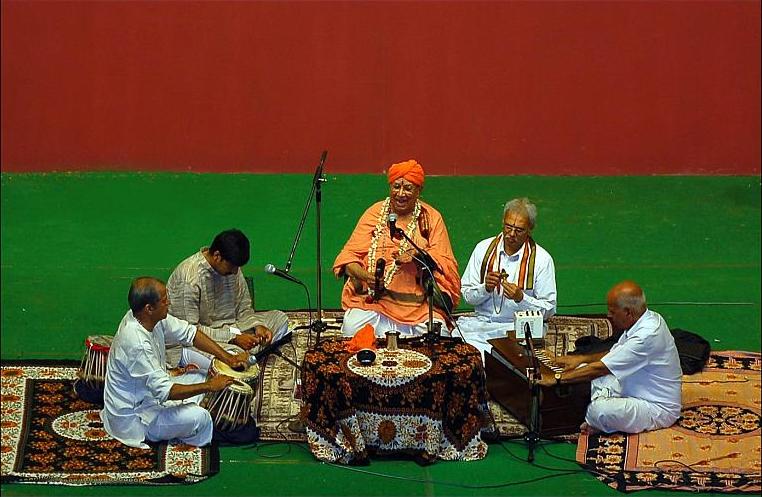
Harikatha is a Hindu storytelling art from South India in which one performer sings, speaks and acts out a sacred tale, helped by co-singers and a drummer. It grew out of the Bhakti movement, took its modern shape in the 19th century in coastal Andhra, and is still kept in Andhra Pradesh, Telangana, Karnataka, Kerala, Maharashtra and Tamil Nadu.
When is Harikatha kept?
Harikatha is kept on no fixed date. Given through the year at temples and gatherings; village singers go round in the Dhanurmaasam period before Sankranti..
Harikatha is a way of telling a Hindu sacred story that mixes speech, song, rhythm and philosophy. One storyteller, called a Haridāsa, carries the tale; co-singers and a drummer answer and expand it. It is kept across South India and in Maharashtra, and it aims to stir devotion, teach right conduct, and point listeners towards liberation.
What it is
Harikatha brings several arts into one telling: speech, poetry, music, drama, dance and philosophy. The performer narrates a religious subject, sings it, acts it out and comments on it. One Haridāsa leads. One or more co-singers take up the songs and enlarge them, and a mridangam player keeps time; the lead storyteller holds a pair of small cymbals to mark the beat. Any Hindu theme can be chosen. Scenes from the epics and the deeds of saints come up often, and the narration branches into side plots and anecdotes that throw light on the main tale.
Origins and history
The form is old, and it reached its present shape within the Bhakti movement, around the 12th century. Purandara Dasa and Kanaka Dasa belong to its famous early Haridāsas. In Hindu mythology the first singer is the sage Narada, who sang for Vishnu; Lava and Kusha, the twin sons of Rama, are said to have sung the Ramayana in his court at Ayodhya. A Telugu branch arose in coastal Andhra in the 19th century through Ajjada Adibhatla Narayana Dasu, whose kāvyas and prabandhas turned it into an art of its own.
What it means
Those who keep Harikatha say its purpose is not amusement alone. It is meant to plant devotion, to press truth and right conduct into the mind, and to teach listeners about the Ātman, the self, by way of story. Knowing the self, in this teaching, is the road to liberation. At its height the form was a popular entertainment, and through that entertainment people took in religious and cultural values. The songs stay in the memory long after the plot fades, so a performance is instruction and worship at once.
Today and change
Harikatha Kalakshepam remains common in Andhra, alongside Burra Katha. Haridāsas who move from village to village singing devotional songs during the Dhanurmaasam period before Sankranti are an old practice. In the 20th century Saraswati Bai, a woman performer, opened a field that Brahmin men had held alone; F. G. Natesa Iyer wrote in 1939 that Brahmins and non-Brahmins now walked freely on ground once forbidden. Later exponents include Vishaka Hari and T S Balakrishna Sastry. Paruthiyur Krishna Sastri left the art for the Pravachan style, and a praised rendering tells of the saint Tyagaraja.
How Harikatha is kept
A Haridāsa takes the lead. The chosen story opens the performance, and the telling moves between spoken narration, song and comment. Co-singers repeat and enlarge the songs, a mridangam player holds the rhythm, and the lead taps a pair of cymbals. Side plots and anecdotes are woven in to bring out a point in the main tale. An evening can run for hours, and listeners sit through it as an act of devotion as much as for pleasure. In villages, Haridāsas also walk from place to place singing devotional songs.
When and where
There is no single date. Harikatha is given at temples, festivals and family gatherings through the year, and a performance can last an evening. One season belongs to the wandering singers: during Dhanurmaasam, the period that comes before the Sankranti festival, Haridāsas go from village to village with devotional songs.
It is strongest in South India: Andhra Pradesh and Telangana, Karnataka, Kerala and the Tamil country, and it is also kept in Maharashtra. In Andhra the Kalakshepam form is still widely performed, and the Telugu branch began in coastal Andhra. Ayodhya belongs to its mythology, as the court where Rama's sons sang, and Tenali is the home town of a much praised performer.
What Harikatha means
The story is never only a story. For those who keep Harikatha, the tale of a saint or a god mirrors the listener's own life, and the songs are meant to move the heart towards devotion. Truth and righteousness are the lesson held up, and behind the lesson sits the teaching about the Ātman, the self, and the way out of bondage. A performance is therefore instruction and worship together.
Questions people ask about Harikatha
When is Harikatha kept?
Harikatha is kept on no fixed date. Given through the year at temples and gatherings; village singers go round in the Dhanurmaasam period before Sankranti..
What is Harikatha?
It is a Hindu storytelling art from South India. One performer, the Haridāsa, sings, speaks and acts out a sacred subject, helped by co-singers and a mridangam player. In Telugu, Tamil and Malayalam it is also called Harikatha Kaalakshepam, which speaks of time given to hearing Hari's story.
Where is it kept?
In India, mainly in Andhra Pradesh, Telangana, Karnataka, Kerala and the Tamil country, and in Maharashtra. The Telugu form is still common in Andhra. Performances happen in temples and at festivals, and wandering singers travel between villages in the Dhanurmaasam season.
Who tells the story?
The narrator is called a Haridāsa. One leads, and one or more co-singers elaborate the songs while a mridangam player keeps time; the lead holds small cymbals for the beat. Early names include Purandara Dasa and Kanaka Dasa, and Saraswati Bai was a pioneering woman performer.
What kind of story is told?
Any Hindu religious subject may be taken. Many performances turn on a scene from an epic or on the deeds of a saint, and side stories and anecdotes are added to bring out the main point. One much praised rendering tells of the life of the saint Tyagaraja.
See also
 PulikaliPainted tigers and leopards dance through Thrissur on the fourth day of Onam
 BhangraA Punjabi harvest dance, first kept by farmers and now performed worldwide
 GhazalA short rhyming poem of love and parting, recited and sung from Arabia to South Asia
 QawwaliDevotional Sufi singing from South Asia, led by hereditary parties at shrines
Good reading and sources
- Harikatha on WikipediaEncyclopedia
- More photos on Wikimedia CommonsPhotos and video
- Wikidata recordOpen data
The facts on this page come from the Wikipedia article "Harikatha", written by its contributors and used under the CC BY-SA 4.0 licence, and from its Wikidata record (CC0). EveryParampara rewrote the text in its own words, with AI assistance, and compares every page with the article to make sure no passage is copied. It may be reused under the same CC BY-SA 4.0 licence with a link back.
It may contain mistakes. Traditions differ from one family, village and community to the next, and the people who keep them know them best. If something is wrong, tell us. Last refreshed 2026-10-09.
More from India
All the traditions of India
🇮🇳 Thrissur, IndiaPulikaliപുലിക്കളി
Painted tigers and leopards dance through Thrissur on the fourth day of OnamPerformance
🇮🇳 Jammu, IndiaBhangra
A Punjabi harvest dance, first kept by farmers and now performed worldwidePerformance
🇮🇳 India and 5 moreGhazalغَزَل
A short rhyming poem of love and parting, recited and sung from Arabia to South AsiaPerformance
🇵🇰 Islamabad, Pakistan and 2 moreQawwaliقَوّالی
Devotional Sufi singing from South Asia, led by hereditary parties at shrinesPerformance
The same idea elsewhere
All of this kind 🇹🇷 Kayseri, Turkey and 4 moreHalay
A traditional line and circle folk dance kept across Turkey, Azerbaijan, Armenia, Iran, and Syria.Performance
🇧🇷 BrazilBaião
A syncopated folk rhythm and partnered dance from northeastern BrazilPerformance
🇹🇷 Kayseri, Turkey and 4 moreHalay
A traditional line and circle folk dance kept across Turkey, Azerbaijan, Armenia, Iran, and Syria.Performance
🇧🇷 BrazilBaião
A syncopated folk rhythm and partnered dance from northeastern BrazilPerformance
 🇺🇦 Kyiv, UkraineBanduraБандура
A Ukrainian plucked string instrument played to accompany epic songs and folk balladsPerformance
🇺🇦 Kyiv, UkraineBanduraБандура
A Ukrainian plucked string instrument played to accompany epic songs and folk balladsPerformance
 🇳🇿 Auckland, New ZealandPoi
A Māori performing art of swinging tethered weights in rhythmical patterns.Performance
🇳🇿 Auckland, New ZealandPoi
A Māori performing art of swinging tethered weights in rhythmical patterns.Performance