Royal, civic and national ceremonySoutheast AsiaSecular and civic
Independence Day
In its own language: Araw ng Kasarinlán
The Philippines' national day, marked each 12 June with flags and parades

Independence Day is the Philippines' national holiday, kept every 12 June. It remembers the 1898 proclamation made at Kawit, Cavite, when Emilio Aguinaldo declared the islands free of Spanish rule. Filipinos at home and abroad mark it with flag ceremonies, parades and readings of the old declaration.
When is Independence Day kept?
Independence Day is kept every year on 12 June, as a one-day public holiday.
Every 12 June the Philippines stops to remember the day in 1898 when Emilio Aguinaldo declared the islands free of Spanish rule. It is the country's national day, a public holiday of flag raisings, parades and speeches. Families, schools and Filipino communities overseas take part.
What it marks
Independence Day is a one-day public holiday in the Philippines. It falls on 12 June and recalls the 1898 proclamation that ended Spanish colonial rule. In Filipino it is Araw ng Kasarinlán, and it is also called Araw ng Kalayaan, the day of freedom. The country's national day designation dates from 1978. Manila stages a national programme, while provinces, towns and schools run their own ceremonies and cultural shows. Filipinos overseas hold gatherings too.
Road to 1898
The Katipunan opened the story. Andres Bonifacio and a group of companions swore in new members at a cave in Pamitinan, in what is now Rodriguez, Rizal, and Bonifacio painted a cry of Philippine independence on the rock. Members tore their tax certificates to pieces. The revolution began in 1896. December 1897 brought the Pact of Biak-na-Bato and a truce, and Aguinaldo and other leaders left for Hong Kong. Then came war between Spain and the United States: Commodore George Dewey sailed from Hong Kong, defeated the Spanish at Manila Bay on 1 May 1898, and the US Navy carried Aguinaldo back to Cavite on 19 May.
The 1898 ceremony
On 5 June 1898 Aguinaldo issued a decree at his house in Cavite El Viejo, naming 12 June as the day of independence. Ambrosio Rianzares Bautista, Aguinaldo's war counsellor, read the 21-page declaration aloud, and 98 Filipinos chosen by Aguinaldo signed it, along with a former United States artillery colonel, L. M. Johnson. The flag was raised for the first time at about half past four that afternoon, as the San Francisco de Malabon band played the Marcha Nacional Filipina. Municipal presidents at Bacoor ratified the act, and the Malolos Congress did so again. No foreign government recognised it; Spain ceded the islands to the United States at Paris, and war with the United States followed.
How the day is kept
Kawit, in Cavite province, holds a commemorative ceremony each year. The flag is raised at the Aguinaldo Shrine, the house where independence was proclaimed, and the 1898 declaration is read aloud. The main national event is in Manila; earlier versions of it drew a parade of uniformed services alongside civic and business groups. The biggest recent parade came in 2018, for the 120th anniversary. Towns, cities, schools and government offices arrange flag ceremonies, wreath layings and cultural performances of their own. Filipino communities abroad hold events as well, often on the weekend nearest the date.
The flag and the date
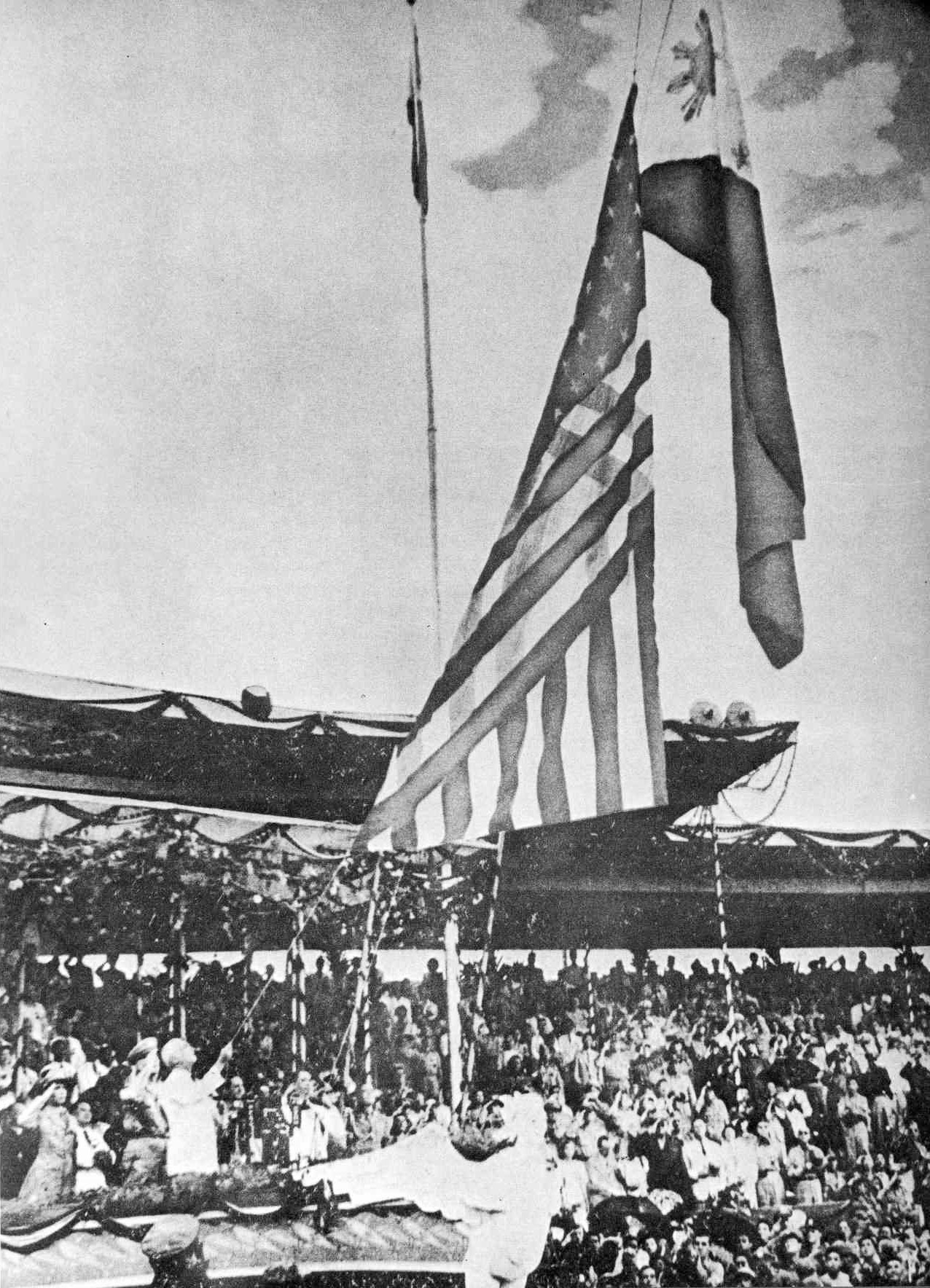
For a time after 1946 the country's independence holiday sat on 4 July, the date Washington recognised the republic through Proclamation 2695 and the Treaty of Manila. In 1962 President Diosdado Macapagal issued a proclamation moving the observance to 12 June. Two years later, Republic Act No. 4166 gave June the name Philippine Independence Day and turned the July holiday into Philippine Republic Day. June 12 had earlier been Flag Day; in 1965 National Flag Day shifted to 28 May, remembering the flag flown after the 1898 victory at Alapan in Imus, Cavite. A 1994 executive order stretched the flag season from 28 May to 12 June.
How Independence Day is kept
Flag ceremonies open the day at government offices, schools and plazas. In Kawit, Cavite, the centrepiece is at the Aguinaldo Shrine, where the flag is raised and the 1898 declaration is read. Manila hosts the national programme, which in some years included a parade of uniformed services and civic groups. Local governments and schools then hold wreath layings and cultural shows. From 28 May to 12 June, public buildings display the national flag. Filipinos abroad organise their own gatherings, parades and dinners.
When and where
The holiday is fixed to 12 June and lasts a single day. It remembers a declaration made on that date in 1898 at Kawit. The date has been a public observance since 1962 and the national day since 1978. A flag-display season opens on 28 May and closes on 12 June.
It is kept throughout the Philippines, on every island and in every province. The strongest observances are in Kawit, Cavite, where the Aguinaldo Shrine stands, and in Manila, where the national celebration is held. Filipino communities abroad also mark the day.
What Independence Day means
For Filipinos the day carries a claim to self-rule made in 1898, before any foreign power accepted it. The flag raised at Kawit, the reading of the old declaration and the shrine itself hold that memory. Moving the date from 4 July to 12 June also turned attention to what Filipinos declared for themselves, rather than the recognition that came from the United States in 1946. Schools treat the date as the country's birthday.


Questions people ask about Independence Day
When is Independence Day kept?
Independence Day is kept every year on 12 June, as a one-day public holiday.
What is Philippine Independence Day?
It is the Philippines' national holiday, kept on 12 June. It recalls the 1898 declaration of independence from Spain and is marked with flag ceremonies, parades, speeches and readings of the old declaration document.
Why is it on 12 June and not 4 July?
For a time the country's independence holiday sat on 4 July, because that was when the United States recognised the republic in 1946. President Diosdado Macapagal moved the observance to 12 June, the date of the 1898 declaration. Law confirmed the change in 1964.
Where is the main ceremony held?
The national programme is in Manila. Kawit, in Cavite province, holds its own annual ceremony at the Aguinaldo Shrine, the house where independence was proclaimed in 1898, with a flag raising and a reading of the declaration.
Do Filipinos abroad celebrate it?
Yes. Filipino communities in other countries hold gatherings, parades and dinners, often on the weekend nearest 12 June, so that the day is marked outside the Philippines as well.
See also
 Good FridayA solemn Christian holy day commemorating the crucifixion and death of Jesus Christ.
 Holy WeekThe solemn seven days leading to Easter, recalling the final week and Passion of Jesus
 Christmas EveThe evening before Christmas, marked by church services, family meals, and gift preparations across Christian cultures.
 PangalayA traditional fingernail dance of the Tausūg and Bajau peoples in the Sulu Archipelago and Sabah.
Good reading and sources
- Research Guides: World of 1898: International Perspectives on the Spanish American War: IntroductionLibrary of Congress, Article
- Research Guides: World of 1898: International Perspectives on the Spanish American War: IntroductionLibrary of Congress, Article
- Independence Day (Philippines) on WikipediaEncyclopedia
- More photos on Wikimedia CommonsPhotos and video
- Wikidata recordOpen data
The facts on this page come from the Wikipedia article "Independence Day (Philippines)", written by its contributors and used under the CC BY-SA 4.0 licence, and from its Wikidata record (CC0). EveryParampara rewrote the text in its own words, with AI assistance, and compares every page with the article to make sure no passage is copied. It may be reused under the same CC BY-SA 4.0 licence with a link back.
It may contain mistakes. Traditions differ from one family, village and community to the next, and the people who keep them know them best. If something is wrong, tell us. Last refreshed 2026-10-05.
More from the Philippines
All the traditions of the Philippines 🇮🇳 India and 4 moreYouth Day
A commemorative holiday honoring young people and youth movements worldwideCeremony
🇦🇺 Australia and 5 moreGood Friday
A solemn Christian holy day commemorating the crucifixion and death of Jesus Christ.Spiritual · Fasting and breaking the fast
🇵🇭 Philippines and 5 moreHoly WeekἉγία καὶ Μεγάλη Ἑβδομάς
The solemn seven days leading to Easter, recalling the final week and Passion of JesusSpiritual · Fasting and breaking the fast
🇮🇳 India and 4 moreYouth Day
A commemorative holiday honoring young people and youth movements worldwideCeremony
🇦🇺 Australia and 5 moreGood Friday
A solemn Christian holy day commemorating the crucifixion and death of Jesus Christ.Spiritual · Fasting and breaking the fast
🇵🇭 Philippines and 5 moreHoly WeekἉγία καὶ Μεγάλη Ἑβδομάς
The solemn seven days leading to Easter, recalling the final week and Passion of JesusSpiritual · Fasting and breaking the fast
 🇹🇼 Yilan, Taiwan and 4 moreTaiwanese opera歌仔戲
A Taiwanese theatrical art of Hokkien balladry, stylized staging, and expressive song.Performance
🇹🇼 Yilan, Taiwan and 4 moreTaiwanese opera歌仔戲
A Taiwanese theatrical art of Hokkien balladry, stylized staging, and expressive song.Performance
The same idea elsewhere
All of this kind 🇺🇸 Philadelphia, United States and 1 moreIndependence Day
The United States' national day of parades, barbecues and fireworks, kept each July 4Ceremony
🇺🇸 Philadelphia, United States and 1 moreIndependence Day
The United States' national day of parades, barbecues and fireworks, kept each July 4Ceremony
 🇺🇸 United StatesTalking stick
A carved staff that shows who may speak at a Northwest Coast gatheringCeremony
🇺🇸 United StatesTalking stick
A carved staff that shows who may speak at a Northwest Coast gatheringCeremony
 🇺🇸 Washington, United StatesState of the Union address
The US president's yearly report to Congress and the nation, given in the House chamberCeremony
🇺🇸 Washington, United StatesState of the Union address
The US president's yearly report to Congress and the nation, given in the House chamberCeremony
 🇮🇳 Kolkata, IndiaJana Gana Mana
India's national anthem, from a Bengali hymn of 1911, sung at civic occasionsCeremony
🇮🇳 Kolkata, IndiaJana Gana Mana
India's national anthem, from a Bengali hymn of 1911, sung at civic occasionsCeremony