Spiritual and religiousSouth AsiaHindu
Lingam
In its own language: liṅga
The pillar-shaped image of Shiva, kept in temples and home shrines

The lingam is the image of Shiva in Shaivism: a pillar of stone, metal, wood, clay or gem, often set in a disked platform called the yoni. It is worshipped across India and in other parts of the subcontinent and Southeast Asia, in temples and at home.
When is Lingam kept?
Lingam is kept on all year round, in temples dedicated to Shiva and in small home shrines.
The lingam is the shape in which many Hindus worship Shiva: a rounded stone pillar, set on a platform, that stands for a god they hold to be without any shape at all. It is a sign rather than a portrait. Devotees treat it as the place where Shiva is present, and it is usually the main image in a temple built for him.
What it is
The word lingam is Sanskrit and carries the sense of a mark, a sign. The object is a short pillar with a rounded top. Followers of Shiva treat it as his image, and an unusual one: no face, no limbs, nothing that looks like a person. Stone is the commonest material, though a lingam may also be metal, wood, gem, clay or something that will not last. It usually stands in a shallow disked platform called the yoni, which lies flat beneath the upright pillar. The platform is shaped so that liquid offered to the pillar drains away and can be collected.
Styles of carving
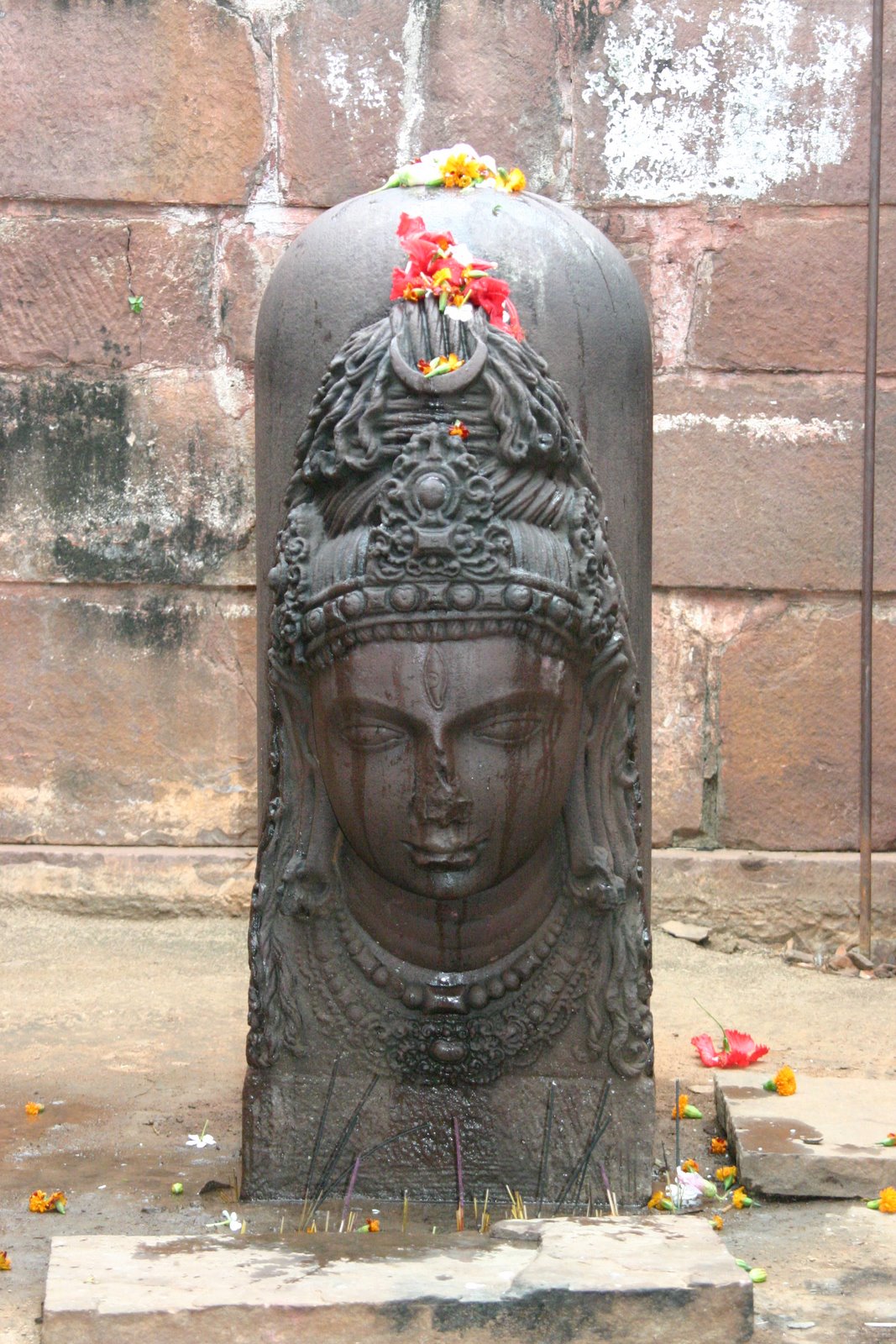
Lingams are made in several traditional forms. The commonest pairing is the pillar with its yoni platform. Together they are read as the feminine and masculine principles, and as the whole of existence. A mukhalingam carries Shiva's face: one face, four faces turned to the four directions, or five, with the fifth on top, standing for Sadashiva. The four-faced kind is the one most often seen. Other lingams are covered with small carved pillars, either one hundred and eight of them or one thousand and one, set out by fixed geometric rules. A lingodbhava shows Shiva emerging from a burning pillar, with a swan above and a wild boar below, and it recalls a Shaiva story in which Brahma, Vishnu and Shiva compete over who comes first.
What it means
For worshippers the pillar holds two powers at once: it makes and it destroys. In the Tantric and Kaula traditions, and in Shaivism and Shaktism more widely, it is read as the point where undifferentiated matter meets pure consciousness, and where a single life meets the whole cosmos. Sivaya Subramuniyaswami taught that its rounded upper part stands for Parashiva, the absolute, beyond time, space and form, while the base, called the pitha, stands for Parashakti, which has form and is the substance of all that exists. Sivananda Saraswati described the linga as an outward sign of a formless being. Some Shaivites call it the axis of the universe.
The older senses
Long before it named an object of worship, linga was a word for a sign. It appears in the Upanishads and the epics with the sense of a mark, a characteristic, or evidence. The Shvetashvatara Upanishad uses it that way, and also says that Shiva, the highest lord, has no linga at all, being beyond every mark, including the mark of gender. In the Nyaya and Vaisheshika schools it is what makes an inference work: smoke is the linga of fire. Sanskrit medical texts use it for the symptoms a physician reads. Panini and Patanjali record it as meaning gender. Buddhist and Jaina writings use the word too.
Debate and dispute
Whether the pillar began as a phallus is argued about. Wendy Doniger and Rohit Dasgupta read it as growing out of an old phallic symbol. Doniger points to later Sanskrit writing, including an eleventh-century Kashmiri text, and to Shaiva works that speak of the lingam as the male organ, while other texts give it an ascetic meaning instead and attach nothing sexual to it. Dasgupta adds that the Gudimallam lingam plainly shows a male organ. From the nineteenth century, European and missionary writers called the pillar and its platform obscene, a reaction that Doniger ties to Victorian attitudes and that led some Indian writers to defend the feminine.
How Lingam is kept
In a temple the lingam stands in the inner room. Worshippers come with offerings, and liquid is poured over the pillar, running down the platform to be gathered. Priests serve the image through the day, and the same pillar may sit in a small shrine at home. In the Shaiva Siddhanta school a devotee is taught to install and adore a five-faced, ten-armed Sadashiva within the linga. Some Lingayats carry a miniature one, a chala-lingam, in a necklace. Stone is the usual material, though clay, metal, wood and gem are used as well.
When and where
Worship of the lingam is at its strongest in India, in temples built for Shiva and in small local shrines. Carved styles spread over the Indian subcontinent and into Southeast Asia. Old examples survive, among them the Gudimallam lingam, and miniature lingams are carried by Lingayats. Anthropologist Christopher John Fuller notes that such a non-figurative image is rare among Hindu sacred sculptures, which usually show gods or animals.
What Lingam means
Those who worship the lingam do not see a portrait of a god with a body. They see a sign of Shiva as he is beyond shape, time and place, and at the same time a sign of his power to make and to end. Joined with the yoni platform, it speaks of two principles, feminine and masculine, meeting and renewing everything that exists. For a devotee the plain pillar can hold the whole of reality, and standing before it is standing at the centre, the axis on which the world turns.


Questions people ask about Lingam
When is Lingam kept?
Lingam is kept on all year round, in temples dedicated to Shiva and in small home shrines.
What is a lingam?
It is the image of Shiva used by Shaivites: a short pillar, usually of stone, with a rounded top. It carries no face or limbs. The word itself is Sanskrit and means a mark or sign. In a temple it is usually the main image, and it can also be kept in a small shrine at home.
Why does it sit on a platform?
That platform is called the yoni. It is flat and lies under the upright pillar, and it is shaped so that liquid poured over the lingam runs off and can be collected. Worshippers read the two together as the feminine and masculine principles, and as the whole of existence.
Is the lingam a phallus?
Scholars disagree. Wendy Doniger and Rohit Dasgupta argue that it grew out of a phallic symbol, and Dasgupta notes that one ancient example, the Gudimallam lingam, plainly shows a male organ. Other texts treat it as an ascetic mark with no sexual meaning, and traditions such as Lingayatism read it as purely spiritual.
Where is it found?
In temples dedicated to Shiva across India, and at home in small shrines. Carved styles are also found in other parts of the Indian subcontinent and in Southeast Asia. Some lingams are natural objects, held to have appeared by themselves, and are worshipped where they stand.
See also
 Kailash Mansarovar YatraA high-altitude pilgrimage to Mount Kailash and Lake Manasarovar in Tibet
 TheyyamA sacred ritual dance and divine invocation from North Malabar in India
Good reading and sources
- Lingam on WikipediaEncyclopedia
- More photos on Wikimedia CommonsPhotos and video
- Wikidata recordOpen data
The facts on this page come from the Wikipedia article "Lingam", written by its contributors and used under the CC BY-SA 4.0 licence, and from its Wikidata record (CC0). EveryParampara rewrote the text in its own words, with AI assistance, and compares every page with the article to make sure no passage is copied. It may be reused under the same CC BY-SA 4.0 licence with a link back.
It may contain mistakes. Traditions differ from one family, village and community to the next, and the people who keep them know them best. If something is wrong, tell us. Last refreshed 2026-10-05.
More from India
All the traditions of India
🇮🇳 India and 1 moreKailash Mansarovar Yatraकैलाश मानसरोवर यात्रा (Hindi); ཀཱའི་ལ་ཤ་མན་ས་རོ་ཝར་ཡ་ཏྲ། (Tibetan)
A high-altitude pilgrimage to Mount Kailash and Lake Manasarovar in TibetSpiritual
🇮🇳 IndiaTheyyam
A sacred ritual dance and divine invocation from North Malabar in IndiaSpiritual
The same idea elsewhere
All of this kind 🇦🇺 Australia and 5 moreGood Friday
A solemn Christian holy day commemorating the crucifixion and death of Jesus Christ.Spiritual · Fasting and breaking the fast
🇦🇺 Australia and 5 moreGood Friday
A solemn Christian holy day commemorating the crucifixion and death of Jesus Christ.Spiritual · Fasting and breaking the fast
 🇮🇱 Jerusalem, IsraelPassoverפסח
A Jewish spring festival celebrating freedom from slavery with ritual mealsSpiritual · Dinner
🇮🇱 Jerusalem, IsraelPassoverפסח
A Jewish spring festival celebrating freedom from slavery with ritual mealsSpiritual · Dinner
 🇵🇭 Philippines and 5 moreHoly WeekἉγία καὶ Μεγάλη Ἑβδομάς
The solemn seven days leading to Easter, recalling the final week and Passion of JesusSpiritual · Fasting and breaking the fast
🇵🇭 Philippines and 5 moreHoly WeekἉγία καὶ Μεγάλη Ἑβδομάς
The solemn seven days leading to Easter, recalling the final week and Passion of JesusSpiritual · Fasting and breaking the fast
 🇮🇱 Jerusalem, IsraelYom Kippurיוֹם כִּפּוּר
The holiest day in Judaism, dedicated to fasting, prayer and atonementSpiritual · Fasting and breaking the fast
🇮🇱 Jerusalem, IsraelYom Kippurיוֹם כִּפּוּר
The holiest day in Judaism, dedicated to fasting, prayer and atonementSpiritual · Fasting and breaking the fast