Music, dance and storytellingLatin America and the Caribbean
Payada
Improvised ten-line verses traded by guitar-playing payadores in the Río de la Plata

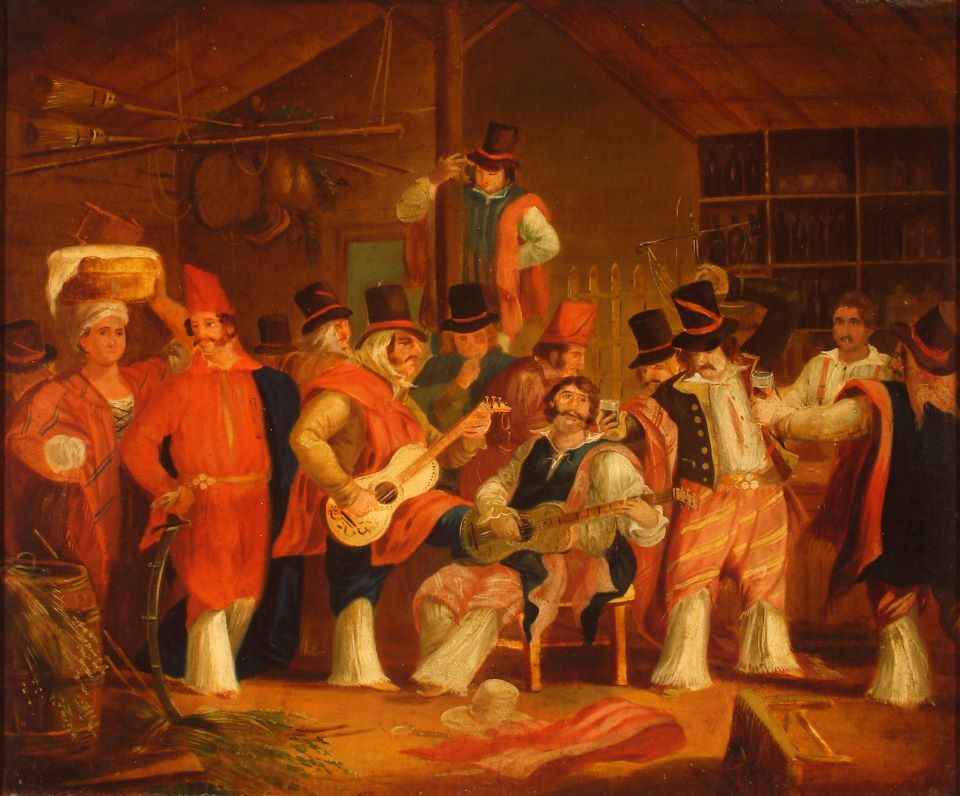
Payada is an improvised song contest and sung poetry of the gaucho culture of Argentina and Uruguay, with related forms in southern Brazil, Paraguay and Chile. A payador makes up ten-line verses to a guitar, alone or against a rival, answering questions and trading jabs until one of them hesitates.
When is Payada kept?
Payada is kept on whenever singers meet, and on the Day of the Payador in Uruguay and Argentina.
Payada is a way of making songs with words invented on the spot. A singer, called a payador, holds a guitar and shapes a ten-line stanza known as a décima, often for hours. Two or more payadores may answer each other in turn, and the audience waits to see who runs out of verses. The custom belongs to the gaucho world of the Río de la Plata.
Improvised verses
The heart of payada is the décima, a stanza of ten lines that is built line by line as the singing goes on. Nothing is written down beforehand. The payador holds a guitar and lets the tune carry the words, so the rhyme has to arrive at the same moment as the sense. In the Río de la Plata the word payador is also used loosely for any guitar player, though in the strict sense it means a person who composes aloud. Three musical settings belong to the form: the cifra, the huella and the milonga.
The contrapunto duel
When two or more payadores meet, the performance becomes a contrapunto. Each singer puts questions to the other and must answer in verse straight away, and the exchanges are often mocking. These duels can run for many hours. A contest finishes when one of the singers cannot reply at once, and that hesitation decides the winner. Skill is judged by how fluent and how pointed the improvised lines are. A payada can therefore be a friendly meeting or a serious test of memory, wit and nerve, watched closely by the people gathered around.
Older roots
According to the tradition's history, the payada grew out of the troubadour singing of southern Spain, which settlers carried with them to Latin America. Once it took hold in Argentina, its development owed much to Afro-Argentine musicians in the later 19th century. At that time the government was encouraging European migration and pushing black Argentines to the margins. Black payadores answered with their verses, asking that the long contribution of Afro-Argentines be recognised, and the art they shaped is still practised in the Americas.
Payadores and their days
Bartolomé Hidalgo, who was born in Montevideo in 1788, is treated as the forerunner of the form and as the earliest gaucho poet. His birthday, 24 August, is marked in Uruguay as the Day of the Payador. Argentina keeps its own Day of the Payador on 23 July, remembering a contest at Paysandú in 1884 between Juan de Nava and Gabino Ezeiza, which Ezeiza won with a piece saluting the town. Simón Méndez, nicknamed Guasquita, was the first payador recorded by name, a soldier who served during the British invasions of the River Plate. Santos Vega stands as the model payador, and many later singers are counted as his successors.
In culture and today
Writers have taken the payada into literature. Rafael Obligado's best known poem is about Santos Vega, and gaucho literature as a whole draws on the figure of the singing horseman. The comedy group Les Luthiers sent it up in a piece called Payada de la vaca, a cow-themed duel, which shows how familiar the form is to audiences far outside the countryside. Payadas are still sung at folk gatherings and competitions. Only one recording of Ezeiza's voice is known to exist, and it holds the song he improvised at Paysandú.
How Payada is kept
A payada usually starts with one singer and a guitar, working through ten-line stanzas made up on the spot as the strings play. When a second payador joins, the pair take turns. One sets a question in verse, the other answers, and that answer turns into the next question. Sharp remarks fly back and forth. Singing goes on as long as both can manage, sometimes deep into the night. Whoever cannot come back with a line at once loses. Listeners press close, because the words last only for the moment.
When and where
There is no season for a payada: it happens whenever singers come together, at a country gathering, a festival or a contest. Two fixed dates honour the payadores. Uruguay marks 24 August, the birthday of Bartolomé Hidalgo, and Argentina marks 23 July, the day of the 1884 contest at Paysandú.
Payada belongs to the Río de la Plata and the gaucho country around it. The sources place it in Uruguay and Argentina above all, with the same art found in southern Brazil and southern Paraguay. In Chile it goes by the name paya and is performed by huasos. Singers also perform it in towns and cities far from the plains, on stages and at festivals.
What Payada means
To the people who keep it, a payada tests the person as much as the singer. Verse has to come quickly, stay courteous in form even when the words sting, and fit the moment. Improvising well shows a clear head and a listening one: a payador has to take in what the other singer has just said. For Afro-Argentine musicians the form also carried a claim, that their community's part in the country's music be acknowledged and that the tradition they made belongs to everyone who sings it.

Questions people ask about Payada
When is Payada kept?
Payada is kept on whenever singers meet, and on the Day of the Payador in Uruguay and Argentina.
What is a payada?
It is a sung performance in which a payador makes up ten-line stanzas, called décimas, over guitar music. When two or more sing against each other the exchange is a contrapunto, with questions, answers and often sharp remarks traded in verse.
Where is it kept?
In Uruguay and Argentina, where the gaucho tradition of the Río de la Plata is strongest. It also appears in southern Brazil and southern Paraguay, and in Chile the same art is called paya and performed by huasos.
How does a contest end?
One payador puts a question to the other, and both must keep answering in verse. The duel can last many hours, and it stops the moment a singer cannot reply straight away. That pause settles who has won.
Who are the well known payadores?
Bartolomé Hidalgo is seen as the earliest gaucho poet, and Simón Méndez, called Guasquita, is the first payador recorded by name. Santos Vega is held up as the model, with Gabino Ezeiza among those who came after him.
See also
 ForróMusic, dance and party from Brazil's Northeast, with accordion, triangle and zabumba drum
 KizombaA close, slow couple dance from Angola, named after a Kimbundu word for partyBaiãoA syncopated folk rhythm and partnered dance from northeastern Brazil
 Paraguayan harpParaguay's national harp, strung with 32 to 46 strings and plucked with long fingernails
Good reading and sources
- Payada on WikipediaEncyclopedia
- More photos on Wikimedia CommonsPhotos and video
- Wikidata recordOpen data
The facts on this page come from the Wikipedia article "Payada", written by its contributors and used under the CC BY-SA 4.0 licence, and from its Wikidata record (CC0). EveryParampara rewrote the text in its own words, with AI assistance, and compares every page with the article to make sure no passage is copied. It may be reused under the same CC BY-SA 4.0 licence with a link back.
It may contain mistakes. Traditions differ from one family, village and community to the next, and the people who keep them know them best. If something is wrong, tell us. Last refreshed 2026-10-05.
More from Uruguay
All the traditions of Uruguay 🇺🇾 Montevideo, Uruguay and 3 moreMurga
A lively Carnival musical theatre of chorus, percussion and social satirePerformance
🇺🇾 Montevideo, Uruguay and 3 moreMurga
A lively Carnival musical theatre of chorus, percussion and social satirePerformance
 🇺🇾 Uruguay and 3 moreTango
A social partner dance of the Río de la Plata, improvised step by stepPerformance
🇺🇾 Montevideo, UruguayNostalgia NightNoche de la Nostalgia
Uruguay's nationwide retro music and dance celebration held every 24 AugustFestival
🇺🇾 Uruguay and 3 moreTango
A social partner dance of the Río de la Plata, improvised step by stepPerformance
🇺🇾 Montevideo, UruguayNostalgia NightNoche de la Nostalgia
Uruguay's nationwide retro music and dance celebration held every 24 AugustFestival
 🇦🇲 Yerevan, Armenia and 6 moreArmenian Genocide Remembrance DayՄեծ Եղեռնի զոհերի հիշատակի օր
An annual day of mourning and remembrance for the victims of the 1915 Armenian Genocide.Spiritual
🇦🇲 Yerevan, Armenia and 6 moreArmenian Genocide Remembrance DayՄեծ Եղեռնի զոհերի հիշատակի օր
An annual day of mourning and remembrance for the victims of the 1915 Armenian Genocide.Spiritual
The same idea elsewhere
All of this kind 🇹🇷 Kayseri, Turkey and 4 moreHalay
A traditional line and circle folk dance kept across Turkey, Azerbaijan, Armenia, Iran, and Syria.Performance
🇹🇷 Kayseri, Turkey and 4 moreHalay
A traditional line and circle folk dance kept across Turkey, Azerbaijan, Armenia, Iran, and Syria.Performance
 🇳🇿 Auckland, New ZealandPoi
A Māori performing art of swinging tethered weights in rhythmical patterns.Performance
🇳🇿 Auckland, New ZealandPoi
A Māori performing art of swinging tethered weights in rhythmical patterns.Performance
 🇺🇦 Kyiv, UkraineBanduraБандура
A Ukrainian plucked string instrument played to accompany epic songs and folk balladsPerformance
🇺🇦 Kyiv, UkraineBanduraБандура
A Ukrainian plucked string instrument played to accompany epic songs and folk balladsPerformance
 🇵🇭 Philippines and 1 morePangalay
A traditional fingernail dance of the Tausūg and Bajau peoples in the Sulu Archipelago and Sabah.Performance
🇵🇭 Philippines and 1 morePangalay
A traditional fingernail dance of the Tausūg and Bajau peoples in the Sulu Archipelago and Sabah.Performance