Dress and adornmentEuropeChristian
Sarafan
In its own language: сарафа́н
A long, flared Russian dress, the everyday wear of peasant women for centuries
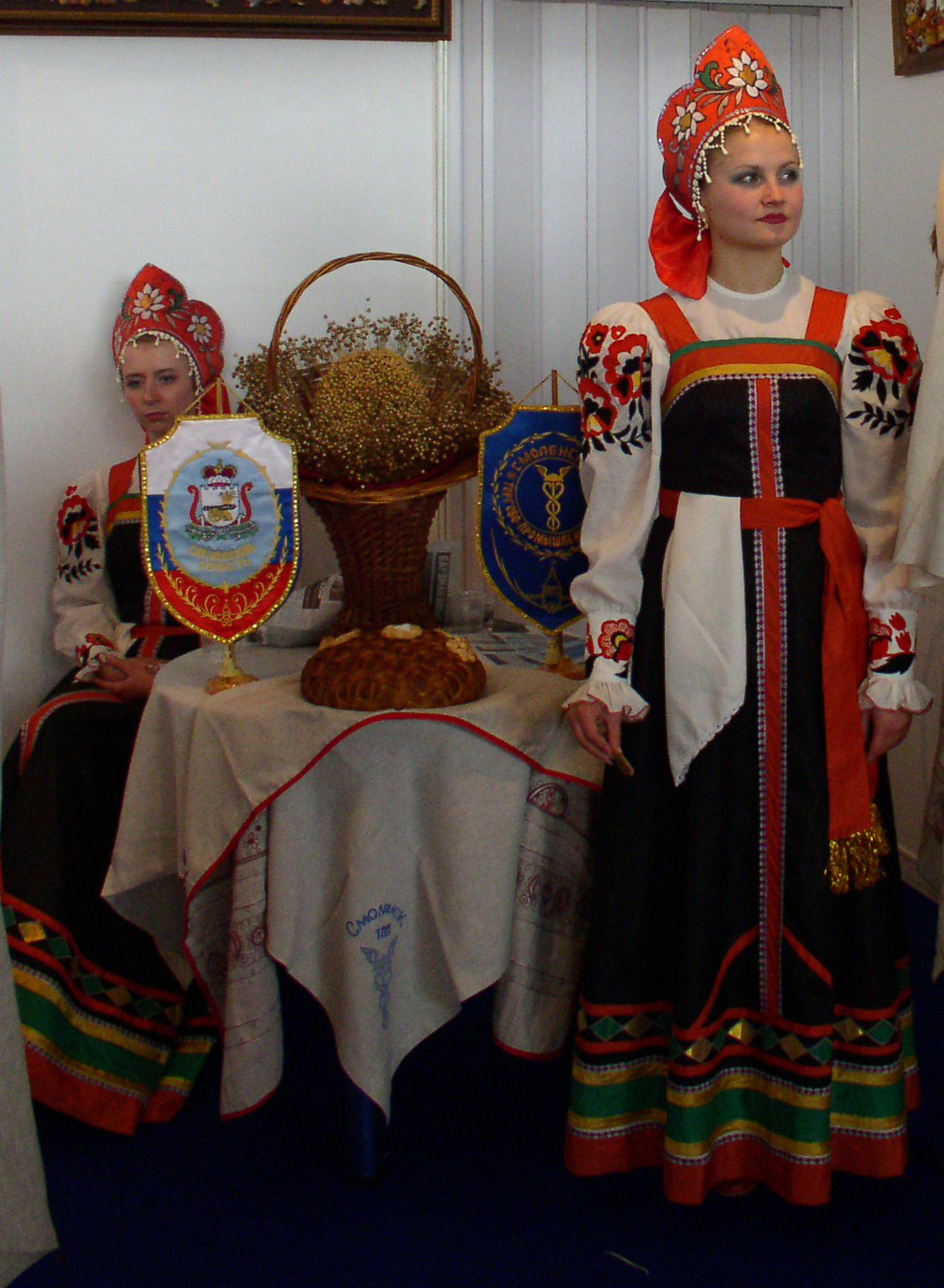
The sarafan is a long, trapezoid dress worn by girls and women and counted as part of Russian folk costume. It was everyday peasant dress in northern and central Russia, noted in records from 1376 and kept in use into the 20th century. Today it belongs to folk performance and holidays.
When is Sarafan kept?
Sarafan is kept on once worn daily; now mainly at Russian folk song and dance performances and on folk and religious holidays.
A sarafan is a long, flared dress worn by girls and women in Russia, cut in a wide trapezoid shape. It forms part of Russian traditional folk costume. In the north and centre of the country it was the everyday dress of peasant women for a long stretch of history. Today it appears mostly on stage and on holidays, and designers are reshaping it for modern wardrobes.
What it is
A sarafan is a long dress with a wide, trapezoid outline, worn by girls and women and counted as part of Russian traditional folk costume. Russian costume of this kind is built on straight, flowing lines rather than fitted shapes. The garment began as a narrower piece and grew wider over time, a change the sources link to the influence of the Russian Orthodox Church. It belongs to a family of Russian dress that also includes the ponyova, a skirt worn by women in the former Grand Principality of Moscow and in parts of southern Russia today.
Origins and history
Records mention the sarafan as far back as 1376, in chronicles. The word itself comes from Persian: sarāpā, which means from head to feet. The cut is thought to follow the clothing of Viking women. Most likely the sarafan grew out of a kaftan-like garment that both women and men wore in Russia. Old Russia, especially under the Grand Principality of Moscow, kept close links with Western and Southwest Asia and carried goods between European lands such as Sweden and Asian lands such as Persia and the region that is now Turkey. Trade with Central Europe brought better cloth and a wider range of colours.
Who wore it
By about 1700, peasant women in northern and central Russia wore the sarafan more often than any other garment. It stayed in regular use well into the 20th century. The reforms of Peter the Great, which brought Westernised standards into Russian life and were disputed at the time, divided the country's dress: peasants went on wearing the sarafan day to day, while the upper classes turned to Central European fashion. Where the Grand Principality of Moscow once ruled, and in what is now southern Russia, women also wore ponyova skirts.
Today and change
Nowadays the sarafan appears mainly in performances of Russian folk song and dance, and people wear it for folk and religious holidays. Designers in Russia, Belarus and Ukraine are taking the old style and turning it into something new: a light summer dress that can fit into a modern wardrobe. The garment has also entered folk art. The outer shell of a matryoshka, the nesting doll, is traditionally painted wearing a sarafan.
How Sarafan is kept
There is no ceremony attached to it. Girls and women put the sarafan on as a dress and wear it through the day. In the north and centre of Russia peasant women used it for daily life well into the 20th century, while wealthier women gave it up after the reforms of Peter the Great. Today people wear it for performances of Russian folk song and dance and for folk and religious holidays, and designers are making new versions of the shape.
When and where
The sarafan has no single date. It was once worn every day, so it belonged to no season or festival, though today it comes out on folk and religious holidays. Its history is measured in centuries rather than a calendar: first noted in chronicles in 1376, everyday peasant dress by around 1700, and still in use into the 20th century.
It belongs to Russia, and inside the country it was strongest in the northern and central regions, including the lands of the former Grand Principality of Moscow. In parts of what is now southern Russia, women wore ponyova skirts as well. Designers in Russia, Belarus and Ukraine now rework the sarafan, and it remains part of Russian folk costume as presented on stage.
What Sarafan means
For Russian folk culture the sarafan works as a marker of national dress, a garment that says Russia without a caption. Its long, unbroken lines match the plain, flowing shape that Russian traditional costume favours. Worn on holidays and on stage, it holds the memory of village life and of the peasant women who kept it going for centuries. Its place on the matryoshka doll shows how firmly it sits in the picture of Russian identity, and the new versions being made suggest that picture is still being added to.


Questions people ask about Sarafan
When is Sarafan kept?
Sarafan is kept on once worn daily; now mainly at Russian folk song and dance performances and on folk and religious holidays.
What is a sarafan?
A long, wide dress worn by girls and women in Russia. Its outline is a trapezoid, wider at the hem, and it belongs to Russian traditional folk costume. It started out as a narrower garment and grew broader over the centuries.
Where does the sarafan come from?
Its name comes from Persian, sarāpā, meaning from head to feet. The cut is thought to follow the clothing of Viking women, and the sarafan most likely grew out of a kaftan-like garment that both women and men wore in Russia.
Is the sarafan still worn today?
Yes. It appears mostly in performances of Russian folk song and dance and on folk and religious holidays. Designers in Russia, Belarus and Ukraine are also reworking it into a light summer dress for modern wardrobes.
Why is a matryoshka doll dressed in a sarafan?
By tradition the outer shell of a matryoshka, the Russian nesting doll, is painted wearing a sarafan. It is one sign of how closely the dress is tied to Russian folk art and to ideas of national identity.
See also
 RushnykA sacred embroidered cloth used in East Slavic rituals, weddings and daily life.
 GáktiA traditional coat worn by the Sámi people across northern Scandinavia and Russia, signaling origin and status through c
 Traditional tattooingThe ancient custom of marking the skin for protection, healing, status and sacred rites
 KalpakA tall cap of Turkic peoples, thick for winter and wide and light for summer
Good reading and sources
- Sarafan on WikipediaEncyclopedia
- More photos on Wikimedia CommonsPhotos and video
- Wikidata recordOpen data
The facts on this page come from the Wikipedia article "Sarafan", written by its contributors and used under the CC BY-SA 4.0 licence, and from its Wikidata record (CC0). EveryParampara rewrote the text in its own words, with AI assistance, and compares every page with the article to make sure no passage is copied. It may be reused under the same CC BY-SA 4.0 licence with a link back.
It may contain mistakes. Traditions differ from one family, village and community to the next, and the people who keep them know them best. If something is wrong, tell us. Last refreshed 2026-10-05.
More from Russia
All the traditions of Russia
🇺🇦 Ukraine and 2 moreRushnykрушник
A sacred embroidered cloth used in East Slavic rituals, weddings and daily life.Dress
🇳🇴 Norway and 3 moreGákti
A traditional coat worn by the Sámi people across northern Scandinavia and Russia, signaling origin and status through cDress
🇪🇬 Egypt and 5 moreTraditional tattooing
The ancient custom of marking the skin for protection, healing, status and sacred ritesDress
🇹🇷 Turkey and 3 moreKalpak
A tall cap of Turkic peoples, thick for winter and wide and light for summerDress
The same idea elsewhere
All of this kind 🇮🇳 Paithan, IndiaPaithani
A handwoven silk sari from Maharashtra, with a squared border and a peacock palluDress
🇮🇳 Paithan, IndiaPaithani
A handwoven silk sari from Maharashtra, with a squared border and a peacock palluDress
 🇮🇱 Israel and 1 moreTzitzitצִיצִית
Knotted ritual fringes worn on a four-cornered garment, a reminder of the commandmentsDress
🇮🇱 Israel and 1 moreTzitzitצִיצִית
Knotted ritual fringes worn on a four-cornered garment, a reminder of the commandmentsDress
 🇼🇸 Samoa and 1 moreʻIe tōga
Precious woven mats exchanged in Samoan ceremonies to honor family ties and chiefly status.Dress
🇼🇸 Samoa and 1 moreʻIe tōga
Precious woven mats exchanged in Samoan ceremonies to honor family ties and chiefly status.Dress
 🇱🇸 LesothoMokorotlo
A conical straw hat that serves as the national symbol of Lesotho and a key element of Basotho traditional dress.Dress
🇱🇸 LesothoMokorotlo
A conical straw hat that serves as the national symbol of Lesotho and a key element of Basotho traditional dress.Dress