Music, dance and storytellingNorth Africa
Tahtib
In its own language: تحطيب
An Egyptian stick dance and martial art kept by men and women in Upper Egypt.

Tahtib is a traditional Egyptian practice that began as military training and later became a folk dance performed with a wooden stick. Men and women in Upper Egypt keep the custom alive through rhythmic performances accompanied by drums and oboes, often sharing it during celebrations or on stage.
When is Tahtib kept?
Tahtib is kept during celebrations, weddings, and public performances.
Tahtib is an ancient Egyptian practice that blends martial skill with folk performance. Practitioners wield a long wooden stick to mimic combat while moving to steady drumbeats and reedy melodies. What began as soldier training centuries ago now appears at village gatherings and cultural stages across Upper Egypt. People keep the tradition alive to honor local history and share rhythm with their neighbors.
Origins and history
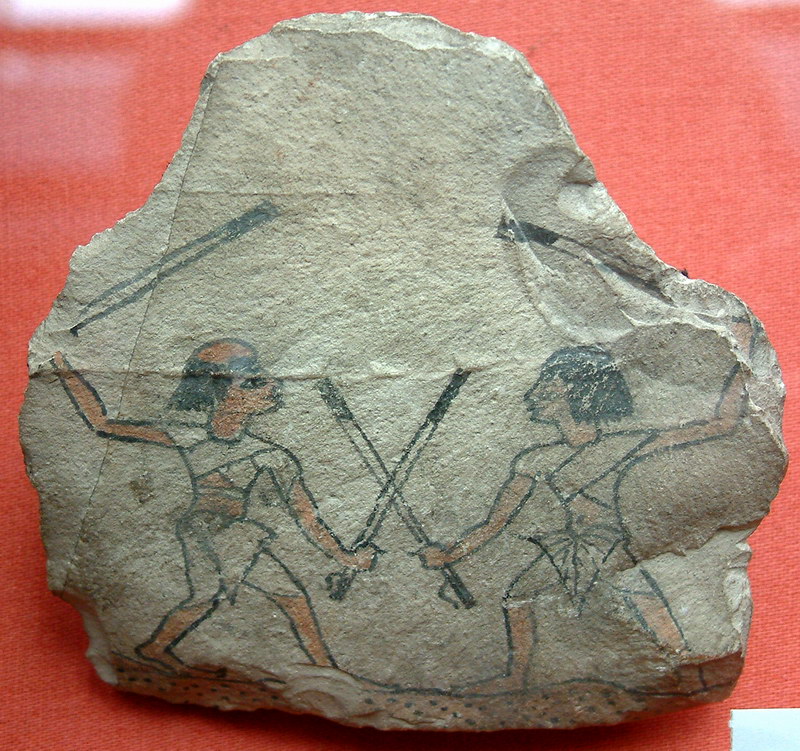
Traces of this practice reach back to ancient stone carvings found near Cairo and Minya. Soldiers learned these movements alongside archery and wrestling during the Old Kingdom era. By the Middle Kingdom, farmers and villagers adopted the routines for leisure. Ancient texts later recorded the activity as a festive pastime enjoyed at weddings and public festivals. Over time, the strict drills softened into a graceful display. The martial roots never vanished completely, but the daily life of villages gradually turned the routine into a shared cultural performance.
How it is kept
Performers move to the steady beat of a bass drum and a sharp folk oboe. One musician strikes the center of the drum for deep tones while tapping the rim for quick rhythms. Dancers hold a four-foot wooden pole and swing it in wide figure-eight patterns that cut through the air. Both men and women take part today. Male dancers usually wear simple traditional clothing, while female performers sometimes adapt the steps for stage shows or balance the pole on their shoulders. Modern instructors have also organized the techniques into structured classes so newcomers can learn safely.
Meaning and practice
The original Arabic title translates to the art of staying straight and honest through the use of a stick. Participants view the exchange as a respectful dialogue rather than a fight. Training focuses on guarding the head while seeking a clean touch on the opponent. Victory comes from one precise strike to the skull or three solid hits to the torso. The routine teaches patience, spatial awareness, and control. Communities still gather to watch the exchanges because the display reinforces local values of discipline and mutual respect.
How Tahtib is kept
Men and women gather in open spaces or on stages to perform the routine. A drummer sets a steady pace while a player answers with quick taps. Dancers hold a long wooden pole and swing it in wide arcs across their bodies. They step forward and back, mirroring each other without making contact. Female performers sometimes adapt the movements for theatrical shows, using lighter hooked poles decorated with foil. Modern schools now teach the defensive strikes and footwork in structured lessons for mixed groups.
When and where
The practice does not follow a fixed calendar date. Communities stage performances during seasonal festivals, wedding celebrations, and public holidays. Tourist venues in southern Egypt schedule regular shows throughout the year to share the custom with visitors.
Upper Egypt remains the heartland of the tradition. Villages along the Nile valley preserve the older styles, while cultural centers in Luxor and Aswan host frequent demonstrations. The practice spreads occasionally to broader Egyptian stages and international folk festivals.
What Tahtib means
The old name frames the exercise as a lesson in integrity and clear conduct. Swinging the pole requires focus and restraint, qualities that elders value in daily life. The controlled exchange between partners mirrors a conversation built on trust. Keeping the routine alive allows younger generations to connect with ancestral skills while learning self-discipline and respect for others.
Questions people ask about Tahtib
When is Tahtib kept?
Tahtib is kept during celebrations, weddings, and public performances.
What exactly is tahtib?
It is a traditional Egyptian practice that combines martial training with folk dance. Participants use a long wooden stick to simulate combat while moving to drumbeats and oboe music.
Where do people perform it today?
The custom stays strongest in Upper Egypt. You can watch regular shows in Luxor and Aswan, and locals still practice it at village gatherings and weddings.
Can women take part?
Yes. While men originally dominated the practice, women now perform both traditional and theatrical versions. Some stage adaptations use lighter, decorated poles and incorporate balancing moves.
How is victory decided in the martial version?
Fighters earn points by striking the opponent. A single clean touch to the head wins immediately, or three solid hits to the body secure the match.
See also
 MizmarA traditional double-reed instrument and drum ensemble for weddings and folk dances
 Mother's DayA worldwide annual celebration dedicated to mothers, maternal bonds and family care
 MawlidAn annual festival marking the birth of the Prophet Muhammad, marked by poetry, processions and feasts.
 Traditional tattooingThe ancient custom of marking the skin for protection, healing, status and sacred rites
Good reading and sources
- Tahtib on WikipediaEncyclopedia
- More photos on Wikimedia CommonsPhotos and video
- Wikidata recordOpen data
The facts on this page come from the Wikipedia article "Tahtib", written by its contributors and used under the CC BY-SA 4.0 licence, and from its Wikidata record (CC0). EveryParampara rewrote the text in its own words, with AI assistance, and compares every page with the article to make sure no passage is copied. It may be reused under the same CC BY-SA 4.0 licence with a link back.
It may contain mistakes. Traditions differ from one family, village and community to the next, and the people who keep them know them best. If something is wrong, tell us. Last refreshed 2026-10-04.
More from Egypt
All the traditions of Egypt 🇱🇧 Lebanon and 5 moreZajalزجل
Half-sung Arabic poetry in colloquial speech, traded as a duel between improvising poetsPerformance
🇪🇬 Egypt and 5 moreMizmarمزمار
A traditional double-reed instrument and drum ensemble for weddings and folk dancesPerformance
🇱🇧 Lebanon and 5 moreZajalزجل
Half-sung Arabic poetry in colloquial speech, traded as a duel between improvising poetsPerformance
🇪🇬 Egypt and 5 moreMizmarمزمار
A traditional double-reed instrument and drum ensemble for weddings and folk dancesPerformance
 🇹🇷 Bursa, Turkey and 5 moreKaragöz and Hacivat
A Turkish shadow play of two quarrelling friends, acted on a lit screen behind a curtainPerformance
🇹🇷 Bursa, Turkey and 5 moreKaragöz and Hacivat
A Turkish shadow play of two quarrelling friends, acted on a lit screen behind a curtainPerformance
 🇪🇬 Egypt and 4 moreOudعُود (ʿūd)
A fretless, pear-shaped Middle Eastern lute, plucked with a plectrum called a rishaPerformance
🇪🇬 Egypt and 4 moreOudعُود (ʿūd)
A fretless, pear-shaped Middle Eastern lute, plucked with a plectrum called a rishaPerformance
The same idea elsewhere
All of this kind 🇹🇷 Kayseri, Turkey and 4 moreHalay
A traditional line and circle folk dance kept across Turkey, Azerbaijan, Armenia, Iran, and Syria.Performance
🇧🇷 BrazilBaião
A syncopated folk rhythm and partnered dance from northeastern BrazilPerformance
🇹🇷 Kayseri, Turkey and 4 moreHalay
A traditional line and circle folk dance kept across Turkey, Azerbaijan, Armenia, Iran, and Syria.Performance
🇧🇷 BrazilBaião
A syncopated folk rhythm and partnered dance from northeastern BrazilPerformance
 🇺🇦 Kyiv, UkraineBanduraБандура
A Ukrainian plucked string instrument played to accompany epic songs and folk balladsPerformance
🇺🇦 Kyiv, UkraineBanduraБандура
A Ukrainian plucked string instrument played to accompany epic songs and folk balladsPerformance
 🇳🇿 Auckland, New ZealandPoi
A Māori performing art of swinging tethered weights in rhythmical patterns.Performance
🇳🇿 Auckland, New ZealandPoi
A Māori performing art of swinging tethered weights in rhythmical patterns.Performance