Festivals and celebrationsLatin America and the CaribbeanChristianSecular and civic
Trinidad and Tobago Carnival
An annual festival of street parades, masquerade bands, steelpan music and dance
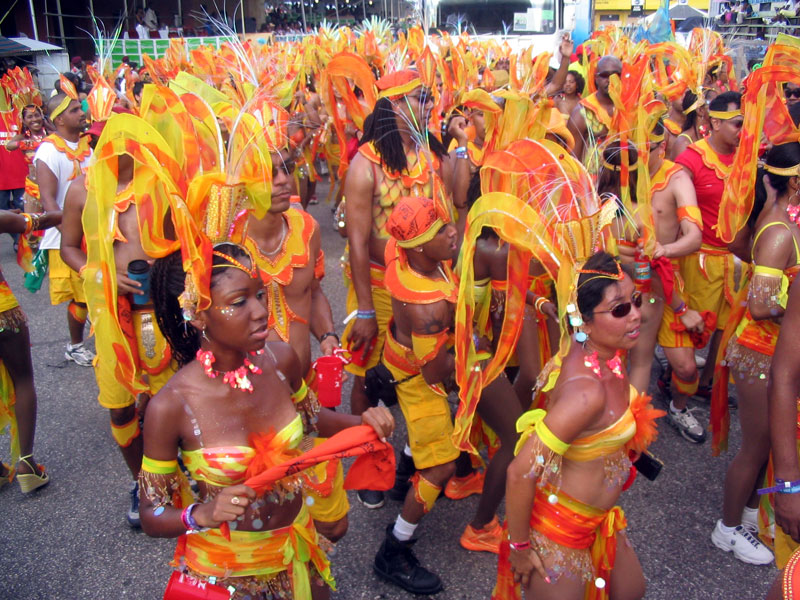
Trinidad and Tobago Carnival is a national festival held across the twin islands on the Monday and Tuesday preceding Ash Wednesday. Communities mark the season with costumed street bands, steelpan competitions, calypso, and soca music, opening before dawn with satirical J'ouvert revels.
When is Trinidad and Tobago Carnival in 2027?
Trinidad and Tobago Carnival 2027 runs from 8 to 9 February 2027. Other years: 2026, 16 to 17 February 2026; 2028, 28 to 29 February 2028.
Trinidad and Tobago Carnival is an annual national festival celebrated on the Monday and Tuesday before Ash Wednesday. Rooted in late eighteenth-century masquerades and the post-Emancipation celebrations of freed African workers, it brings together large costumed bands, steel drum orchestras, and street parades. Participants mark the days leading into Christian Lent with high-energy street parties, dance, and music competitions.
Origins and Canboulay
The celebration dates back to the 1780s, when French West Indian planters, free people of colour, and enslaved Africans migrated to Trinidad. Planters held private masquerade balls before the Lenten fast. Excluded from these parties, enslaved people staged parallel events that mocked their enslavers and preserved African rituals. Following the 1834 abolition of slavery, freed workers commemorated their liberty through Canboulay processions, bearing burning sugar cane torches, drumming, and practicing the calinda martial art. British colonial authorities attempted to suppress these gatherings, sparking riots during the 1880s and prompting legislation that established the official dawn starting hour for street festivities.
Music and steelpan
Music forms the backbone of the entire festival. Calypso emerged in the seventeenth century from West African kaiso songs, originally sung in French Creole by lead singers to mock plantation owners and pass messages between workers. In modern times, faster soca rhythms share the road with traditional calypso. When colonial laws banned African drums and stick fighting after the Canboulay riots, musicians adapted by striking bamboo poles together. By 1937, performers began shaping discarded oil drums, metal bins, and frying pans into acoustic instruments called steelpans, creating an orchestral tradition that later gained worldwide attention.
J'ouvert and road parades
The main festival begins at daybreak on Carnival Monday with J'ouvert, which translates from French as the break of day. Revellers parade through the early morning wearing informal, satirical outfits while covering their bodies in mud, dark oil, and powder. By Monday afternoon and throughout Carnival Tuesday, the celebration shifts toward elaborate masquerade bands. Huge groups of masqueraders, including established bands such as Tribe, Bliss, and Harts, move along city streets in coordinated, brightly decorated outfits alongside limbo dancers, mobile sound rigs, and steel orchestras.
Traditional masquerade characters
Several distinct character costumes, collectively known as traditional mas, carry symbolic commentary and local folklore. The Dame Lorraine parodies nineteenth-century French aristocratic women with exaggerated hips and bust, often played by men. The Pierrot Grenade acts as a ragged jester parodying educated scholars, while the Moko Jumbie walks above the crowd on tall wooden stilts. Storytellers perform as the Midnight Robber wearing an oversized hat, while the Jab Molassi covers himself in oil or molasses to represent a devil. Other classic roles include the donkey-riding Burrokeet and whiteface minstrel singers.
How Trinidad and Tobago Carnival is kept
Celebrations begin weeks in advance with band launches and musical fetes. The main street festival opens before dawn on Carnival Monday with J'ouvert, where participants coat themselves in mud, oil, and powder and dance through public streets. Later on Monday and throughout Carnival Tuesday, masqueraders don large, colourful costumes and march in organized bands. Crowds follow sound systems and steel orchestras, while performers stage stick-fighting bouts, limbo contests, calypso competitions, and steelpan showcases across the capital and surrounding towns.
When and where
The festival takes place annually over the two days directly preceding Ash Wednesday, which marks the beginning of Christian Lent. Although the core street parade runs across Carnival Monday and Tuesday, associated fetes and band launches take place in the preceding weeks.
Carnival is held throughout the islands of Trinidad and Tobago, with the largest parades, costume competitions, and steelband performances centering on the capital city, Port of Spain. Similar celebrations modelled on this tradition also occur across North America and Europe.
What Trinidad and Tobago Carnival means
Carnival embodies resistance, liberation, and cultural resilience. Its customs descend directly from the struggles of enslaved Africans who used masquerade, song, and Canboulay torch processions to mock oppressive rulers and celebrate their 1834 emancipation. Characters like the Dame Lorraine, Pierrot Grenade, and Midnight Robber use satire and storytelling to challenge colonial authority, while steelpan and calypso preserve ancestral musical heritage under historical bans.


Days Trinidad and Tobago Carnival is marked
Trinidad and Tobago Carnival dates: 2026, 2027, 2028
| Year | Trinidad and Tobago Carnival date |
|---|---|
| 2026 | 16 to 17 February 2026 |
| 2027 | 8 to 9 February 2027 |
| 2028 | 28 to 29 February 2028 |
Questions people ask about Trinidad and Tobago Carnival
When is Trinidad and Tobago Carnival in 2027?
Trinidad and Tobago Carnival 2027 runs from 8 to 9 February 2027. Other years: 2026, 16 to 17 February 2026; 2028, 28 to 29 February 2028.
What is the Trinidad and Tobago Carnival?
It is an annual national festival celebrated before Lent, featuring large masquerade bands, calypso and soca music, steelpan orchestra contests, and street processions.
What happens during J'ouvert?
J'ouvert begins before sunrise on Carnival Monday. Participants dress in satirical clothing, douse themselves in mud, oil, or powder, and dance through the streets to open the celebrations.
How were steelpans invented?
After colonial bans prohibited African drums and percussion sticks, musicians in Trinidad in the late 1930s began tuning and beating discarded oil drums, metal lids, and frying pans into musical instruments.
See also
 Rama NavamiA Hindu spring festival marking the birth of Rama with prayer, fasting and processions
 HosayAn Indo-Caribbean Muharram commemoration with ornate floats, drumming and processions
 DiwaliA five-day festival of lights celebrated across India and its diaspora to mark the victory of light over darkness.
 Christmas EveThe evening before Christmas, marked by church services, family meals, and gift preparations across Christian cultures.
Good reading and sources
- 8 of the best Caribbean carnivalsNational Geographic, Article
- Up Close at Trinidad's CarnivalSmithsonian Magazine, Article
- The subversive power of calypso musicBBC, Article
- 8 of the best Caribbean carnivalsNational Geographic, Article
- Up Close at Trinidad's CarnivalSmithsonian Magazine, Article
- The subversive power of calypso musicBBC, Article
- Trinidad and Tobago Carnival on WikipediaEncyclopedia
- More photos on Wikimedia CommonsPhotos and video
- Wikidata recordOpen data
The facts on this page come from the Wikipedia article "Trinidad and Tobago Carnival", written by its contributors and used under the CC BY-SA 4.0 licence, and from its Wikidata record (CC0). EveryParampara rewrote the text in its own words, with AI assistance, and compares every page with the article to make sure no passage is copied. It may be reused under the same CC BY-SA 4.0 licence with a link back.
It may contain mistakes. Traditions differ from one family, village and community to the next, and the people who keep them know them best. If something is wrong, tell us. Last refreshed 2026-10-04.
More from Trinidad and Tobago
All the traditions of Trinidad and Tobago
🇮🇳 Ayodhya, India and 5 moreRama Navamiराम नवमी
A Hindu spring festival marking the birth of Rama with prayer, fasting and processionsFestival
 🇮🇳 Mathura, India and 5 moreHoliहोली (Hindi)
A spring festival of colours and bonfires that marks the end of winter and the triumph of good over evil.Festival
🇹🇹 Chaguanas, Trinidad and Tobago and 1 moreDivali Nagar
An annual cultural exposition in Trinidad and Tobago celebrating Hindu traditions during the Diwali season.Festival
🇮🇳 Mathura, India and 5 moreHoliहोली (Hindi)
A spring festival of colours and bonfires that marks the end of winter and the triumph of good over evil.Festival
🇹🇹 Chaguanas, Trinidad and Tobago and 1 moreDivali Nagar
An annual cultural exposition in Trinidad and Tobago celebrating Hindu traditions during the Diwali season.Festival
 🇳🇬 Oyo, Nigeria and 3 moreSango Festival
An annual Yoruba gathering in Nigeria honoring the deity of thunder and lightningFestival · Feasts and festival meals
🇳🇬 Oyo, Nigeria and 3 moreSango Festival
An annual Yoruba gathering in Nigeria honoring the deity of thunder and lightningFestival · Feasts and festival meals
The same idea elsewhere
Fasting and feasting compared 🇮🇪 Ireland and 5 moreHalloween
An annual observance on 31 October marking the eve of All Saints' Day, rooted in Christian tradition and Celtic heritageFestival · Sweets given and shared
🇮🇪 Ireland and 5 moreHalloween
An annual observance on 31 October marking the eve of All Saints' Day, rooted in Christian tradition and Celtic heritageFestival · Sweets given and shared
 🇹🇷 Turkey and 5 moreEid al-Fitrعيد الفطر
The feast that ends Ramadan, opened with morning prayers, sweets and visits homeFestival · Feasts and festival meals
🇹🇷 Turkey and 5 moreEid al-Fitrعيد الفطر
The feast that ends Ramadan, opened with morning prayers, sweets and visits homeFestival · Feasts and festival meals
 🇦🇺 Australia and 5 moreGood Friday
A solemn Christian holy day commemorating the crucifixion and death of Jesus Christ.Spiritual · Fasting and breaking the fast
🇮🇳 Ayodhya, India and 7 moreDiwaliदीपावली (Dīpāvalī)
A five-day festival of lights celebrated across India and its diaspora to mark the victory of light over darkness.Festival · Feasts and festival meals
🇦🇺 Australia and 5 moreGood Friday
A solemn Christian holy day commemorating the crucifixion and death of Jesus Christ.Spiritual · Fasting and breaking the fast
🇮🇳 Ayodhya, India and 7 moreDiwaliदीपावली (Dīpāvalī)
A five-day festival of lights celebrated across India and its diaspora to mark the victory of light over darkness.Festival · Feasts and festival meals