Music, dance and storytellingEurope
Cantu a tenore
In its own language: cantu a tenòre
Four men singing in a tight circle, a vocal art of Sardinia's Barbagia hills

Four men stand close together and sing as one group, a way of singing in several voices from Sardinia, the island region of Italy. It is strongest in the Barbagia hills in the island's centre, and UNESCO has listed the tradition as intangible cultural heritage.
In the hills of central Sardinia, four men stand shoulder to shoulder and sing as a single instrument. One carries the words, the others hold a low, rough hum around him. This is cantu a tenore, a way of singing in parts that belongs to the island's pastoral villages and is learned by ear, without any written score, from one singer to the next.
What it is
Cantu a tenore is a Sardinian way of singing in several voices at once. In English the word tenore is often confused with the voice type called tenor. Here it names the practice itself and not a range of pitch. On the island this kind of singing carries other names in other districts: in Gallura it is known as taja, and in Logudoro as concordu. Inside Barbagia, in the island's centre, people distinguish cuncordu, which is mostly sacred and sung in ordinary voices, from tenore, which is mostly non-religious and makes use of overtones.
The four voices
A group is made up of four men who stand in a tight ring. Their parts are named from the highest down. The oche, also called boche, meaning voice, takes the melody alone. Below it comes the mesu oche, the half voice. Then the contra, or counter, and at the bottom the bassu, the bass. The bassu sounds the same note the oche sings, while the contra places its line a fifth above the bassu. The upper pair sing plainly. The lower pair press their sound and use the larynx to shape it.
Words and syllables
The oche is the only singer who uses language. He carries a poem in Sardinian, and the verses may tell of history and war, mock someone, speak of love, or voice a complaint. The three others answer with syllables that carry no meaning, sounds such as bim-bam-boo. The solo line begins alone, and the rest enter when he gives them a sign. Because those entry points shift from one performance to another, the harmonies change each time. The result is a little like a round that never comes out the same way twice.
Sounds of the countryside
Listeners often say the lower voices copy the world of the shepherds. In that telling, the mesu oche is the wind, the contra is a sheep calling, and the bassu is a cow lowing. Every village sings in its own manner, and the differences are plain enough that people can name the place a group comes from as soon as they hear it. Some anthropologists hold that singing of this kind reaches back to Nuragic times, the age of the island's stone towers. That claim rests on interpretation rather than on written record.
Who sings it
Today the groups are made up of men. Both cuncordu and cantu a tenore are sung by male voices. Older people remember a time when women's groups sang as well, and Sardinia's history has a long matriarchal strand. Among the groups people name are Tenores di Bitti and Tenore de Orosei, with Tenore di Oniferi and Tenores di Neoneli also well known. UNESCO proclaimed the tradition an example of intangible cultural heritage in 2005, and it appears on the Representative List as Canto a tenore, Sardinian pastoral songs.
How Cantu a tenore is kept
Four men gather and stand in a close circle, facing inward. One of them, the oche, begins alone with a poem in Sardinian. When he signals, the other three come in: the mesu oche, the contra and the bassu, each holding a separate part. The two lower voices press their sound, the upper two sing plainly, and a low drone sits under the words. Nothing is written down. Singers learn by listening and joining in, and every village shapes the whole in its own way.
When and where
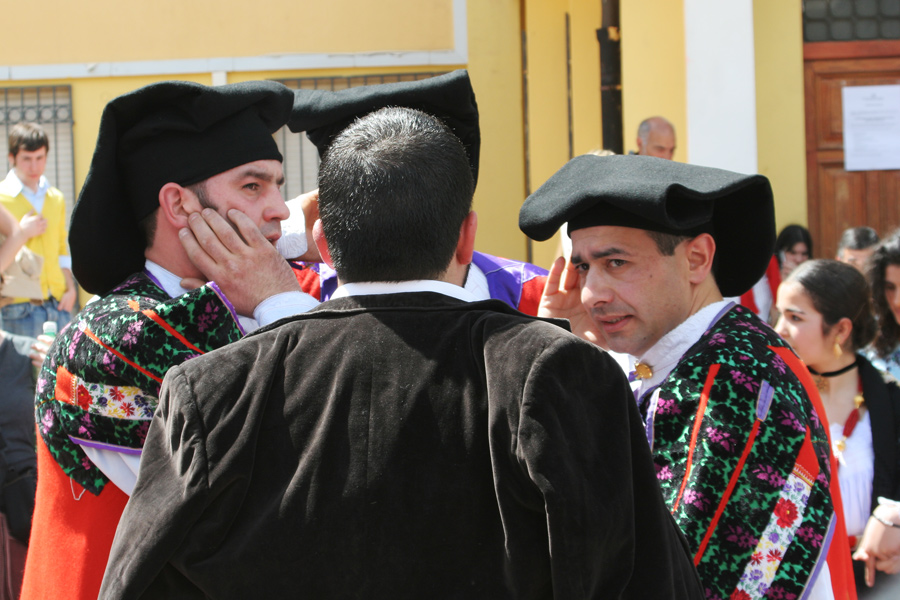
The singing belongs to Sardinia, the island region of Italy, and is strongest in Barbagia, its mountainous centre. Other districts keep related forms under their own names, among them Gallura and Logudoro. Photographs of the singing have been made in the town of Oliena.
What Cantu a tenore means
For the villages that keep it, this singing is a mark of place. A listener can often tell which village a group comes from, which makes the style part of local identity rather than one shared repertoire. The lower voices are heard as the countryside itself: wind, a sheep, a cow, the daily world of shepherds. The solo voice carries poetry about love, history, mockery or protest. UNESCO recognition treats the practice as heritage that lives in people rather than in objects.

Questions people ask about Cantu a tenore
What is cantu a tenore?
It is a Sardinian way of singing in several voices at once, performed by four men who stand in a close circle. One sings the words, the others hold parts around him. The word tenore here names the practice itself, not the voice type called tenor.
Where is it kept?
On Sardinia, the island region of Italy, above all in Barbagia, its mountainous centre. Related ways of singing with their own local names are kept in other districts of the island.
Who sings it today?
Groups of four men perform it today. Women's groups are remembered from the past, and people say they once sang as well. Among the best known are Tenores di Bitti and Tenore de Orosei, along with Tenore di Oniferi and Tenores di Neoneli.
What do the voices sound like?
The top two voices sing plainly. The two lower ones press their voices and use the larynx, which gives a rougher, buzzing tone. Popular tradition hears wind, a bleating sheep and a lowing cow in the lower parts.
Why is it on a UNESCO list?
UNESCO proclaimed cantu a tenore an example of intangible cultural heritage in 2005. It appears on the Representative List as Canto a tenore, Sardinian pastoral songs, with Italy named as the state party.
See also
 LändlerA three-quarter time partner dance from the Alpine region, known for hopping steps and yodeling.
 Christmas carolFestive songs and hymns sung during the Christmas season and door to door
 LipizzanerA gray riding horse breed and centuries-old tradition of classical dressage kept by the Spanish Riding School.
 ChristmasA festival of Jesus's birth, kept on 25 December with gifts, lights and shared meals
Good reading and sources
- Cantu a tenore on WikipediaEncyclopedia
- More photos on Wikimedia CommonsPhotos and video
- Wikidata recordOpen data
The facts on this page come from the Wikipedia article "Cantu a tenore", written by its contributors and used under the CC BY-SA 4.0 licence, and from its Wikidata record (CC0). EveryParampara rewrote the text in its own words, with AI assistance, and compares every page with the article to make sure no passage is copied. It may be reused under the same CC BY-SA 4.0 licence with a link back.
It may contain mistakes. Traditions differ from one family, village and community to the next, and the people who keep them know them best. If something is wrong, tell us. Last refreshed 2026-10-05.
More from Italy
All the traditions of Italy
🇦🇹 Vienna, Austria and 3 moreLändler
A three-quarter time partner dance from the Alpine region, known for hopping steps and yodeling.Performance
🇬🇧 United Kingdom and 5 moreChristmas carol
Festive songs and hymns sung during the Christmas season and door to doorPerformance
🇦🇹 Vienna, Austria and 4 moreLipizzanerLipicanec
A gray riding horse breed and centuries-old tradition of classical dressage kept by the Spanish Riding School.Performance
 🇲🇳 Mongolia and 5 moreThroat singing
Several deep, guttural singing styles, each named and kept by its own peoplePerformance
🇲🇳 Mongolia and 5 moreThroat singing
Several deep, guttural singing styles, each named and kept by its own peoplePerformance
The same idea elsewhere
All of this kind 🇹🇷 Kayseri, Turkey and 4 moreHalay
A traditional line and circle folk dance kept across Turkey, Azerbaijan, Armenia, Iran, and Syria.Performance
🇹🇷 Kayseri, Turkey and 4 moreHalay
A traditional line and circle folk dance kept across Turkey, Azerbaijan, Armenia, Iran, and Syria.Performance
 🇳🇿 Auckland, New ZealandPoi
A Māori performing art of swinging tethered weights in rhythmical patterns.Performance
🇳🇿 Auckland, New ZealandPoi
A Māori performing art of swinging tethered weights in rhythmical patterns.Performance
 🇵🇭 Philippines and 1 morePangalay
A traditional fingernail dance of the Tausūg and Bajau peoples in the Sulu Archipelago and Sabah.Performance
🇵🇭 Philippines and 1 morePangalay
A traditional fingernail dance of the Tausūg and Bajau peoples in the Sulu Archipelago and Sabah.Performance