Music, dance and storytellingEurope
Castell
A Catalan tradition of building multi-level human towers at festivals, requiring strength, balance, and community solida

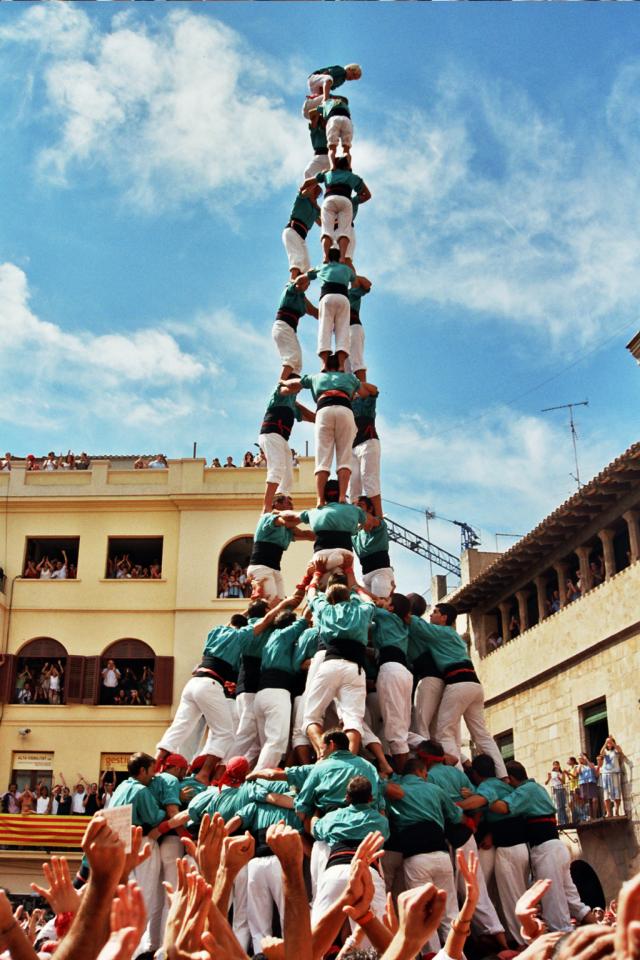
The castell is a human tower built by teams called colles castelleres during festivals in southern Catalonia and the Balearic Islands. Participants stack themselves in tiers to reach heights of up to ten people, then carefully dismantle the structure from the top down. This practice, rooted in 18th-century Valls, was recognized by UNESCO in 2010 as an Intangible Cultural Heritage of Humanity.
When is Castell kept?
Castell is kept during local festivals throughout the year.
The castell is a living tradition where groups of people form intricate human towers at festivals across Catalonia. Teams known as colles castelleres work together to build these structures, which can reach ten levels high, before safely taking them apart. The practice emphasizes physical strength, mental balance, and deep community trust, reflecting core Catalan values of courage and common sense.
Origins and history
The custom began in the town of Valls near Tarragona, with the first records appearing in 1712. It evolved from the Ball dels Valencians, though it draws inspiration from the older Muixeranga tradition in Algemesí. For centuries, the activity remained confined to southern Catalonia. Interest surged in the 1960s and 1970s, leading to wider adoption across the region. A major shift occurred in the 1980s when women joined the formerly male-only discipline. Their inclusion allowed for lighter, stronger towers, enabling the construction of nine- and ten-story structures that were previously impossible.
Building the tower
Teams construct the tower in two distinct phases. First, they form the pinya, a dense base of supporters on the ground that bears the weight and cushions any falls. Once the base is stable, musicians play traditional Toc de Castells music. The upper layers are then added quickly to reduce strain on those below. The highest participant, the enxaneta, climbs to the peak and raises a hand to signal completion. Dismantling follows immediately, starting from the top and moving downward in reverse order until everyone reaches the ground safely.
Attire and safety
Castellers wear white trousers, a black sash called a faixa, and shirts in their team's color. The sash supports the lower back and provides handholds for climbing. They also wear bandanas, often red with white spots, to secure hair and offer extra grip. Performers climb barefoot to improve balance and feel. Safety measures include nearby ambulances and mandatory helmets for children since 2006. Accidents are rare, and the motto guiding participants is 'Strength, balance, courage, and common sense.'
Structure and terminology
Towers are named by the number of people per level and total height, such as a tres de vuit (three people per level, eight levels). The base is usually a pinya, but taller towers may add a folre or manilles for reinforcement. Special techniques include aixecat per sota, where layers are lifted from the ground up. Success is described as descarregat if fully completed and dismantled, or carregat if it falls during disassembly. The phrase fer pinya has entered everyday language to mean coming together in solidarity.
How Castell is kept
Teams called colles gather at festivals to attempt various tower structures. Members form the pinya base, while others climb to create tiers. The enxaneta reaches the top to signal success. The group then dismantles the tower from the highest level down. Participants wear specific attire including colored shirts and sashes. Music accompanies the build and dismantle phases. The practice requires rigorous training and teamwork to ensure safety and structural integrity.
When and where
The tradition takes place during local festivals throughout the year in Catalonia and the Balearic Islands. Dates vary by location and event schedule.
The custom originated in Valls and remains strongest in southern Catalonia. It is now practiced in Barcelona, Tarragona, Vilafranca del Penedès, and other towns. The Balearic Islands also host regular castell events.
What Castell means
The castell embodies the Catalan values of strength, balance, courage, and common sense. It represents community solidarity, as seen in the phrase fer pinya. The structure relies on trust between members, with each person supporting those above and relying on those below. It is a celebration of collective effort and cultural identity.


Questions people ask about Castell
When is Castell kept?
Castell is kept during local festivals throughout the year.
What is a castell?
A castell is a human tower built by teams called colles castelleres during festivals in Catalonia. Participants stack themselves in tiers to reach heights of up to ten people, then carefully dismantle the structure from the top down.
Where is this tradition kept?
The castell originates in Valls, Spain, and is primarily practiced in southern Catalonia and the Balearic Islands. It has spread to other parts of Catalonia and is performed at local festivals throughout the region.
How tall can a castell be?
Towers can reach up to ten levels high. The tallest recorded structure is the 4 de 10, featuring four people per level across ten stories. Taller towers often require additional base support like a folre or manilles.
What does the term fer pinya mean?
Fer pinya literally means making a pinecone, referring to the dense base of the tower. In everyday Catalan, it describes people coming together in solidarity to accomplish a shared goal or task.
See also
 HalloweenAn annual observance on 31 October marking the eve of All Saints' Day, rooted in Christian tradition and Celtic heritage
 Our Lady of GuadalupeA Marian apparition to Juan Diego in Mexico City in December 1531, celebrated on December 12.
 TapasSmall Spanish snacks or appetizers served hot or cold, often shared among friends.
Good reading and sources
- Young girl dies after fall from nine-storey human towerThe Guardian, Article
- Human towersUNESCO, Heritage listing
- Close-Up: Catalonia's human towersBBC, Article
- Young girl dies after fall from nine-storey human towerThe Guardian, Article
- Human towersUNESCO, Article
- Close-Up: Catalonia's human towersBBC, Article
- Castell on WikipediaEncyclopedia
- More photos on Wikimedia CommonsPhotos and video
- Wikidata recordOpen data
The facts on this page come from the Wikipedia article "Castell", written by its contributors and used under the CC BY-SA 4.0 licence, and from its Wikidata record (CC0). EveryParampara rewrote the text in its own words, with AI assistance, and compares every page with the article to make sure no passage is copied. It may be reused under the same CC BY-SA 4.0 licence with a link back.
It may contain mistakes. Traditions differ from one family, village and community to the next, and the people who keep them know them best. If something is wrong, tell us. Last refreshed 2026-10-04.
More from Spain
All the traditions of Spain 🇲🇦 Morocco and 5 moreAndalusi classical musicطرب أندلسي
A classical suite of vocal and instrumental music shared across North AfricaPerformance
🇲🇦 Morocco and 5 moreAndalusi classical musicطرب أندلسي
A classical suite of vocal and instrumental music shared across North AfricaPerformance
 🇪🇸 Seville, SpainSevillanas
A folk dance and song from Seville, kept at fairs and festivals across Andalusia.Performance
🇪🇸 Granada, SpainCante jondo
A solemn and profound vocal tradition of Andalusian flamenco song.Performance
🇪🇸 Seville, SpainSevillanas
A folk dance and song from Seville, kept at fairs and festivals across Andalusia.Performance
🇪🇸 Granada, SpainCante jondo
A solemn and profound vocal tradition of Andalusian flamenco song.Performance
 🇪🇸 Spain and 1 moreBertsolaritza
Improvised songs sung in Basque, rhymed on the spot at contests and gatheringsPerformance
🇪🇸 Spain and 1 moreBertsolaritza
Improvised songs sung in Basque, rhymed on the spot at contests and gatheringsPerformance
The same idea elsewhere
All of this kind 🇹🇷 Kayseri, Turkey and 4 moreHalay
A traditional line and circle folk dance kept across Turkey, Azerbaijan, Armenia, Iran, and Syria.Performance
🇹🇷 Kayseri, Turkey and 4 moreHalay
A traditional line and circle folk dance kept across Turkey, Azerbaijan, Armenia, Iran, and Syria.Performance
 🇳🇿 Auckland, New ZealandPoi
A Māori performing art of swinging tethered weights in rhythmical patterns.Performance
🇳🇿 Auckland, New ZealandPoi
A Māori performing art of swinging tethered weights in rhythmical patterns.Performance
 🇵🇭 Philippines and 1 morePangalay
A traditional fingernail dance of the Tausūg and Bajau peoples in the Sulu Archipelago and Sabah.Performance
🇵🇭 Philippines and 1 morePangalay
A traditional fingernail dance of the Tausūg and Bajau peoples in the Sulu Archipelago and Sabah.Performance