Festivals and celebrationsSouth AsiaHinduIndigenous and traditional
Indra Jatra
In its own language: Yenyā Punhi
An eight-day street festival in Nepal featuring masked dances, chariot processions, and sacred pole ceremonies.

Indra Jatra is a major religious festival held annually in the Kathmandu Valley of Nepal. It honors Indra, the king of heaven, for bringing rain and ensuring a prosperous harvest. The celebration includes masked dances, chariot processions, and rituals to remember deceased family members.
When is Indra Jatra kept?
Indra Jatra is kept on annually during the eleventh month of the Nepal Sambat calendar, lasting eight days from the full moon to the dark fortnight..
Indra Jatra is an annual street festival in Nepal that honors Indra, the king of heaven. People celebrate to thank him for rain and a good harvest. The event features masked dances, chariot processions, and rituals to honor ancestors. It is a living tradition kept by the Newar community in the Kathmandu Valley.
Origins and history
King Gunakamadeva started this festival in the tenth century to mark the founding of Kathmandu city. It has grown into the largest religious street festival in the region. The Kumari Jatra part began later in the mid-eighteenth century under King Jaya Prakash Malla. The dates change every year because they follow the lunar Nepal Era calendar. The celebration lasts for eight days, starting on the twelfth day of the bright fortnight and ending on the fourth day of the dark fortnight.
Ceremonies and processions
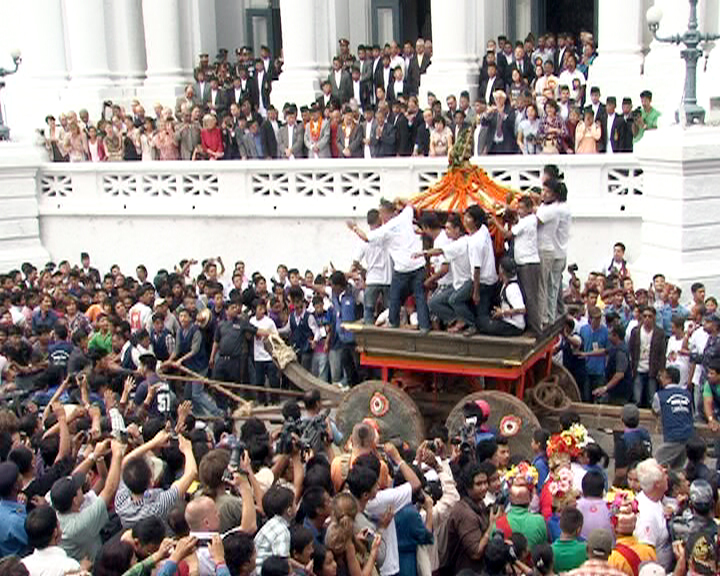
The festival begins with the erection of a Yosin pole at Kathmandu Durbar Square. Men drag this bark-stripped tree from a nearby forest through the streets. Participants also perform Upaku Wanegu, offering butter lamps to honor family members who died in the past year. A key event is the Kumari Jatra, where three large chariots carrying representations of deities are pulled through the city over three days. Women now pull one of these chariots on the final day.
Dances and masks
Masked dancers perform throughout the eight days to entertain crowds and control them before chariot parades. Pulu Kisi, believed to carry Indra, runs through streets knocking into people playfully. Majipā Lākhey, a demon figure, performs agile movements in market squares. Other groups include Sawa Bhakku, who wear blue and red masks, and Dee Pyākhan, which features various gods and goddesses. These performances create a festive mood across the historic city.
Local variations
While Kathmandu hosts the main events, other cities observe their own versions. In Bhaktapur, the focus shifts to Yama Dyaḥ, poles representing the deity of death, which are worshipped for protection. Locals also carry Yamata sky lamps made of bamboo. One day features Indrayani Jātrā, where her image is carried to a historic pond for illumination with oil lamps. Patan and Khokana also hold smaller ceremonies with unique local customs and processions.
How Indra Jatra is kept
People in the Kathmandu Valley participate by watching and joining processions. The festival starts with dragging a sacred pole to Durbar Square. Families offer butter lamps to remember the dead. Three large chariots are pulled through the streets by musicians and participants. Masked dancers perform in squares and alleys, interacting with the crowd. In Bhaktapur, locals erect different poles and carry sky lamps. The events continue for eight days, moving through specific routes in each city.
When and where
It falls annually during the eleventh month of the Nepal Sambat calendar. The exact dates shift each year based on the lunar cycle. The festival spans eight days, beginning on the twelfth day of the bright fortnight and concluding on the fourth day of the dark fortnight.
The main site is Kathmandu Durbar Square in Nepal. The festival is unique to the Kathmandu Valley. It is also observed in Bhaktapur and Patan, though with distinct local traditions. Smaller ceremonies occur in places like Khokana.
What Indra Jatra means
The festival thanks Indra for rain and a successful harvest. It marks the start of two great Hindu festivals. The butter lamps honor ancestors and show respect to relatives. The Yosin pole represents Indra's banner. The chariots carry divine figures through the community. The dances bring joy and help manage crowds during the busy celebrations.



Questions people ask about Indra Jatra
When is Indra Jatra kept?
Indra Jatra is kept on annually during the eleventh month of the Nepal Sambat calendar, lasting eight days from the full moon to the dark fortnight..
What is Indra Jatra?
It is the largest religious street festival in Nepal, held in the Kathmandu Valley. It honors Indra, the king of heaven, for rain and harvest. The event includes masked dances, chariot processions, and ancestor rituals.
Where does it take place?
The main celebration is in Kathmandu Durbar Square. It is unique to the Kathmandu Valley. Other cities like Bhaktapur and Patan also hold their own versions with different local customs and processions.
Who keeps this tradition?
The Newar community in Nepal keeps this tradition. Both Hindus and Buddhists in the region participate. The festival was started by King Gunakamadeva in the tenth century to commemorate the founding of Kathmandu.
See also
 DiwaliA five-day festival of lights celebrated across India and its diaspora to mark the victory of light over darkness.
 HoliA spring festival of colours and bonfires that marks the end of winter and the triumph of good over evil.
 NavaratriA nine-night Hindu festival honoring the goddess Durga and her nine forms through prayer, fasting, and dance.
 Buddha's BirthdayA festival marking the birth of Siddhartha Gautama, observed across Asia with temple rituals and community gatherings.
Good reading and sources
- Indra Jatra on WikipediaEncyclopedia
- More photos on Wikimedia CommonsPhotos and video
- Wikidata recordOpen data
The facts on this page come from the Wikipedia article "Indra Jatra", written by its contributors and used under the CC BY-SA 4.0 licence, and from its Wikidata record (CC0). EveryParampara rewrote the text in its own words, with AI assistance, and compares every page with the article to make sure no passage is copied. It may be reused under the same CC BY-SA 4.0 licence with a link back.
It may contain mistakes. Traditions differ from one family, village and community to the next, and the people who keep them know them best. If something is wrong, tell us. Last refreshed 2026-10-04.
More from Nepal
All the traditions of Nepal
🇮🇳 Ayodhya, India and 7 moreDiwaliदीपावली (Dīpāvalī)
A five-day festival of lights celebrated across India and its diaspora to mark the victory of light over darkness.Festival · Feasts and festival meals
🇮🇳 Mathura, India and 5 moreHoliहोली (Hindi)
A spring festival of colours and bonfires that marks the end of winter and the triumph of good over evil.Festival
🇮🇳 Kolkata, India and 5 moreNavaratriनवरात्रि (Navarātri)
A nine-night Hindu festival honoring the goddess Durga and her nine forms through prayer, fasting, and dance.Festival · Fasting and breaking the fast
 🇮🇳 India and 3 moreMaha Shivaratriमहाशिवरात्रि
A Hindu night of fasting and vigil dedicated to Shiva, marking his divine union with Parvati.Festival
🇮🇳 India and 3 moreMaha Shivaratriमहाशिवरात्रि
A Hindu night of fasting and vigil dedicated to Shiva, marking his divine union with Parvati.Festival
The same idea elsewhere
Remembering the ancestors compared 🇮🇱 Jerusalem, IsraelSukkotסוכות
A seven-day autumn Jewish festival of temporary booths, harvest prayers and hospitalitySpiritual
🇮🇱 Jerusalem, IsraelSukkotסוכות
A seven-day autumn Jewish festival of temporary booths, harvest prayers and hospitalitySpiritual
 🇵🇪 Cusco, Peru and 4 moreIntiinti (Quechua)
The Inca sun deity, honoured with temples, offerings and the June festival Inti RaymiSpiritual
🇵🇪 Cusco, Peru and 4 moreIntiinti (Quechua)
The Inca sun deity, honoured with temples, offerings and the June festival Inti RaymiSpiritual
 🇮🇪 Ireland and 2 moreJack-o'-lantern
A carved pumpkin lantern lit with a candle to brighten and protect Halloween nightsFolklore
🇮🇪 Ireland and 2 moreJack-o'-lantern
A carved pumpkin lantern lit with a candle to brighten and protect Halloween nightsFolklore
 🇹🇱 Timor-LesteUma Lulik
Sacred ancestral clan houses and ritual shrines in East TimorSpiritual
🇹🇱 Timor-LesteUma Lulik
Sacred ancestral clan houses and ritual shrines in East TimorSpiritual