Knucklebones
An ancient hand game of tossing, catching, and scooping small bones or stones

Knucklebones is a traditional game of dexterity played across the world using small animal bones, pebbles, or metal pieces. Players toss one token into the air while scooping up others from the ground before catching the falling piece.
Knucklebones is an ancient game of coordination played across many cultures. Players toss one or more tokens into the air and must gather or manipulate other pieces on the ground before making the catch. Traditionally played with sheep ankle bones, pebbles, or cloth bags, the pastime tests hand speed, rhythm, and steady concentration.
Origins and early history
Excavations show that people played with animal ankle bones, known as astragali, as early as 5000 BCE. Because sheep and goat ankle bones land on four distinct sides, early players also used them for gambling and fortune-telling. Ancient writers recorded different legends about its birth. Plato noted a story giving credit to the Egyptian god Thoth, while Herodotus wrote that people in Lydia created the game during a severe famine. In ancient Greece and Rome, both children and adults played, sometimes tossing bones into holes or wagering on the numeric scores assigned to each uneven face.
How the game is played
While rules vary widely across regions, the basic game relies on quick hand movements. A player tosses a single object, called a jack or mother stone, into the air. Before that piece falls back down or a ball bounces, the player must pick up one or more pieces from the playing surface using the same hand. Rounds usually advance in difficulty, starting with picking up single items, then pairs, until all must be scooped at once. Another common challenge involves throwing pieces upward and catching them cleanly on the back of the hand.
Regional traditions
Distinct variations thrive across several continents. In Mongolia and across Central Asia, players use sheep bones called shagai for team contests, musical instruments, and divination. In parts of East Asia like China and Korea, children play with small pebbles or sewn cloth bags filled with rice and beans. Across the Pacific and Southeast Asia, such as in the Philippines and Polynesia, players toss a leader stone while gathering smaller pebbles or large seeds. In Israel, children throw small metal cubes, keeping the action airborne without letting pieces bounce.
Materials and objects
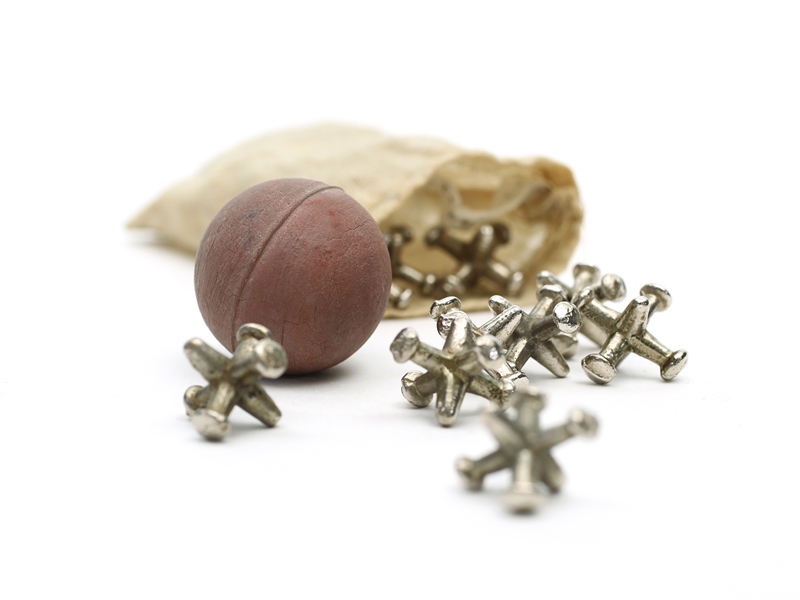
Traditional sets made use of what was naturally available in the local landscape. Pastoral communities favored the talus bones of sheep, goats, or calves, while coastal groups gathered smooth beach pebbles, cowrie shells, or flat circular seeds. In modern times, manufactured jacks consist of six-pointed pieces molded from metal or plastic, often paired with a small rubber ball. Cloth pouches filled with grains or azuki beans, known as ojami in Japan, provide a softer alternative for tossing and catching routines.
How Knucklebones is kept
Players gather around a flat surface, placing a group of small pieces on the ground. One player throws a primary piece into the air. While it remains airborne, the player quickly collects one or more resting pieces with the same hand and catches the descending token. The rounds progress through stages of increasing difficulty, requiring players to pick up larger clusters or perform extra hand tricks before catching. A turn ends if a player drops a piece or touches an illegal token.
When and where
Knucklebones is played year-round as an informal pastime and social contest, though some Central Asian communities feature it prominently during cultural festivals and public gatherings.
The game is played worldwide across Europe, Central Asia, East Asia, South Asia, the Middle East, and the Pacific Islands. It remains especially prominent as a traditional pastime in Central Asian countries such as Mongolia, as well as throughout Southeast Asia and the Pacific.
What Knucklebones means
In ancient cultures and Central Asian pastoral life, animal ankle bones held spiritual and divinatory significance beyond casual play. The four distinct sides of the bone represented domestic animals like horses, sheep, goats, and camels, connecting the game to pastoral wealth, luck, and fate.



Questions people ask about Knucklebones
What is knucklebones?
Knucklebones is a traditional dexterity game where players toss a token into the air and scoop up other pieces from the surface before catching the falling item.
What objects are used to play knucklebones?
Historically, players used sheep or goat ankle bones, smooth pebbles, shells, or bean bags. Modern sets often use six-pointed metal or plastic jacks and a small ball.
Where did the game originate?
The exact origin is unknown, though animal ankle bones date back to around 5000 BCE in excavations. Ancient Greek and Roman texts record legends attributing it to Lydia or Egypt.
How do players win knucklebones?
A player wins by successfully completing a series of increasingly difficult throwing, scooping, and catching challenges without dropping pieces or failing a catch.
See also
 Ancient Olympic GamesA quadrennial athletic festival held in ancient Greece to honor the god Zeus
 ShagaiTraditional ankle bone games and fortune-telling played across Central Asia.
 Hunting with eaglesThe Central Asian tradition of hunting foxes and hares from horseback with golden eagles.
 DreidelA four-sided top spun for small stakes, most often by Jewish families at Hanukkah
Good reading and sources
- Encyclopaedia BritannicaArticle
- Mongolian knuckle-bone shootingUNESCO, Heritage listing
- Mongolian knuckle-bone shootingUNESCO, Article
- Knucklebones on WikipediaEncyclopedia
- More photos on Wikimedia CommonsPhotos and video
- Wikidata recordOpen data
The facts on this page come from the Wikipedia article "Knucklebones", written by its contributors and used under the CC BY-SA 4.0 licence, and from its Wikidata record (CC0). EveryParampara rewrote the text in its own words, with AI assistance, and compares every page with the article to make sure no passage is copied. It may be reused under the same CC BY-SA 4.0 licence with a link back.
It may contain mistakes. Traditions differ from one family, village and community to the next, and the people who keep them know them best. If something is wrong, tell us. Last refreshed 2026-10-05.
More from Greece
All the traditions of Greece 🇹🇷 Edirne, Turkey and 3 moreOil wrestlingYağlı güreş
Oiled wrestlers in leather trousers: Turkey's national sport, centred on KırkpınarGame
🇬🇷 Olympia, GreeceAncient Olympic Gamesτὰ Ὀλύμπια
A quadrennial athletic festival held in ancient Greece to honor the god ZeusGame
🇹🇷 Edirne, Turkey and 3 moreOil wrestlingYağlı güreş
Oiled wrestlers in leather trousers: Turkey's national sport, centred on KırkpınarGame
🇬🇷 Olympia, GreeceAncient Olympic Gamesτὰ Ὀλύμπια
A quadrennial athletic festival held in ancient Greece to honor the god ZeusGame
 🇬🇷 Olympia, GreeceHeraean Games
An ancient Greek festival of running races for unmarried young women at OlympiaGame
🇬🇷 Olympia, GreeceHeraean Games
An ancient Greek festival of running races for unmarried young women at OlympiaGame
 🇬🇷 Greece and 5 moreHandshake
A brief clasp of hands to greet, part or seal a deal, with local rules on how it is doneEtiquette
🇬🇷 Greece and 5 moreHandshake
A brief clasp of hands to greet, part or seal a deal, with local rules on how it is doneEtiquette
The same idea elsewhere
All of this kind 🇺🇸 Fairbanks, United States and 2 moreWorld Eskimo-Indian Olympics
An annual Arctic gathering of traditional survival games, athletics, and cultural artsGame
🇺🇸 Fairbanks, United States and 2 moreWorld Eskimo-Indian Olympics
An annual Arctic gathering of traditional survival games, athletics, and cultural artsGame
 🇲🇽 MexicoRarájipari
A traditional endurance running ball game of the Rarámuri people in northern MexicoGame
🇲🇽 MexicoRarájipari
A traditional endurance running ball game of the Rarámuri people in northern MexicoGame
 🇰🇬 Cholpon-Ata, Kyrgyzstan and 2 moreWorld Nomad GamesДүйнөлүк көчмөндөр оюндары
A two-yearly contest of Central Asian nomadic sports, first staged in Kyrgyzstan in 2014Game
🇰🇬 Cholpon-Ata, Kyrgyzstan and 2 moreWorld Nomad GamesДүйнөлүк көчмөндөр оюндары
A two-yearly contest of Central Asian nomadic sports, first staged in Kyrgyzstan in 2014Game
 🇲🇽 Veracruz, Mexico and 3 moreMesoamerican ballgameōllamalīztli
An ancient Mesoamerican ball game, struck with the hips on stone courtsGame
🇲🇽 Veracruz, Mexico and 3 moreMesoamerican ballgameōllamalīztli
An ancient Mesoamerican ball game, struck with the hips on stone courtsGame