Games, sport and playMiddle EastMuslim
Oil wrestling
In its own language: Yağlı güreş
Oiled wrestlers in leather trousers: Turkey's national sport, centred on Kırkpınar

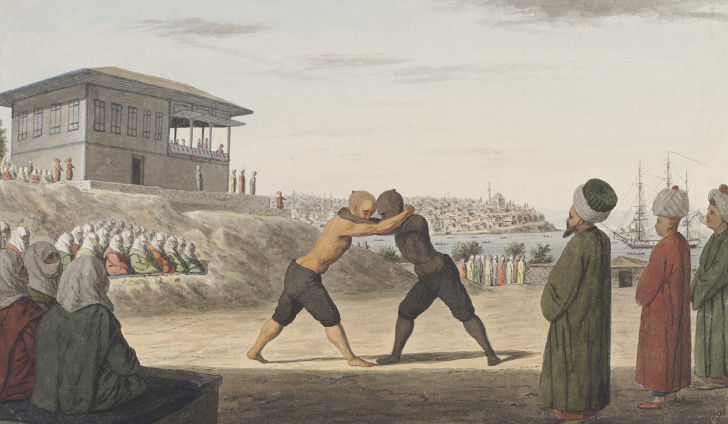
Oil wrestling, or yağlı güreş, is the national sport of Turkey. Men greased with oil, wearing only the kıspet, a leather garment below the knee, try to throw one another. The form grew out of karakucak wrestling after the Seljuk conquest, and it is kept today at the Kırkpınar tournament in Edirne and at festivals in Turkey, Bulgaria and northern Greece.
When is Oil wrestling kept?
Oil wrestling is kept on three days in early summer for the Kırkpınar tournament, with other bouts across the year.
Oil wrestling is Turkey's national sport. Two men stripped to the waist, their bodies slicked with oil, grip each other's leather trousers and try to bring each other down. The wrestlers are called pehlivans, and the biggest of them carry the title başpehlivan. Beyond the contest, oiling each other and the opening peşrev ritual carry meanings of respect, prayer and comradeship.
What it is
Oil wrestling is a grappling sport in which both men grease themselves before the bout begins. Each competitor wears a kıspet, a loose leather garment that stops below the knee, and nothing above the waist. Because the bodies are slippery, ordinary holds are difficult, and the leather trousers become a target. The sport is described as Turkey's national game, and its rules sit close to karakucak, another wrestling style from the same part of the world. The men who take part are called pehlivans.
Origins and history
Old records place wrestling with oiled bodies in several ancient lands. Practices like it are traced to Sumer and Babylon, and to Assyria and Egypt. It was also popular among the ancient Greeks and Romans. During the First Achaemenid conquest of Egypt the custom reached Iran and Anatolia, and communities in Thrace and the Balkans were wrestling this way some 4,500 years ago. Related folk styles live on among Turkic-speaking peoples across Western Eurasia, where they are known as Köraş, Khuresh and Kurash.
The Kırkpınar tournament
Ottoman-era Anatolia had its own freestyle wrestling, karakucak, and wrestlers there wore leather and poured olive oil on their skin; that practice turned into yağlı güreş. Training took place in tekke, houses that were athletic and spiritual at once. The chief gathering is Kırkpınar, at Edirne in Turkish Thrace. Sources date its start to 1346, and Ottoman chronicles and papers show it running every year from 1362. Guinness counts it the oldest sanctioned sporting competition that has never stopped, though it has been cancelled around seventy times and moved to its current site in 1924. Roughly a thousand wrestlers meet there each early summer.
How matches are won
A wrestler is beaten when his opponent puts his back on the ground, which the tradition describes as showing the belly to the stars. Sitting up propped on both hands also loses, as does touching the ground with two elbows or with an elbow and a hand. If the kıspet is pulled down and a man is exposed, he is out. Victory comes from lifting the rival and carrying him three paces, or turning him about. Matches had no fixed length until 1975; now the başpehlivan class is allowed forty minutes and the pehlivan class thirty, with extra time and points if needed. The champion earns the title başpehlivan, and three straight wins bring a golden belt.
Peşrev and the kıspet
Before the wrestling itself comes peşrev, an opening that is warm-up, prayer and theatre in one. The men line up, the previous winner on the right, turn towards the Kıbla, and join hands, right in right and left in left, while a cazgır prays aloud. Those linked hands say that each is more than a brother to the other. The kıspet takes its name from the Arabic kiswa by way of Persian, and follows the modesty rule for Muslim men, covering from the belt to below the knee. Until the 1960s it was buffalo hide and weighed twelve or thirteen kilos; now it is calfskin, around two kilos. Wrestlers oil each other before the bout as a sign of balance and mutual respect.
How Oil wrestling is kept
Pehlivans from many towns gather for a festival. They help one another grease up, then line up for peşrev, the opening ritual that combines prayer with warm-up. The previous year's winner takes the right-hand place in the line. Fights follow, governed by the sport's own rules about how a man can be brought down. When a bout goes the full time without a result, extra minutes and scoring settle it. At the close of the tournament the winner is proclaimed başpehlivan, and prizes are given out, including a golden belt for three wins in a row.
When and where
Kırkpınar falls in early summer and lasts three days at Edirne. The sources date the games from 1346, and Ottoman documents record them running every year from 1362. Wrestlers also compete at other festivals in Turkey at other points in the year. The last man standing at Kırkpınar becomes başpehlivan for that year.
The sport's home is Turkey, where it is the national game, and it is strongest at Edirne in Turkish Thrace. Festivals also run in the Turkish-inhabited parts of Bulgaria, in the Ludogorie and the Rhodopes, and in northern Greece, around Serres in Eastern Macedonia and in the Rhodope Mountains of West Thrace. The Netherlands has competitions overseen by its own power sport federation.
What Oil wrestling means
Oil wrestling carries meanings beyond the result. The peşrev is described as prayer as much as preparation, and the joined hands speak of a brotherhood of a special kind, each man standing in for Ali and Selim, whom the tradition holds to be the founders of Kırkpınar. Oiling a rival is done as a display of balance and mutual respect. In the Ottoman tekke, the mat and the prayer room shared one house, so body and spirit were trained together. A younger wrestler who beats an older one kisses his hand, the familiar Turkish mark of respect for an elder.


Questions people ask about Oil wrestling
When is Oil wrestling kept?
Oil wrestling is kept on three days in early summer for the Kırkpınar tournament, with other bouts across the year.
What is oil wrestling?
It is a grappling sport and the national game of Turkey. The two wrestlers, called pehlivans, cover themselves in oil and wear only a kıspet, a leather garment reaching below the knee. They try to throw each other, and the champion of the biggest meeting carries the title başpehlivan.
Where and when is it kept?
Its heart is Turkey, above all the Kırkpınar tournament at Edirne in Turkish Thrace, which runs for three days in early summer. Bouts happen in other Turkish towns at other times of year. Festivals are also held among Turkish communities in Bulgaria and northern Greece.
Why are the wrestlers oiled?
Oil is poured on before a bout, and the men do it for one another. The sources describe this as a display of balance and mutual respect between rivals. It also makes the skin too slippery for ordinary holds, so the leather trousers become the main way to control an opponent.
How is a match won or lost?
A man loses if his opponent puts his back on the ground, if he sits propped on both hands, or if an elbow or both elbows touch the ground. Victory comes by lifting the other man and carrying him three steps or spinning him. Time limits now decide bouts that go the distance, with points used if needed.
See also
 World Nomad GamesA two-yearly contest of Central Asian nomadic sports, first staged in Kyrgyzstan in 2014
 KurashCentral Asian traditional upright folk wrestling using cloth belts or towels
 JereedRiders on horseback throw blunt wooden javelins at rivals in this Turkish team sportKırkpınarA three-day Turkish oil wrestling contest near Edirne, held each June since 1360
Good reading and sources
- Oil wrestling on WikipediaEncyclopedia
- More photos on Wikimedia CommonsPhotos and video
- Wikidata recordOpen data
The facts on this page come from the Wikipedia article "Oil wrestling", written by its contributors and used under the CC BY-SA 4.0 licence, and from its Wikidata record (CC0). EveryParampara rewrote the text in its own words, with AI assistance, and compares every page with the article to make sure no passage is copied. It may be reused under the same CC BY-SA 4.0 licence with a link back.
It may contain mistakes. Traditions differ from one family, village and community to the next, and the people who keep them know them best. If something is wrong, tell us. Last refreshed 2026-10-05.
More from Turkey
All the traditions of Turkey
🇰🇬 Cholpon-Ata, Kyrgyzstan and 2 moreWorld Nomad GamesДүйнөлүк көчмөндөр оюндары
A two-yearly contest of Central Asian nomadic sports, first staged in Kyrgyzstan in 2014Game
🇺🇿 Uzbekistan and 5 moreKurashкөрәш
Central Asian traditional upright folk wrestling using cloth belts or towelsGame
🇹🇷 Edirne, TurkeyKırkpınar
A three-day Turkish oil wrestling contest near Edirne, held each June since 1360Game
🇹🇷 Erzurum, TurkeyJereedCirit
Riders on horseback throw blunt wooden javelins at rivals in this Turkish team sportGame
The same idea elsewhere
All of this kind 🇺🇸 Fairbanks, United States and 2 moreWorld Eskimo-Indian Olympics
An annual Arctic gathering of traditional survival games, athletics, and cultural artsGame
🇺🇸 Fairbanks, United States and 2 moreWorld Eskimo-Indian Olympics
An annual Arctic gathering of traditional survival games, athletics, and cultural artsGame
 🇨🇭 Aproz, Switzerland and 2 moreCombat de Reines
An annual Swiss pushing contest where Hérens cows compete for herd dominanceGame
🇨🇭 Aproz, Switzerland and 2 moreCombat de Reines
An annual Swiss pushing contest where Hérens cows compete for herd dominanceGame
 🇲🇽 MexicoRarájipari
A traditional endurance running ball game of the Rarámuri people in northern MexicoGame
🇲🇽 MexicoRarájipari
A traditional endurance running ball game of the Rarámuri people in northern MexicoGame
 🇸🇪 Mora, SwedenVasaloppet
A 90 km cross-country ski race from Sälen to Mora, run every March since 1922Game
🇸🇪 Mora, SwedenVasaloppet
A 90 km cross-country ski race from Sälen to Mora, run every March since 1922Game