Life-cycle ritesSouth AsiaMuslim
Pakistani wedding
In its own language: پاکستانی شادی
Weddings across Pakistan: a match is found, a contract signed, two families joined

In Pakistan a wedding is usually arranged with family help, and it joins two households as much as two people. Most couples marry under Islamic law, and the celebrations run from a proposal and an engagement to the nikah contract and the walima reception, with local customs varying by region.
When is Pakistani wedding kept?
Pakistani wedding is kept on a date the families choose, at any time of year.
In Pakistan, a marriage is normally arranged with relatives playing a part, and the wedding joins two families as much as two people. The path runs from a search for a suitable match, through a proposal and an engagement, to the nikah contract and the walima reception. Most couples marry under Islamic law, while the celebrations take on the colour of each region.
Finding a match
In most Pakistani families the search for a husband or wife is the opening step of the whole process. Men and women past twenty are generally thought ready for it. Relatives, friends or a go-between often make the introduction, and in the classic arranged match the two may barely know each other before the wedding. A newer pattern lets a couple meet and talk for months or years first; if they agree, the man's family then forwards a proposal. A third path, marriage by the couple's own choice, is uncommon, because it sets aside the consent of the family.
Proposal and engagement
When the man's side is ready, its representatives call on the woman's family. In an arranged match this first visit is only a chance to get acquainted, and both sides then decide whether to meet again. If they agree to a second meeting, the man's parents and elders come to the bride's house and ask, on his behalf, for the marriage to go ahead. Once the answer is yes, drinks and snacks are served, and the bride may receive jewellery and other presents; some families recite Surah Al-Fatihah. Then comes the engagement, known as nisbat, mangni or habar bandi. Rings are exchanged, prayers are said, and a wedding date is fixed.
Nikah and walima
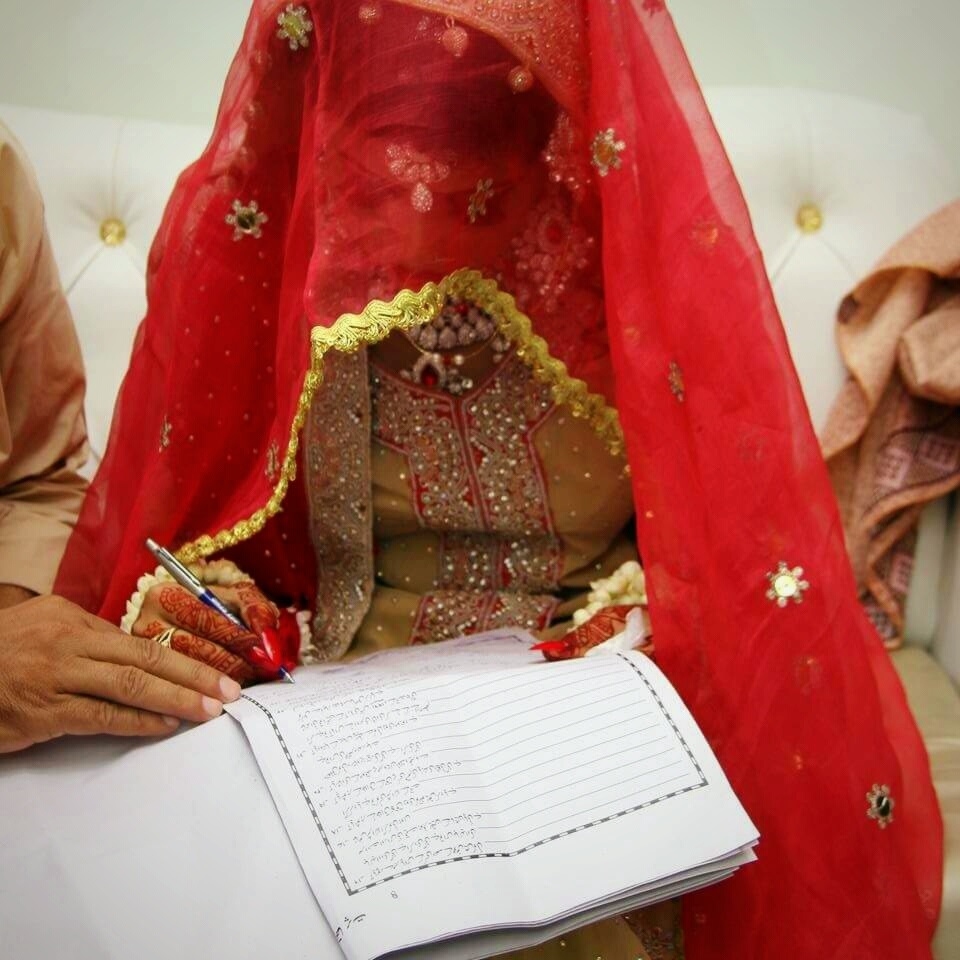
A Pakistani wedding turns on two events. The nikah is the marriage itself: bride and groom sign the nikahnama, the contract, before close family. A religious scholar licensed by the government conducts it, and each side must have two witnesses so that everyone can see the consent is freely given. After that, or on a later day, the couple holds the walima, the reception that announces the marriage to the wider world. Relatives and guests from both families are invited in large numbers. Weddings once took place at home; today halls, restaurants and hotels are common, and printed shadi cards announce the date.
Regional variations
Customs change with place and community. Baloch weddings are famously grand and quick, often over in a day or two; the groom is the saloonk and the bride the banoor. A red scarf and gifts are given when a proposal is accepted, and women of both houses write the guest list. Henna is painted on the bride's hands while friends and family lay money on a plate called the leth; afterwards there is a mahfil, a gathering with food and the men's Chaap dance. Pashtun weddings follow Pashtunwali, and the Attan dance closes them. Punjabi families hold a dholki night of singing before the wedding, and the bride returns to her parents for a while after it.
Law and change
Marriage in Pakistan sits inside a legal framework as well as a family one. In January 2026 the Supreme Court of Pakistan ruled that a husband who takes a second wife without the first wife's agreement, or without the approval of an Arbitration Council, may face criminal and civil action. The case began with a wife seeking to end her marriage after her husband remarried without her written consent or the council's clearance. The court set aside earlier decisions by the Peshawar High Court and a family court, ordered the husband to pay mahr, and held that a wife's petition cannot be turned into khula against her will.
How Pakistani wedding is kept
The search for a match comes first, usually through relatives or a go-between. A visit follows, then a proposal made by the groom's family at the bride's house, and refreshments once it is accepted. At the engagement, nisbat or mangni, rings are exchanged and the wedding date is set. The nikah comes next: the contract is signed before close family, with two witnesses on each side, and a licensed scholar conducts it. The walima reception makes the union public. Regional ceremonies, such as a dholki night, a henna evening or the Attan dance, sit around these two main events.
When and where
A wedding can be held at any time of year; the families choose the date, often at the engagement. In arranged and semi-arranged matches a year or more may pass between the engagement and the ceremony, since preparations take time.
These customs belong to Pakistan. They are followed by families across the country, with their own forms among Baloch, Pashtun and Punjabi communities, and they travel with Pakistani families who have settled abroad.
What Pakistani wedding means
A marriage here is understood as more than a private bond. It ties two households together, and the families, not only the couple, take part in making it. Consent matters: witnesses are present at the nikah so that both partners can be seen to agree freely. The walima then declares the union openly to relatives, neighbours and friends. For many, the religious contract and the family alliance carry equal weight, which is why a wedding is planned by so many people at once.


Questions people ask about Pakistani wedding
When is Pakistani wedding kept?
Pakistani wedding is kept on a date the families choose, at any time of year.
What is a Pakistani wedding like?
It is a family celebration built around two main events. The nikah is the religious contract, signed by the bride and groom before close relatives with witnesses present. The walima is the reception that follows, where the marriage is announced publicly and both families entertain their guests.
Who arranges the marriage?
Most often relatives do. A family member, a friend or a go-between introduces a possible couple. In the older arranged pattern the two may hardly know each other, though a growing number of couples meet and talk for months before deciding, and then a formal proposal follows.
Where is it kept?
In Pakistan, among families of every region, including Baloch, Pashtun and Punjabi households. Each region adds its own ceremonies. Pakistani communities living abroad also keep the customs, so the same events are held far from home.
Is the bride's agreement needed?
Yes. At the nikah each side brings two witnesses so that the consent of both partners is clear. In January 2026 the Supreme Court of Pakistan also held that a man who marries a second time without his first wife's agreement or an Arbitration Council's approval may face criminal and civil action.
See also
 Persian gardenAn ancient tradition of creating walled, geometric sanctuaries of shade and flowing water
 PhulkariGeometric and floral threadwork embroidered by Punjabi women on handwoven cotton.
 LohriA northern Indian midwinter festival of evening bonfires, folk songs and harvest foods
Good reading and sources
The facts on this page come from the Wikipedia article "Marriage in Pakistan", written by its contributors and used under the CC BY-SA 4.0 licence, and from its Wikidata record (CC0). EveryParampara rewrote the text in its own words, with AI assistance, and compares every page with the article to make sure no passage is copied. It may be reused under the same CC BY-SA 4.0 licence with a link back.
It may contain mistakes. Traditions differ from one family, village and community to the next, and the people who keep them know them best. If something is wrong, tell us. Last refreshed 2026-10-05.
More from Pakistan
All the traditions of Pakistan 🇮🇳 India and 1 moreMayian
A pre-wedding cleansing ritual in Punjabi traditions, using turmeric paste to prepare the couple for marriage.Rite of passage
🇮🇳 India and 1 moreMayian
A pre-wedding cleansing ritual in Punjabi traditions, using turmeric paste to prepare the couple for marriage.Rite of passage
 🇮🇳 India and 1 morePunjabi wedding traditions
The multi-day marriage customs and rituals of Hindu and Sikh Punjabi familiesRite of passage · Sweets given and shared
🇮🇳 India and 1 morePunjabi wedding traditions
The multi-day marriage customs and rituals of Hindu and Sikh Punjabi familiesRite of passage · Sweets given and shared
 🇪🇬 Egypt and 5 moreIslamic marital practices
Islamic wedding customs, from matchmaking and mahr to the nikah contract and walima feast.Rite of passage
🇪🇬 Egypt and 5 moreIslamic marital practices
Islamic wedding customs, from matchmaking and mahr to the nikah contract and walima feast.Rite of passage
 🇨🇳 China and 5 morePostpartum confinement
A period of rest, nourishment, and seclusion for mothers after giving birth.Rite of passage
🇨🇳 China and 5 morePostpartum confinement
A period of rest, nourishment, and seclusion for mothers after giving birth.Rite of passage
The same idea elsewhere
Weddings compared 🇳🇪 In-Gall, NigerCure Salée
A yearly gathering of Tuareg and Wodaabe nomads in In-Gall to mark the end of the rainy season.Festival
🇳🇪 In-Gall, NigerCure Salée
A yearly gathering of Tuareg and Wodaabe nomads in In-Gall to mark the end of the rainy season.Festival
 🇳🇿 Auckland, New ZealandWharenui
A Māori carved communal meeting house at the centre of tribal life in New ZealandHome
🇳🇿 Auckland, New ZealandWharenui
A Māori carved communal meeting house at the centre of tribal life in New ZealandHome
 🇮🇩 Indonesia and 2 moreKenduri
A communal prayer meal and gathering shared across Indonesia, Malaysia and BruneiSpiritual · Feasts and festival meals
🇮🇩 Indonesia and 2 moreKenduri
A communal prayer meal and gathering shared across Indonesia, Malaysia and BruneiSpiritual · Feasts and festival meals
 🇳🇿 New ZealandTivaevaetīvaevae
A traditional Polynesian art of artistic quilting made by women for gifts and ceremonies.Craft
🇳🇿 New ZealandTivaevaetīvaevae
A traditional Polynesian art of artistic quilting made by women for gifts and ceremonies.Craft