Dress and adornmentNorth Africa
Moroccan kaftan
A floor-length tunic worn by Moroccan women for weddings and celebrations, featuring heavy embroidery and rich textiles.

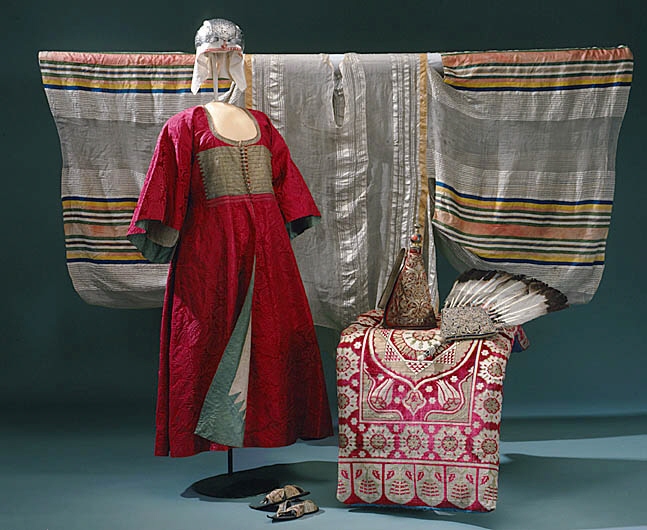
Women in Morocco preserve this ankle-grazing robe for nuptials and major social gatherings. The style emerged around the sixteenth century, drawing on medieval Andalusian aesthetics and later Ottoman court influences brought by rulers who adopted Turkish customs. Artisans craft each piece using luxurious fabrics and precise stitching passed through generations.
When is Moroccan kaftan kept?
Moroccan kaftan is kept at weddings and formal ceremonies.
The Moroccan kaftan stands as a floor-length tunic cherished by women throughout Morocco for weddings and important family events. Crafted from sumptuous textiles and decorated with detailed metallic stitching, the garment blends medieval Andalusian design with Ottoman court styles. Local makers continue to produce these robes, keeping the sewing methods alive within households and bridal preparations.
Historical roots
Accounts from the sixteenth century mark the earliest appearance of the robe in Morocco. Scholars trace the silhouette to the region's medieval past, linking it to the artistic legacy of Al-Andalus. Some researchers suggest the style arrived through the Saadi ruler Abd al-Malik, who spent years abroad and returned wearing Turkish attire while reshaping his government after Ottoman models.
Construction and fabric
Makers select heavy silks, velvets, or brocades to cut the full-length garment. The front opens fully, and sleeves reach the wrists. Artisans apply dense needlework using metallic threads, creating patterns along the neckline, cuffs, and hem. The finished robe hangs straight from the shoulders, offering a dignified drape suitable for formal occasions.
Bridal traditions
Families treat the kaftan as a vital component of a bride's wardrobe. Mothers and grandmothers often hand down sewing knowledge to younger women, ensuring the techniques survive. Young brides may receive multiple versions of the robe, some reserved for the ceremony and others for reception festivities, showcasing the skill of local embroiderers.
How Moroccan kaftan is kept
Women wear the kaftan during nuptial processions and celebratory meals. Elders teach girls how to cut the cloth and apply thread work, preserving the craft inside homes. The garment serves as a marker of status and cultural pride, worn proudly at public gatherings and private parties alike.
When and where
On wedding days and during seasonal festivals
Across Morocco, particularly in urban centers where tailoring workshops thrive
What Moroccan kaftan means
The robe represents feminine dignity and connection to ancestral artistry. The richness of the fabric and the density of the stitching signal the wearer's family standing. Passing the sewing skills between generations honors the women who crafted the garments before.


Questions people ask about Moroccan kaftan
When is Moroccan kaftan kept?
Moroccan kaftan is kept at weddings and formal ceremonies.
What is the Moroccan kaftan?
It is a long, open-front tunic worn by women in Morocco. The robe reaches the ankles and features elaborate stitching made with metallic threads. Families keep the tradition alive for weddings and formal events.
How did the style develop?
Records show the robe existed by the sixteenth century. Designers combined older Andalusian shapes with Turkish elements introduced by a ruler who adopted Ottoman clothing and administrative practices.
See also
 DjellabaA long, loose hooded robe worn by men and women across North AfricaChaabiA North African music and dance tradition meaning 'of the people', played at weddings and festivals.
 Tan-Tan MoussemAn annual gathering of Saharan nomadic tribes with music, trading and equestrian arts
 NegafaThe woman who dresses a bride and guards the customs of a Moroccan wedding
Good reading and sources
- Moroccan Caftan: art, traditions and skillsUNESCO, Heritage listing
- Moroccan Caftan: art, traditions and skillsUNESCO, Article
- Kaftan on WikipediaEncyclopedia
- More photos on Wikimedia CommonsPhotos and video
- Wikidata recordOpen data
The facts on this page come from the Wikipedia article "Kaftan", written by its contributors and used under the CC BY-SA 4.0 licence, and from its Wikidata record (CC0). EveryParampara rewrote the text in its own words, with AI assistance, and compares every page with the article to make sure no passage is copied. It may be reused under the same CC BY-SA 4.0 licence with a link back.
It may contain mistakes. Traditions differ from one family, village and community to the next, and the people who keep them know them best. If something is wrong, tell us. Last refreshed 2026-10-05.
More from Morocco
All the traditions of Morocco
🇲🇦 Morocco and 1 moreDjellabaجلابة
A long, loose hooded robe worn by men and women across North AfricaDress
 🇪🇸 Valencia, Spain and 1 moreZaragüellessarāwīl (Andalusi Arabic), saragüells (Valencian)
Wide, pleated breeches of Andalusian origin, worn as traditional dress in parts of Spain and Morocco.Dress
🇪🇸 Valencia, Spain and 1 moreZaragüellessarāwīl (Andalusi Arabic), saragüells (Valencian)
Wide, pleated breeches of Andalusian origin, worn as traditional dress in parts of Spain and Morocco.Dress
 🇹🇷 Turkey and 3 moreYashmakyaşmak
A traditional face and head veil worn in Turkey, Egypt and TurkmenistanDress
🇲🇦 Tan-Tan, MoroccoTan-Tan Moussem
An annual gathering of Saharan nomadic tribes with music, trading and equestrian artsFestival
🇹🇷 Turkey and 3 moreYashmakyaşmak
A traditional face and head veil worn in Turkey, Egypt and TurkmenistanDress
🇲🇦 Tan-Tan, MoroccoTan-Tan Moussem
An annual gathering of Saharan nomadic tribes with music, trading and equestrian artsFestival
The same idea elsewhere
Weddings compared 🇼🇸 Samoa and 1 moreʻIe tōga
Precious woven mats exchanged in Samoan ceremonies to honor family ties and chiefly status.Dress
🇼🇸 Samoa and 1 moreʻIe tōga
Precious woven mats exchanged in Samoan ceremonies to honor family ties and chiefly status.Dress
 🇹🇱 Timor-LesteUma Lulik
Sacred ancestral clan houses and ritual shrines in East TimorSpiritual
🇹🇱 Timor-LesteUma Lulik
Sacred ancestral clan houses and ritual shrines in East TimorSpiritual
 🇮🇩 Indonesia and 2 moreKenduri
A communal prayer meal and gathering shared across Indonesia, Malaysia and BruneiSpiritual · Feasts and festival meals
🇺🇬 UgandaKwanjula
A formal marriage introduction ritual of the Baganda people in Uganda, where families meet to exchange gifts and seek blRite of passage
🇮🇩 Indonesia and 2 moreKenduri
A communal prayer meal and gathering shared across Indonesia, Malaysia and BruneiSpiritual · Feasts and festival meals
🇺🇬 UgandaKwanjula
A formal marriage introduction ritual of the Baganda people in Uganda, where families meet to exchange gifts and seek blRite of passage