Crafts and makingLatin America and the Caribbean
Ñandutí
Paraguayan needle lace named for a spider's web, worked in thread and cut free

Ñandutí is a needle lace from Paraguay, worked in cotton or silk thread. Its Guaraní name points to a spider's web, and the lace resembles one. Lacemakers stretch cloth on a frame, trace a design onto it, fill circles with radiating stitches and cut the backing away. Asunción is closely tied to the craft.
Ñandutí is a lace made by hand in Paraguay, built up with a needle and fine thread. Its name comes from the Guaraní language and points to a spider's web, which is what the finished circles of thread resemble. Lacemakers stretch cloth on a frame, draw their design, work the pattern in thread and then cut the cloth away so only the lace remains.
What it is
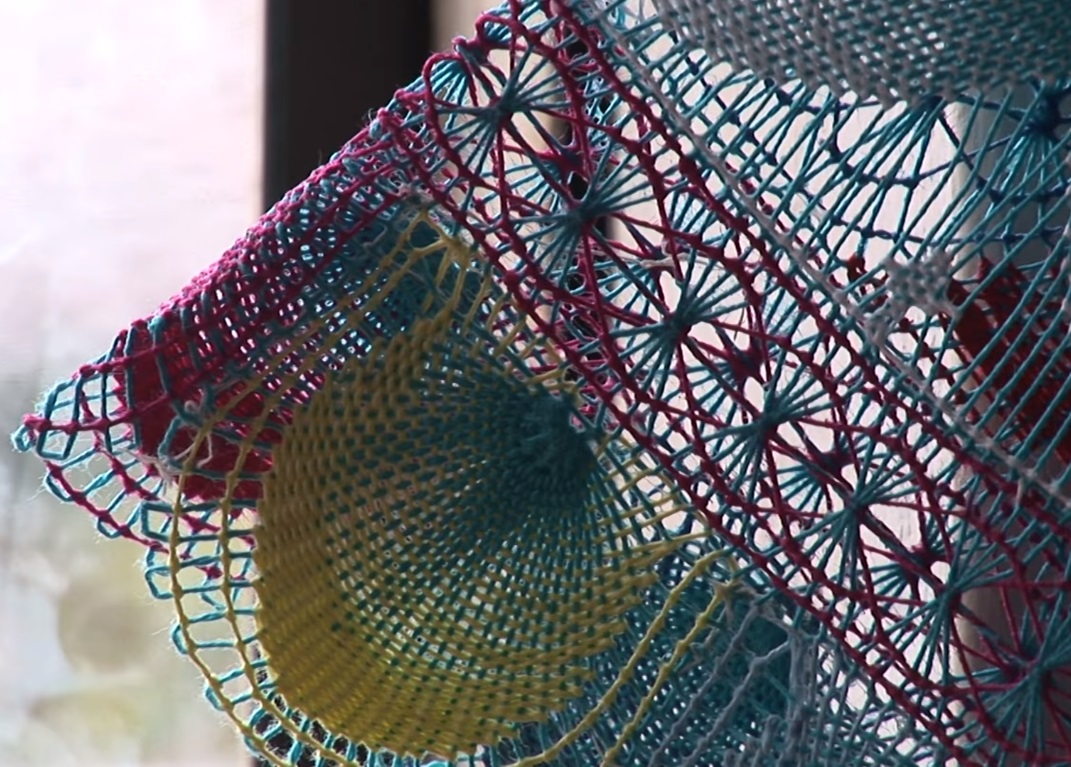
Ñandutí is a lace, a fabric of open patterns made from thread rather than woven on a loom. Paraguayan makers work it in cotton or silk, using a needle rather than bobbins. The finished lace is built from circles, squares and rectangles, each roughly two inches, or five centimetres, across, and each crossed by lines of thread that spread out from the middle like the spokes of a wheel. That radiating structure is the mark people recognise first. Because the thread is not woven into cloth, the pieces are light and see-through, and they can be joined into larger mats or shaped for a collar.
The name and books
The word ñandutí comes from Guaraní, a language of Paraguay that is official there and Indigenous, and it names the spider's web. The likeness is easy to see in the finished work, where fine threads run out from a centre as a spider's lines run out from a hub. A book by Annick Sanjurjo, published in 1978, calls the lace the flower in the spider's web. Gustavo González had written about it in Asunción in 1967. Asunción, the capital, is the city most often linked with the craft.
Setting up the frame
The maker begins with a frame. It is quadrangular, square or rectangular, and its four sides are tied together at the corners with twine. A piece of ordinary fabric is then stretched across it, also with twine, and pulled tight so that the needlework has something firm to sit on. Her design is first drawn on paper. That paper goes under the stretched cloth, and she traces the outline onto the fabric above it, so the circles she plans to fill show through. Everything that follows is worked with a needle and thread, with the cloth as a temporary floor.
Building a motif
With the design showing through the cloth, the maker starts the warp, which she calls the armaje, of the first disc. She makes a stitch at the top of the circle and one at the bottom, on the diameter, and works clockwise until somewhere between 120 and 150 rays cross the disc. Two rounds of darning stitch then lock those rays together at the middle, the part called the apyte. From here she may form a single flower or a star, or divide the warp into three roughly equal parts. Concentric circles, made in a knot stitch known as fillet, follow. Her motifs, the dechados, are set across the middle third using only two stitches: darning, or the woven stitch, and fillet.
Cutting the lace free
When the discs are ornamented, the needle stage ends. The maker turns the frame around so the back of the work faces her, and takes up the scissors. She cuts the supporting fabric in the spaces between the stitches that hold each disc's rays, working around every circle's outline with the point of the blade, and lifts out the small remaining pieces of cloth. The rim of the whole piece is spared, so there is always an edge to hold. A single motif can be freed this way, but it is more common to make a whole mat or collar at once, linking the circles as the rays are laid down.
How Ñandutí is kept
The people who keep ñandutí are Paraguay's lacemakers, and the accounts describe them as women working at home or in workshops. A square frame is tied at its corners, cloth is stretched over it, and a traced design guides the work. The maker lays down the rays of one disc with her needle, knots them at the centre, patterns the middle third, and rings the rim. Disc after disc follows, either singly or joined into one large piece. Finally she turns the frame, cuts the cloth away between the stitches and pulls out the scraps, leaving the lace to stand on its own.
When and where
Ñandutí belongs to Paraguay, where it is made and worn as a traditional lace. Asunción, the capital, is the city named most often in connection with it: the captions that accompany images of the work place it there. The craft is Paraguayan rather than tied to any one town, and the sources describe its makers simply as Paraguayan.
What Ñandutí means
The name carries the meaning. In Guaraní, ñandutí refers to a spider's web, and the lace repeats that shape: threads radiate from a middle point and cross the open spaces between. Annick Sanjurjo's book on the craft, published in 1978, uses the phrase the flower in the spider's web, which sets a blossom inside the web of thread. Makers also keep their own words for the parts: apyte for the centre of a disc, dechados for the decorative motifs.


Questions people ask about Ñandutí
What is ñandutí?
It is a traditional lace from Paraguay, made by hand with a needle and cotton or silk thread. The work is built from circles, squares and rectangles of radiating thread, usually about five centimetres across, and the cloth it is stitched onto is cut away at the end.
Where is it made?
In Paraguay. Asunción, the capital, is the city most often named in connection with the lace, and the sources describe the people who make it simply as Paraguayan lacemakers.
Why is it called ñandutí?
The word belongs to Guaraní, an official and Indigenous language of Paraguay, and it means spider's web. The finished lace has threads running out from a centre, which gives it that likeness.
What is the lace used for?
The sources mention mats and collars. A single motif can be finished on its own, but it is more usual to work a whole item as one piece, with the discs linked together while the rays are laid down.
What does a lacemaker work with?
A quadrangular frame tied at the corners with twine, cloth stretched over it, and a needle and thread. A design drawn on paper is slipped under the cloth and traced onto it before the stitching starts. Scissors come at the end, to cut the lace free from its backing.
See also
 Paraguayan harpParaguay's national harp, strung with 32 to 46 strings and plucked with long fingernails
 Bark paintingOchre pictures on flattened tree bark, an Aboriginal art form of northern Australia
 BatokIndigenous Filipino tattooing, once worn as dress, rank and a rite of passage
 KhatamA Persian inlay craft that builds geometric patterns from thousands of tiny cut pieces
Good reading and sources
The facts on this page come from the Wikipedia article "Ñandutí", written by its contributors and used under the CC BY-SA 4.0 licence, and from its Wikidata record (CC0). EveryParampara rewrote the text in its own words, with AI assistance, and compares every page with the article to make sure no passage is copied. It may be reused under the same CC BY-SA 4.0 licence with a link back.
It may contain mistakes. Traditions differ from one family, village and community to the next, and the people who keep them know them best. If something is wrong, tell us. Last refreshed 2026-10-05.
More from Paraguay
All the traditions of Paraguay
🇵🇾 ParaguayParaguayan harp
Paraguay's national harp, strung with 32 to 46 strings and plucked with long fingernailsPerformance
 🇺🇾 Montevideo, Uruguay and 4 morePayada
Improvised ten-line verses traded by guitar-playing payadores in the Río de la PlataPerformance
🇺🇾 Montevideo, Uruguay and 4 morePayada
Improvised ten-line verses traded by guitar-playing payadores in the Río de la PlataPerformance
 🇦🇷 Argentina and 4 moreAsado
A slow fire, a grill and a shared table: how people gather to cook and eat meatTable custom · Feasts and festival meals
🇦🇷 Argentina and 4 moreAsado
A slow fire, a grill and a shared table: how people gather to cook and eat meatTable custom · Feasts and festival meals
 🇵🇾 Paraguay and 3 moreTereré
Paraguay's cold yerba mate drink, passed around in one cup with a metal strawTable custom · Tea, coffee and drinking ceremonies
🇵🇾 Paraguay and 3 moreTereré
Paraguay's cold yerba mate drink, passed around in one cup with a metal strawTable custom · Tea, coffee and drinking ceremonies
The same idea elsewhere
All of this kind
🇮🇷 Shiraz, Iran and 1 moreKhatamخاتم
A Persian inlay craft that builds geometric patterns from thousands of tiny cut piecesCraft
 🇮🇪 Galway, Ireland and 1 moreBrigid's crossCros Bhríde
A cross of woven rushes or straw, made for Saint Brigid's Day on the first of FebruaryCraft
🇦🇺 AustraliaBark painting
Ochre pictures on flattened tree bark, an Aboriginal art form of northern AustraliaCraft
🇮🇪 Galway, Ireland and 1 moreBrigid's crossCros Bhríde
A cross of woven rushes or straw, made for Saint Brigid's Day on the first of FebruaryCraft
🇦🇺 AustraliaBark painting
Ochre pictures on flattened tree bark, an Aboriginal art form of northern AustraliaCraft
 🇺🇸 United States and 1 moreDreamcatcherᐊᓴᐱᑫᔒᓐᐦ (asabikeshiinh)
A hand-woven hoop from Anishinaabe tradition, hung above a cradle to protect a childCraft
🇺🇸 United States and 1 moreDreamcatcherᐊᓴᐱᑫᔒᓐᐦ (asabikeshiinh)
A hand-woven hoop from Anishinaabe tradition, hung above a cradle to protect a childCraft