Pavlovo Posad shawl
In its own language: Павловопосадский платок
A woolen Russian shawl printed with flowers, made in the town of Pavlovsky Posad

The Pavlovo Posad shawl is a traditional Russian woolen shawl and handicraft, printed with floral patterns, most often roses, usually on a black ground. It has been made in the town of Pavlovsky Posad in the Moscow Oblast since the middle of the 19th century, after woolen shawls became fashionable in Russia early in that century.
The Pavlovo Posad shawl is a woolen wrap with printed flowers, made in the Russian town of Pavlovsky Posad. Woolen shawls became fashionable in Russia at the start of the 19th century, and this town has been the home of the style since the middle of that century. The shawls are still worn in Russia and in neighbouring countries.
What it is
The Pavlovo Posad shawl is a woolen wrap, described in the sources as a traditional Russian garment and a handicraft. Its ground is usually black. Over that ground sit floral ornaments mixing large and small shapes, and roses are the motif used most. English writing gives other names for the same thing, such as Pavlovsky shawl and Povlovo Posad scarf, and the Russian name is Павловопосадский платок. The shawl takes its name from the small town where it is made, Pavlovsky Posad, in the Moscow Oblast. The sources also use the word scarf for it.
Origins and history
Woolen shawls came into fashion in Russia at the beginning of the 19th century. The first shawls of this kind were made in Pavlovsky Posad, a small town in the Moscow Oblast, from the middle of that century. That is the history the sources give: a fashion for wool wraps, then a town that took up the work and kept the name. No founder, workshop or single designer is named. Nothing is said about how the patterns were first drawn or who drew them, so the origin of the ornament itself stays unrecorded in the material.
Pattern and colour
Two features stand out in the design, according to the sources. One is the ground colour. Black is the usual base. Red has always been the colour used most on these shawls, and in Russian culture red carries the meaning of beautiful, which is often given as the reason for it. The other is the ornament. Large and small flowers are combined on one cloth, with roses leading the pattern. The sources add that Oriental and Turkish ornaments were also popular on the scarves at some times. The exact arrangement of the pattern is not described.
Today and change
These shawls still enjoy great popularity in Russia and in the countries around it, according to the article. The material describes them as both a garment and a handicraft, so the same object is something worn and something made by hand in a named place. Because the sources do not give dates for later changes, nothing can be said here about new colours, new sizes or new ways of making them. What comes through is continuity: a town, a woolen wrap, flowers on a dark ground, and people who keep choosing it.
How Pavlovo Posad shawl is kept
Woolen shawls entered Russian wardrobes as a fashion at the start of the 19th century, and Pavlovsky Posad began making them in the middle of that century. A shawl is worn over the shoulders as a wrap, and the design is what marks it out: a black ground, usually, with flowers printed across it, roses above all, and red the colour used most. Oriental and Turkish ornaments have also been popular on these scarves. The sources name no wearers and describe no steps or ceremony, only an object made in one town and worn well beyond it.
When and where
Pavlovsky Posad, a small town in the Moscow Oblast of Russia, is the place tied to these shawls and gives them their name. They are still popular in Russia and in the countries around it, according to the article. That is as far as the sources go: the town as the home of the work, and Russia together with its neighbours as the places where the shawls are worn.
What Pavlovo Posad shawl means
Red is the colour used most on the shawls, and in Russian culture red carries the meaning of beautiful. That link is the one piece of meaning the sources give. The flowers, roses especially, are described as ornament rather than explained, and the mixture of large and small blooms is presented as a matter of composition. So what the shawl means, as far as the material shows, lies in its colour and in the craft of a named town.

Questions people ask about Pavlovo Posad shawl
What is a Pavlovo Posad shawl?
It is a woolen shawl and a traditional Russian handicraft, printed with flowers, most often roses, on a ground that is usually black. English sources also call it a Pavlovsky shawl or a Povlovo Posad scarf, and the Russian name is Павловопосадский платок.
When did these shawls first appear?
Woolen shawls became fashionable in Russia at the beginning of the 19th century. The first shawls of this kind were produced in the middle of that century in the town of Pavlovsky Posad. The sources give no earlier date for the pattern or for the craft.
Where are they made and worn?
They are made in Pavlovsky Posad, a small town in the Moscow Oblast of Russia, and the town gives the shawl its name. They remain popular in Russia and in the countries around it, so the craft belongs to one place while the shawls are worn far beyond it.
What do the shawls look like?
The ground is normally black. Flowers cover it in a mix of large and small ornaments, with roses used most often. Red is the colour these shawls have always favoured, and Oriental and Turkish ornaments have also been popular on them at various times.
See also
 GáktiA traditional coat worn by the Sámi people across northern Scandinavia and Russia, signaling origin and status through c
 RushnykA sacred embroidered cloth used in East Slavic rituals, weddings and daily life.
 Traditional tattooingThe ancient custom of marking the skin for protection, healing, status and sacred rites
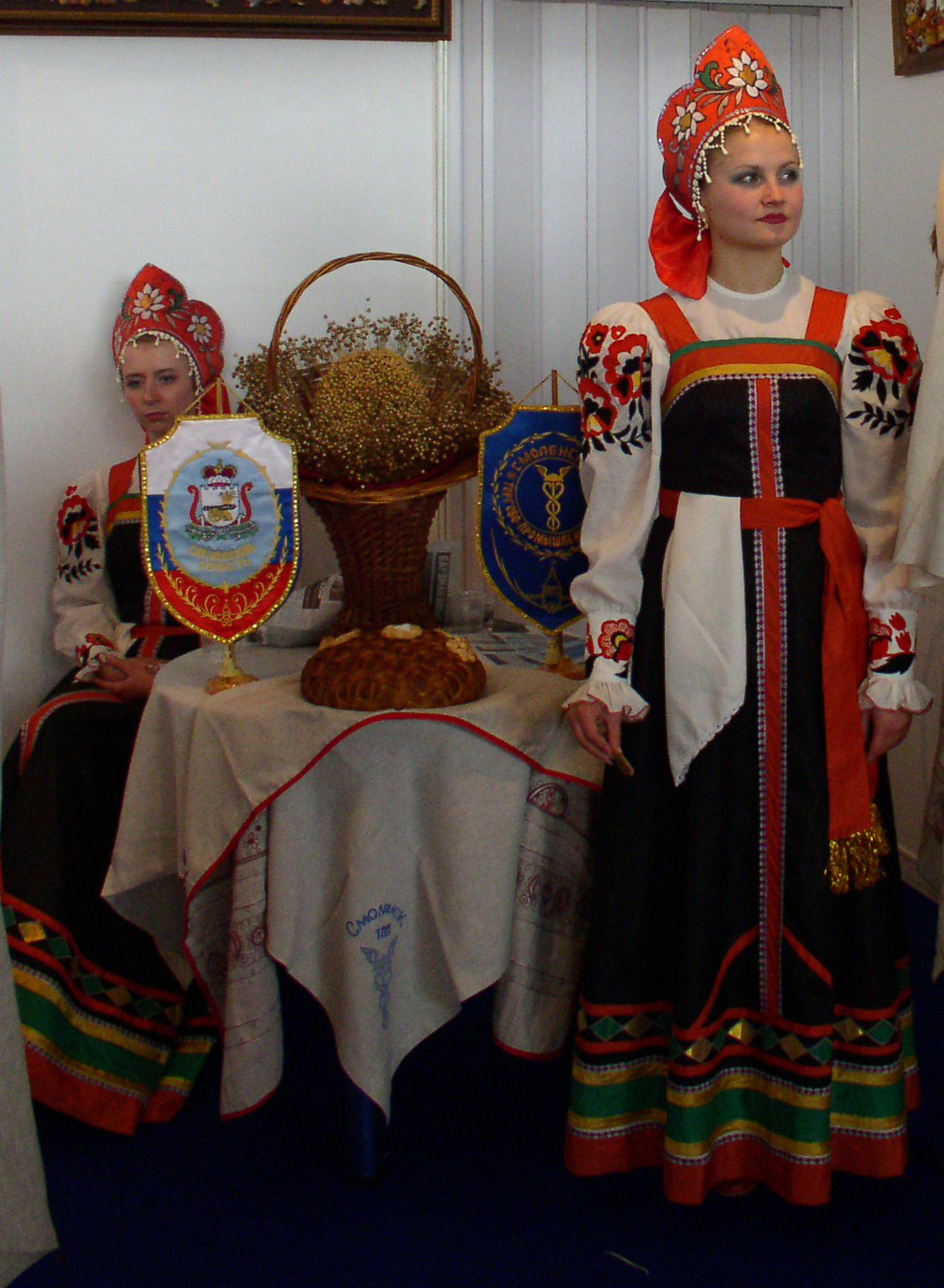 SarafanA long, flared Russian dress, the everyday wear of peasant women for centuries
Good reading and sources
- Pavlovo Posad shawl on WikipediaEncyclopedia
- More photos on Wikimedia CommonsPhotos and video
- Wikidata recordOpen data
The facts on this page come from the Wikipedia article "Pavlovo Posad shawl", written by its contributors and used under the CC BY-SA 4.0 licence, and from its Wikidata record (CC0). EveryParampara rewrote the text in its own words, with AI assistance, and compares every page with the article to make sure no passage is copied. It may be reused under the same CC BY-SA 4.0 licence with a link back.
It may contain mistakes. Traditions differ from one family, village and community to the next, and the people who keep them know them best. If something is wrong, tell us. Last refreshed 2026-10-05.
More from Russia
All the traditions of Russia
🇺🇦 Ukraine and 2 moreRushnykрушник
A sacred embroidered cloth used in East Slavic rituals, weddings and daily life.Dress
🇳🇴 Norway and 3 moreGákti
A traditional coat worn by the Sámi people across northern Scandinavia and Russia, signaling origin and status through cDress
🇪🇬 Egypt and 5 moreTraditional tattooing
The ancient custom of marking the skin for protection, healing, status and sacred ritesDress
 🇬🇪 Georgia and 5 moreChokha
A high-collared wool coat of the Caucasus, worn by men for battle and ceremonyDress
🇬🇪 Georgia and 5 moreChokha
A high-collared wool coat of the Caucasus, worn by men for battle and ceremonyDress
The same idea elsewhere
All of this kind 🇮🇳 Paithan, IndiaPaithani
A handwoven silk sari from Maharashtra, with a squared border and a peacock palluDress
🇮🇳 Paithan, IndiaPaithani
A handwoven silk sari from Maharashtra, with a squared border and a peacock palluDress
 🇮🇱 Israel and 1 moreTzitzitצִיצִית
Knotted ritual fringes worn on a four-cornered garment, a reminder of the commandmentsDress
🇮🇱 Israel and 1 moreTzitzitצִיצִית
Knotted ritual fringes worn on a four-cornered garment, a reminder of the commandmentsDress
 🇼🇸 Samoa and 1 moreʻIe tōga
Precious woven mats exchanged in Samoan ceremonies to honor family ties and chiefly status.Dress
🇼🇸 Samoa and 1 moreʻIe tōga
Precious woven mats exchanged in Samoan ceremonies to honor family ties and chiefly status.Dress
 🇱🇸 LesothoMokorotlo
A conical straw hat that serves as the national symbol of Lesotho and a key element of Basotho traditional dress.Dress
🇱🇸 LesothoMokorotlo
A conical straw hat that serves as the national symbol of Lesotho and a key element of Basotho traditional dress.Dress