Life-cycle ritesEuropeChristianSecular and civic
Russian wedding traditions
A Russian wedding runs two days to a week, with ransom games, crowns and toasts

Russian weddings are multi-day celebrations, usually lasting between two days and a week, with feasting, singing, toasts and dancing. Families in Russia keep them, and the shape of the day varies from region to region, bringing together an Orthodox crowning, a civil registration and a tour of the city.
When is Russian wedding traditions kept?
Russian wedding traditions is kept on usually two days to a week; the church service falls on the first morning and the civil registration comes after it..
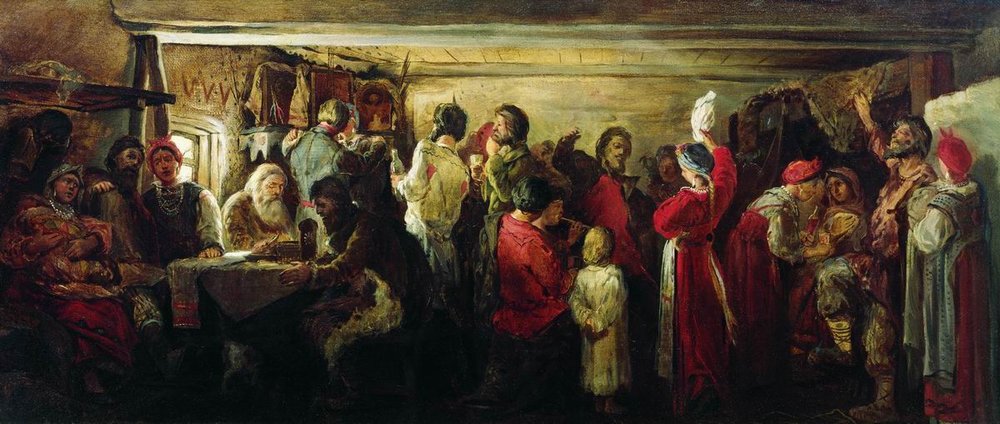
Russian wedding traditions are the ways families in Russia mark a marriage, and they usually stretch over two days or as much as a week. A couple may be crowned in an Orthodox church, register their marriage at a state office, and then tour the city with their witnesses before a long reception of toasts, songs and games.
What it is
Russian weddings are family events that run longer than a single day, often two days and sometimes a full week. Dancing, singing, speeches and a large meal fill the time. The couple's attendants are not called best man and bridesmaid but witnesses, or svideteli in Russian. The ring exchange and the main ceremony belong to the first day. Regional practice differs, so no two weddings look quite the same, yet certain customs appear again and again. Some couples have taken on customs from Western weddings as well, such as giving maids of honour a place in the wedding party.
Ransom and betrothal
The groom's arrival at the bride's house begins with a game. He brings money or jewellery as an opening offer, and the family answers by bringing out someone else, veiled so the face cannot be seen. When he realises the trick he asks for his bride, and the family asks for a larger sum. Once they are content, the real bride comes out. The church service has two parts, the Betrothal and the Crowning, and married friends may be asked to carry the rings, the wife placing one on the bride before her husband does the same for the groom.
Crowning in church
The priest meets the couple at the church door, blesses them and gives each a lit candle. A deacon leads a litany for them, the rings are blessed and put on their right hands, and the priest prays over the Betrothal, recalling Bible passages about rings. Moving to the centre of the church, the couple stand on new rose-coloured cloth and state aloud that they marry freely and are promised to nobody else. Crowns go on their heads. After readings from the Epistle and Gospel they share a cup of wine, or grape juice, and the priest wraps his stole around their joined hands to lead them three times around a lectern where the Gospel Book lies.
Civil registration
The civil part comes after the church. The couple go to a state office, the ZAGS department of public services, for a ceremony called rospis' v zagse. Relatives meet them with bread and salt, and the whole thing lasts fifteen to thirty minutes: rings are exchanged and the pair are declared husband and wife. In some regions parents give them two crystal glasses to break, and each shard stands for a year of marriage. Outside, they release balloons or, more often, two white doves. The bride sends up one more balloon with the name she is giving up.
City tour and reception
Once the papers are signed, the newlyweds and their witnesses often drive around the city, visiting historical places, with close friends sometimes joining them. This is when most of the wedding photographs are taken. A doll is tied to the car, and people believe it gathers up the good wishes of everyone who sees it; afterwards the couple wash it and keep it for luck. The reception follows. The first toast is raised to the newlyweds, then guests shout Gorko, which means bitter. The newlyweds answer with a kiss. A second toast honours the parents, and the couple open the dancing. A tamada, or entertainer, runs the games and keeps guests talking to each other.
How Russian wedding traditions is kept
Things start at the bride's home, where the groom offers money or jewellery and is shown a veiled stand-in before the real bride appears. An Orthodox couple then go to church for candles, the blessing of the rings, the crowns, the readings, the shared cup and the walk around the lectern. The state office comes next, with bread and salt from the family and sometimes glasses to break. The couple and their witnesses tour the city, then meet guests for toasts, the first dance and the tamada's games. Feasting continues for several days.
When and where
There is no fixed date in the year. The church service, when the couple choose one, is held in the morning after the Divine Liturgy, and the rings are blessed on the altar during that liturgy. The civil registration follows, then the drive around the city, then the evening reception with its toasts and dancing. Eating and drinking carry on for several days after that.
Russian weddings are kept across Russia, and customs differ from one region to another. The church crowning belongs to Eastern Orthodox practice. The civil registration takes place at a state office, the ZAGS department of public services, where relatives wait with bread and salt. The city tour passes historical sites, which is where most wedding photographs are taken.
What Russian wedding traditions means
For Orthodox couples the crown, not the ring, is the sign of the marriage, and the service is called the Mystery of Crowning. Standing on new rose-coloured cloth marks a new life. Walking three times around the lectern where the Gospel Book rests pictures married life as a pilgrimage. Doves released outside stand for love and partnership, the broken glasses are read as years together, and the balloon carrying the bride's maiden name is a farewell to it.



Questions people ask about Russian wedding traditions
When is Russian wedding traditions kept?
Russian wedding traditions is kept on usually two days to a week; the church service falls on the first morning and the civil registration comes after it..
What is a Russian wedding like?
A couple may be crowned in an Orthodox church, register the marriage at a state office, drive around the city with their witnesses, and then meet guests for a reception of toasts, songs, dancing and games. Regional customs differ, and some couples add practices borrowed from Western weddings.
How long do the celebrations last?
Anywhere from two days to a week. The church ceremony and the ring exchange fall on the first day, the civil registration and the city tour come after, and the reception runs into the evening. Families keep eating, drinking and celebrating for several more days.
Why do guests shout Gorko?
The word means bitter. Guests call it out after the first toast to the newlyweds, and the pair reply with a kiss, which is taken as the sweet answer to the bitter drink in their glasses. A second toast, to the parents, follows.
Who are the witnesses?
The couple's attendants are called witnesses, or svideteli. During the church service they may hold the crowns above the heads of the bride and groom. They also join the drive around the city and stand with the couple through the day.
Where do the ceremonies take place?
Orthodox couples often marry in a church, and every couple registers the marriage at a state office, the ZAGS department of public services. Photographs are usually taken during a tour of historical places in the town or city, and the reception follows afterwards.
See also
 SamovarA heated urn that brews tea for a slow, sociable pour, from Russia to Iran and Kashmir
 Housewarming partyA gathering held soon after moving into a new home to celebrate the space and welcome guests.
 RushnykA sacred embroidered cloth used in East Slavic rituals, weddings and daily life.
 Tsagaan SarThe Mongolian Lunar New Year festival of peace, elders, white foods and renewal
Good reading and sources
- Russian wedding traditions on WikipediaEncyclopedia
- More photos on Wikimedia CommonsPhotos and video
- Wikidata recordOpen data
The facts on this page come from the Wikipedia article "Russian wedding traditions", written by its contributors and used under the CC BY-SA 4.0 licence, and from its Wikidata record (CC0). EveryParampara rewrote the text in its own words, with AI assistance, and compares every page with the article to make sure no passage is copied. It may be reused under the same CC BY-SA 4.0 licence with a link back.
It may contain mistakes. Traditions differ from one family, village and community to the next, and the people who keep them know them best. If something is wrong, tell us. Last refreshed 2026-10-05.
More from Russia
All the traditions of Russia 🇷🇺 RussiaOctobering
A short-lived Soviet naming rite that put the Red Star in place of the baptismal crossRite of passage
🇺🇦 Ukraine and 2 moreRushnykрушник
A sacred embroidered cloth used in East Slavic rituals, weddings and daily life.Dress
🇷🇺 Russia and 4 moreHousewarming party
A gathering held soon after moving into a new home to celebrate the space and welcome guests.Home
🇷🇺 RussiaOctobering
A short-lived Soviet naming rite that put the Red Star in place of the baptismal crossRite of passage
🇺🇦 Ukraine and 2 moreRushnykрушник
A sacred embroidered cloth used in East Slavic rituals, weddings and daily life.Dress
🇷🇺 Russia and 4 moreHousewarming party
A gathering held soon after moving into a new home to celebrate the space and welcome guests.Home
The same idea elsewhere
Weddings compared 🇳🇿 Auckland, New ZealandWharenui
A Māori carved communal meeting house at the centre of tribal life in New ZealandHome
🇳🇿 Auckland, New ZealandWharenui
A Māori carved communal meeting house at the centre of tribal life in New ZealandHome
 🇳🇪 In-Gall, NigerCure Salée
A yearly gathering of Tuareg and Wodaabe nomads in In-Gall to mark the end of the rainy season.Festival
🇳🇪 In-Gall, NigerCure Salée
A yearly gathering of Tuareg and Wodaabe nomads in In-Gall to mark the end of the rainy season.Festival
 🇮🇩 Indonesia and 2 moreKenduri
A communal prayer meal and gathering shared across Indonesia, Malaysia and BruneiSpiritual · Feasts and festival meals
🇮🇩 Indonesia and 2 moreKenduri
A communal prayer meal and gathering shared across Indonesia, Malaysia and BruneiSpiritual · Feasts and festival meals
 🇳🇿 New ZealandTivaevaetīvaevae
A traditional Polynesian art of artistic quilting made by women for gifts and ceremonies.Craft
🇳🇿 New ZealandTivaevaetīvaevae
A traditional Polynesian art of artistic quilting made by women for gifts and ceremonies.Craft