Spiritual and religiousEuropeChristian
Botafumeiro
A giant swinging censer of brass and silver that fills the Santiago de Compostela Cathedral with incense during solemn f

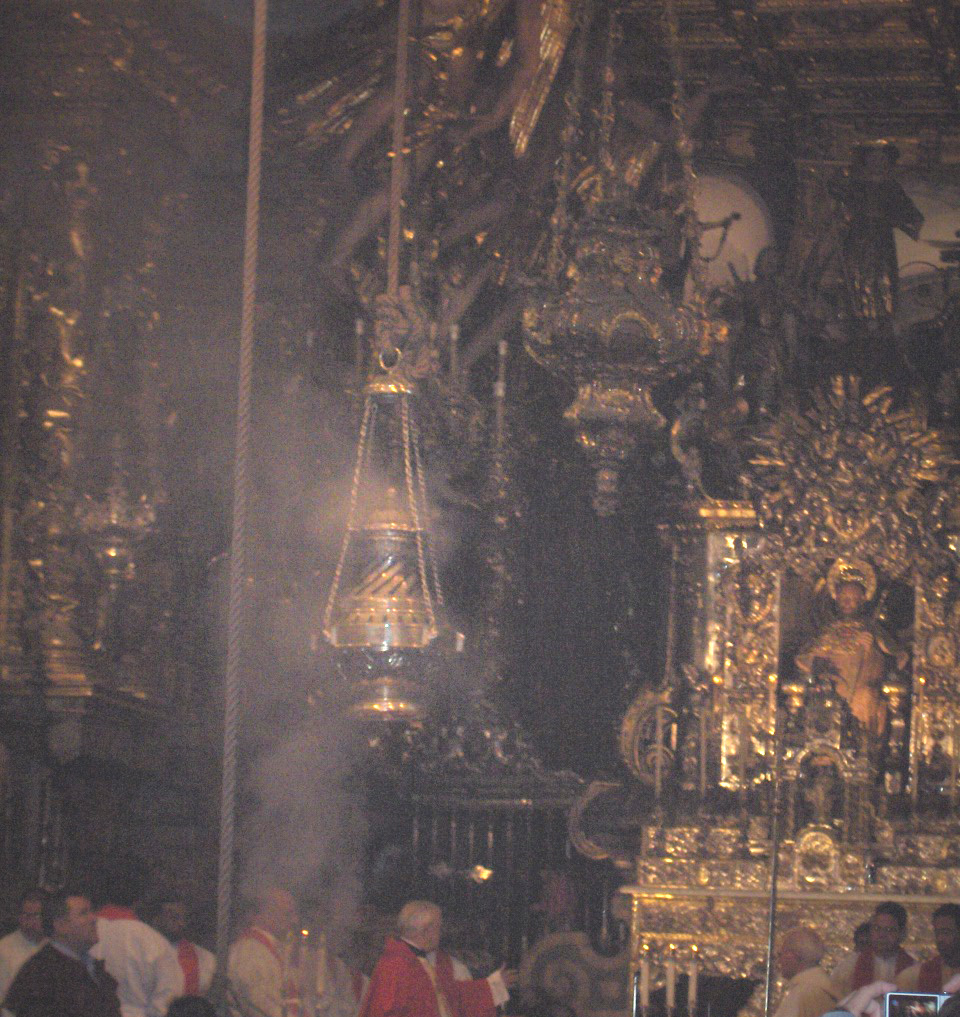
The Botafumeiro is a massive thurible kept at the Santiago de Compostela Cathedral in Spain. Eight men in mauve robes pull ropes to swing the censer through the transept, releasing clouds of incense during major religious celebrations.
When is Botafumeiro marked?
Botafumeiro is kept as part of Christmas, which is on Friday, 25 December 2026.
The Botafumeiro is a giant swinging censer used inside the Santiago de Compostela Cathedral in Spain. During important feasts, eight robed men pull ropes to send the heavy vessel soaring through the air. It releases thick clouds of incense that fill the church, a practice linked to ancient prayers and the welcome of weary pilgrims.
The great censer
The current Botafumeiro weighs eighty kilograms and stands nearly two meters tall. It is made of brass and bronze with a thin layer of silver. A goldsmith named José Losada crafted this version in eighteen fifty-one. Before that, a silver censer donated by King Louis XI of France served the cathedral until French troops stole it in eighteen hundred and nine. The vessel hangs twenty meters above the floor from a wooden pulley system installed in sixteen hundred and four. This mechanism uses drums of different sizes to multiply the movement of the ropes. Another smaller censer called La Alcachofa handles regular masses.
How the swing works
Eight men known as tiraboleiros operate the thurible. They wear long mauve capes while pulling thick ropes attached to the censer. The team starts the motion by pushing the heavy metal body. Then they rhythmically haul the lines to increase the swing. The Botafumeiro travels sixty-five meters between the side doors of the transept. At its fastest point, the censer moves at roughly sixty-eight kilometers per hour. The operators secure the rope with marine knots to prevent accidents. Historically, hooks were used, which sometimes failed.
History and purpose
The custom likely began in the twelfth century to greet tired travelers who arrived at the shrine. Many pilgrims came after long journeys without bathing, and the smoke was thought to shield against illness. Burning incense also serves as a form of prayer. Over time, the pulley system evolved to allow wider swings. The present silver-plated vessel replaced a stolen medieval one. Artisans restored the current Botafumeiro in two thousand six after repairing dents and cracks.
When it swings
The swinging ritual occurs only on specific holy days throughout the year. These include Epiphany, Easter, Pentecost, and the Feast of Saint James in July. Other occasions feature the Assumption of Mary, All Saints' Day, Christmas, and the Immaculate Conception. On these dates, the thurible performs its grand arc. Private performances are available for visitors, though standard use remains tied to the liturgical calendar.
How Botafumeiro is kept
Eight tiraboleiros in mauve robes pull ropes to swing the Botafumeiro. They push the censer to start, then haul the lines to build momentum. The heavy brass and silver vessel soars through the transept, releasing incense. This happens on major feast days like the Feast of Saint James.
When and where
The Botafumeiro operates on fixed liturgical dates. These include Easter, Pentecost, the Feast of Saint James, Christmas, and Epiphany. The exact timing depends on the church calendar.
The tradition takes place inside the Santiago de Compostela Cathedral in Galicia, Spain. The censer hangs from the dome above the transept.
What Botafumeiro means
The smoke represents a prayer offered to God. Historically, the incense was believed to shield against illness and helped freshen the air for tired pilgrims arriving at the shrine. The swinging motion amplifies the distribution of the scent throughout the vast space.


Days Botafumeiro is marked
Questions people ask about Botafumeiro
When is Botafumeiro marked?
Botafumeiro is kept as part of Christmas, which is on Friday, 25 December 2026.
What is the Botafumeiro?
It is a large swinging censer kept at the Santiago de Compostela Cathedral in Spain. Eight men pull ropes to make the heavy metal vessel soar through the air during religious feasts.
How does the Botafumeiro move?
Tiraboleiros push the censer to start its motion. They then pull ropes connected to a pulley system to increase the swing. The censer reaches speeds of about sixty-eight kilometers per hour.
Why is incense used?
The smoke serves as a form of prayer. Historically, it was thought to protect against disease and helped freshen the air for tired pilgrims arriving at the cathedral.
See also
 CandlemasA Christian feast of candle blessings marking the end of the Christmas season
 Camino de SantiagoA Christian walking pilgrimage across Europe to the shrine of Saint James in Spain
 Holy Week in SevilleA week of solemn processions and floats through the streets of Seville to mark the Passion of Christ.
 St John's EveBonfires, feasting and worship on the short night before John the Baptist's feast
Good reading and sources
- Botafumeiro on WikipediaEncyclopedia
- More photos on Wikimedia CommonsPhotos and video
- Wikidata recordOpen data
The facts on this page come from the Wikipedia article "Botafumeiro", written by its contributors and used under the CC BY-SA 4.0 licence, and from its Wikidata record (CC0). EveryParampara rewrote the text in its own words, with AI assistance, and compares every page with the article to make sure no passage is copied. It may be reused under the same CC BY-SA 4.0 licence with a link back.
It may contain mistakes. Traditions differ from one family, village and community to the next, and the people who keep them know them best. If something is wrong, tell us. Last refreshed 2026-10-04.
More from Spain
All the traditions of Spain
🇫🇷 France and 5 moreCandlemas
A Christian feast of candle blessings marking the end of the Christmas seasonSpiritual
🇪🇸 Seville, SpainHoly Week in SevilleSemana Santa de Sevilla
A week of solemn processions and floats through the streets of Seville to mark the Passion of Christ.Spiritual
🇪🇸 Santiago de Compostela, Spain and 7 moreCamino de SantiagoEl Camino de Santiago
A Christian walking pilgrimage across Europe to the shrine of Saint James in SpainSpiritual
🇪🇸 Spain and 5 moreSt John's Eve
Bonfires, feasting and worship on the short night before John the Baptist's feastSpiritual
The same idea elsewhere
Pilgrimage compared 🇦🇺 AustraliaThe Dreaming
A living spiritual worldview and law connecting Aboriginal Australians to ancestors, land, and community.Spiritual
🇦🇺 AustraliaThe Dreaming
A living spiritual worldview and law connecting Aboriginal Australians to ancestors, land, and community.Spiritual
 🇮🇳 India and 5 moreThaipusam
A Tamil Hindu festival honoring Murugan through devotional burdens and pilgrimageSpiritual
🇮🇳 India and 5 moreThaipusam
A Tamil Hindu festival honoring Murugan through devotional burdens and pilgrimageSpiritual
 🇵🇭 Cebu City, Philippines and 4 moreSinulog Festival
An annual Philippine dance festival and Catholic devotion honouring the Santo NiñoFestival
🇵🇭 Cebu City, Philippines and 4 moreSinulog Festival
An annual Philippine dance festival and Catholic devotion honouring the Santo NiñoFestival
 🇵🇪 Cusco, PeruQoyllur Rit'iQuyllurit'i
An Andean mountain pilgrimage uniting indigenous star lore and Catholic devotionSpiritual
🇵🇪 Cusco, PeruQoyllur Rit'iQuyllurit'i
An Andean mountain pilgrimage uniting indigenous star lore and Catholic devotionSpiritual