Spiritual and religiousSouth AsiaHindu
Thaipusam
A Tamil Hindu festival honoring Murugan through devotional burdens and pilgrimage

Thaipusam is a Tamil Hindu observance commemorating Lord Murugan defeating the demonic Surapadman using a divine lance granted by Parvati. Devotees make barefoot pilgrimages while balancing wooden arches, carrying pots of milk, or enduring pierced skewers to discharge spiritual vows.
When is Thaipusam in 2027?
Thaipusam 2027 is on Friday, 22 January 2027. Other years: 2028, Thursday, 10 February 2028.
Thaipusam is an annual festival celebrated by Tamil Hindus to honour the deity Murugan. The day marks the mythic moment when Murugan received a sacred spear from Parvati and overcame the demon Surapadman. Believers prepare through prayer, fasting, and celibacy before joining sacred walks. Many worshipers carry decorative burdens called kavadis, transport pots of cow milk, or pierce their skin with skewers to fulfill promises and balance spiritual debts.
The story of Murugan
According to the Kanda Puranam, three demons named Surapadman, Tarakasuran, and Singamukhan gained boons from Shiva that made them near-immortal tyrants. When the celestial devas sought relief from their oppression, Shiva released sparks of fire from six heads. These flames traveled through the wind, the fire god Agni, and the sacred Ganga to Lake Saravana. There, six infants appeared, nurtured by handmaidens called Krittikas, before Parvati combined them into six-headed Murugan. Parvati presented Murugan with the vel, a holy lance. Murugan and his commanders marched to battle, cleaving Surapadman into two. The defeated demon became a mango tree, then transformed into a peacock mount and a rooster emblem.
Bearing the kavadi
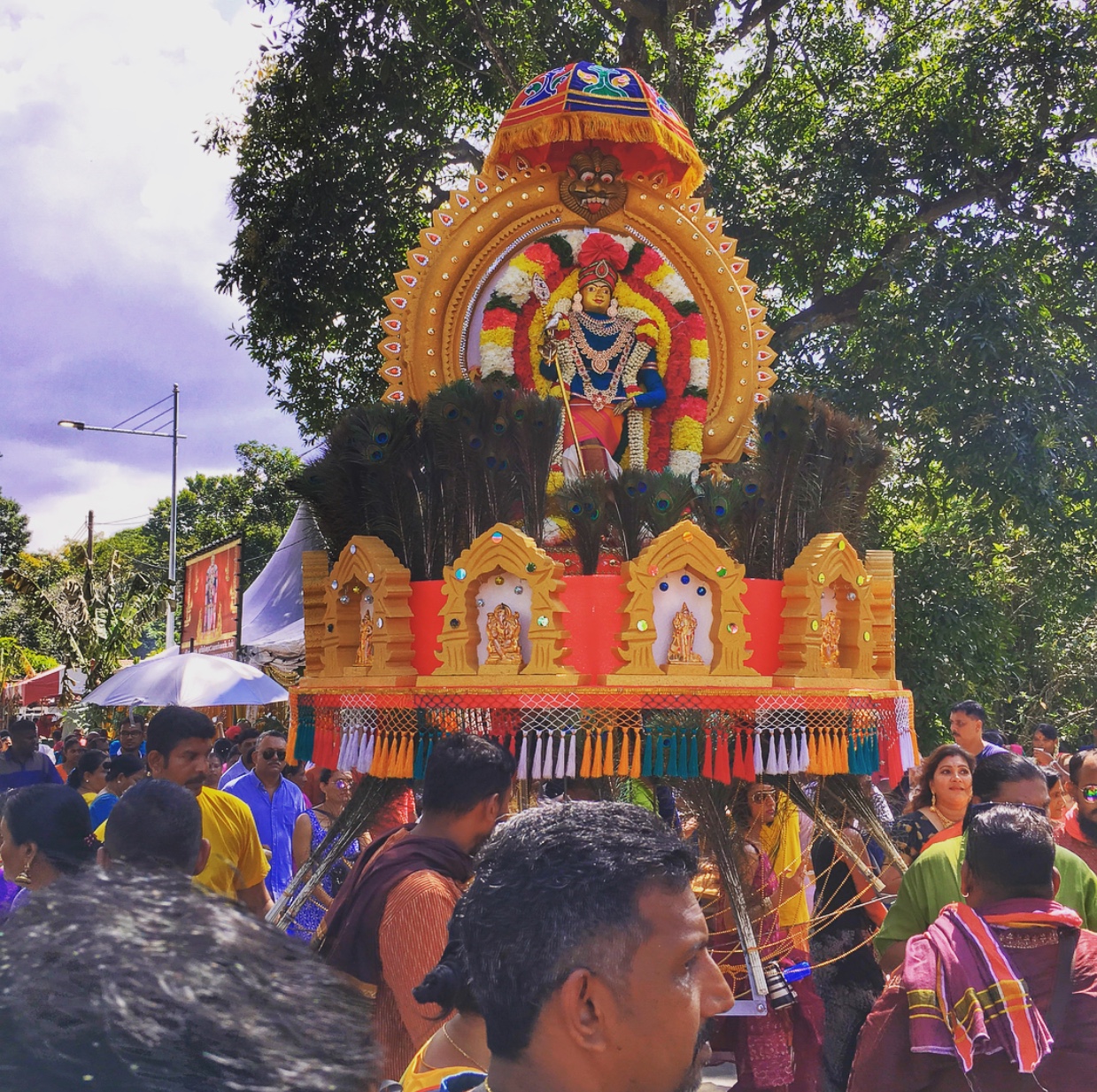
Devotees shoulder physical loads known as kavadis, a ritual practice called Kavadi Aattam. In its basic style, a kavadi consists of an arched wooden or metal frame rested across the neck. Pilgrims carry these structures to plead for Murugan's aid, request recovery for sick kin, or settle religious obligations. Many bring milk offerings in brass jars, known as pal kavadi, alongside sugar cane, fresh coconut, and blossoms. Others construct the elaborate vel kavadi, a tall shrine trimmed with peacock plumage and supported by metal hooks that pierce the torso. Sacred ash, called vibuthi, is dusted over puncture marks. Drum rhythms and repeated chants encourage worshipers to slip into an ecstatic trance.
Devotion and preparation
Participation requires rigorous spiritual discipline. Murugan is connected with yogic restraint and the granting of mukti, or release from rebirth. Long before the festival begins, participants purify themselves through abstention, daily prayer, a strict vegetarian regimen, and celibacy. On the ceremonial day, barefoot pilgrims make their trek while dancing to percussive music. Some pierce their tongues or cheeks with small skewers shaped like the god's lance, maintaining absolute quiet along the road. While Indian statutes restrict public self-mortification, limiting severe body piercings in South India, devotional marches remain immense gatherings of faith, where personal endurance demonstrates absolute surrender to the deity.
Observances across the globe
From its South Indian roots, Thaipusam has expanded throughout the worldwide Tamil community. In India, massive assemblies gather at historic temples such as Palani and Tiruchendur, alongside temple tank float celebrations in Chennai and Madurai. Across Southeast Asia, the festival draws enormous crowds. Pilgrims in Malaysia climb the steep steps to Batu Caves near Kuala Lumpur, while Singaporeans march between Sri Srinivasa Perumal Temple and Sri Thendayuthapani Temple. It is recognized as a public holiday in Mauritius, where processions ascend Kovil Montagne. Communities in South Africa, Fiji, and Indonesia hold parallel ceremonies, including Medan, where thousands accompany a centuries-old wooden chariot between local sanctuaries.
How Thaipusam is kept
Devotees begin with days of physical purification, adhering to vegetarian food, fasting, and celibacy. On the festival morning, participants smear sacred ash onto their flesh and gather near designated temples. Some offer pots filled with cow milk, while others attach heavy, arched wooden structures or multi-spiked shrines to their shoulders and torsos. Skewers shaped like lances may be passed through the tongue or cheeks. Rhythmic drumming and choral singing accompany the faithful as they enter a trance. Walking without shoes, they process through public streets toward Murugan's inner sanctum, dancing in rhythm with their devotional burdens.
When and where
The festival takes place every year during the Tamil calendar month of Thai. The exact day is determined by the alignment of the full moon with the asterism known as Pusam, which usually corresponds to late January or early February.
The celebration is held across Tamil Nadu and Kerala in India, and extensively across the Tamil diaspora. Major observances take place at Batu Caves near Kuala Lumpur, inside urban temples in Singapore, at Kovil Montagne in Mauritius, and across communities in South Africa, Indonesia, and Fiji.
What Thaipusam means
Bearing the kavadi represents the physical settlement of a spiritual debt and total submission to Murugan. By enduring discomfort, fasting, and piercing, worshipers seek healing for relatives or freedom from karmic ties. The lance, or vel, symbolizes divine wisdom piercing through ignorance, commemorating Murugan's victory over demonic pride and ego, while the peacock and rooster embody subdued lower impulses turned toward sacred service.
On the table
- Cow milk
- Sugarcane
- Tender coconut


Days Thaipusam is marked
Thaipusam dates: 2027, 2028
| Year | Thaipusam date |
|---|---|
| 2027 | Friday, 22 January 2027 |
| 2028 | Thursday, 10 February 2028 |
Questions people ask about Thaipusam
When is Thaipusam in 2027?
Thaipusam 2027 is on Friday, 22 January 2027. Other years: 2028, Thursday, 10 February 2028.
What is Thaipusam?
Thaipusam is a major Tamil Hindu festival celebrating the victory of the deity Murugan over the demon Surapadman, marked by devotional burdens, milk offerings, and barefoot processions.
What is a kavadi?
Kavadi means burden in Tamil. It is a wooden or steel arch, or an elaborate pierced frame decorated with peacock feathers, carried on a worshiper's shoulders to repay a spiritual vow.
Where is Thaipusam most widely observed?
It is kept across South India and within Tamil diaspora nations, drawing massive gatherings at Batu Caves near Kuala Lumpur, throughout Singapore, and at Kovil Montagne in Mauritius.
See also
 Isra and Mi'rajAn Islamic observance marking the prophet Muhammad’s night journey and ascent through the heavens.
 Krishna JanmashtamiA Hindu festival celebrating the birth of Krishna with fasting, singing and night vigils
 Mid-Autumn FestivalAn annual harvest festival celebrating family reunions, full moons and mooncakes
 NavaratriA nine-night Hindu festival honoring the goddess Durga and her nine forms through prayer, fasting, and dance.
Good reading and sources
- Vanquishing the demonThe Hindu, Article
- Malaysia's Thaipusam festivalBBC, Article
- Vanquishing the demonThe Hindu, Article
- Malaysia's Thaipusam festivalBBC, Article
- Thaipusam on WikipediaEncyclopedia
- More photos on Wikimedia CommonsPhotos and video
- Wikidata recordOpen data
The facts on this page come from the Wikipedia article "Thaipusam", written by its contributors and used under the CC BY-SA 4.0 licence, and from its Wikidata record (CC0). EveryParampara rewrote the text in its own words, with AI assistance, and compares every page with the article to make sure no passage is copied. It may be reused under the same CC BY-SA 4.0 licence with a link back.
It may contain mistakes. Traditions differ from one family, village and community to the next, and the people who keep them know them best. If something is wrong, tell us. Last refreshed 2026-10-04.
More from India
All the traditions of India 🇮🇳 India and 5 morePretaप्रेत
Offerings and rites for spirits enduring deep hunger across Asian traditions.Spiritual
🇮🇳 Badrinath, IndiaChota Char Dham
Four Himalayan shrines in Uttarakhand, visited in one season each yearSpiritual
🇮🇳 India and 5 morePretaप्रेत
Offerings and rites for spirits enduring deep hunger across Asian traditions.Spiritual
🇮🇳 Badrinath, IndiaChota Char Dham
Four Himalayan shrines in Uttarakhand, visited in one season each yearSpiritual
 🇮🇳 India and 1 moreKailash Mansarovar Yatraकैलाश मानसरोवर यात्रा (Hindi); ཀཱའི་ལ་ཤ་མན་ས་རོ་ཝར་ཡ་ཏྲ། (Tibetan)
A high-altitude pilgrimage to Mount Kailash and Lake Manasarovar in TibetSpiritual
🇮🇳 India and 1 moreKailash Mansarovar Yatraकैलाश मानसरोवर यात्रा (Hindi); ཀཱའི་ལ་ཤ་མན་ས་རོ་ཝར་ཡ་ཏྲ། (Tibetan)
A high-altitude pilgrimage to Mount Kailash and Lake Manasarovar in TibetSpiritual
 🇮🇳 Mumbai, India and 1 moreFire templeآتشکده
A consecrated sanctuary where Zoroastrians tend sacred fires and gather for worshipSpiritual
🇮🇳 Mumbai, India and 1 moreFire templeآتشکده
A consecrated sanctuary where Zoroastrians tend sacred fires and gather for worshipSpiritual
The same idea elsewhere
Pilgrimage compared 🇵🇱 Poland and 5 moreChristmas Eve
The evening before Christmas, marked by church services, family meals, and gift preparations across Christian cultures.Festival · Dinner
🇵🇱 Poland and 5 moreChristmas Eve
The evening before Christmas, marked by church services, family meals, and gift preparations across Christian cultures.Festival · Dinner
 🇰🇷 Seoul, South KoreaTemplestay템플스테이
A program that invites visitors to live in South Korean Buddhist temples and join the daily routines of monastic life.Spiritual · Dinner
🇰🇷 Seoul, South KoreaTemplestay템플스테이
A program that invites visitors to live in South Korean Buddhist temples and join the daily routines of monastic life.Spiritual · Dinner
 🇵🇭 Marinduque, PhilippinesMoriones Festival
A Holy Week reenactment in Marinduque where masked participants search for the Roman centurion Longinus.Festival
🇵🇭 Marinduque, PhilippinesMoriones Festival
A Holy Week reenactment in Marinduque where masked participants search for the Roman centurion Longinus.Festival
 🇦🇺 AustraliaThe Dreaming
A living spiritual worldview and law connecting Aboriginal Australians to ancestors, land, and community.Spiritual
🇦🇺 AustraliaThe Dreaming
A living spiritual worldview and law connecting Aboriginal Australians to ancestors, land, and community.Spiritual