Dolman
A Hungarian-bred garment, worn as hussar uniform and later as a woman's outdoor wrap

Two garments carry the name. One was a short, tight military jacket with braid trimming, worn by Hungarian hussars and by peasants from the sixteenth century. The other was a one-piece outer wrap that women in the West wore in the 1870s and 1880s, often cut from silk velvet, fur or wool.
When is Dolman kept?
Dolman is kept on no day or season is attached to it. It belongs to the sixteenth to nineteenth centuries in Hungary and to the 1870s and 1880s in Western wom.
A dolman is a garment with two distinct histories. One is a soldier's shirt or a jacket trimmed with braid, tied to Hungarian hussars. The other is an outdoor wrap worn by women in the West in the 1870s and 1880s. Peasants in Hungary had it from the sixteenth century, and the name moved from Turkish into Hungarian, then into other tongues.
Two garments, one name
The name covers more than one thing. It can mean a shirt made for soldiers, and it can mean an outer jacket whose surface is worked with passementerie, the braid, cord and bead trimmings that give a garment its texture. The term itself came from Turkish and entered Hungarian, and from there it passed into other languages. In Hungary peasants wore the garment from the sixteenth century, and it spread through the country over time. Wealthier peasant households took it up first. People living in the poorest circumstances only had it near the end of the nineteenth century.
Hussar uniform
Hungarian hussars turned the garment into formal military dress. The style travelled into Western armies between the sixteenth and nineteenth centuries. The jacket was cut short and close to the body, and passementerie covered it. Beneath it a man wore an embroidered shirt, tight at the waist, flaring below into a skirt that in the csakora manner came down near the knee. A sash went round the waist, with an ornate sword or saber hanging from it. The whole look came to stand for a romantic idea of soldiering and patriotism. Over the jacket a pelisse might be worn, a similar coat with fur trim, usually carried on the left shoulder with the sleeves left to hang.
Women's outdoor wrap
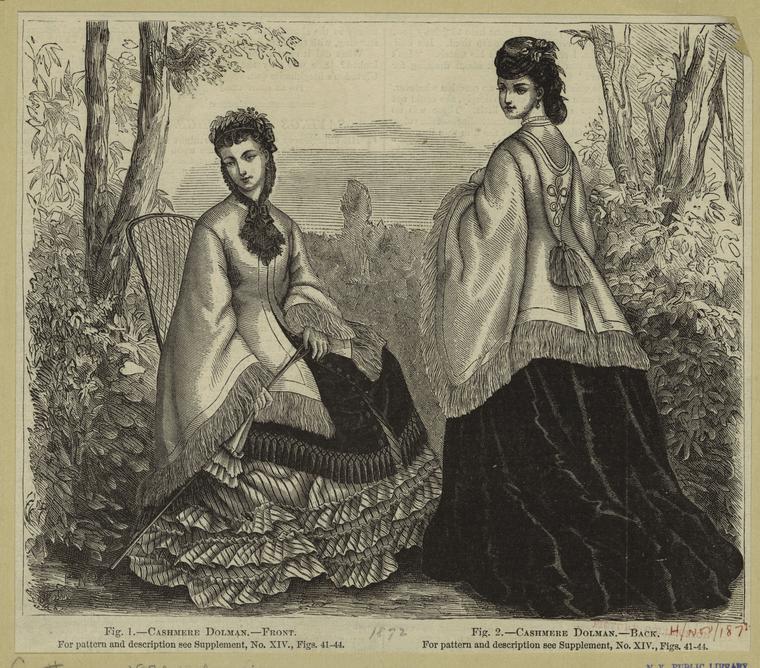
In the nineteenth century women in the West wore a dolman outdoors, a jacket-like covering in the manner of a mantle. It was fashionable in the 1870s and 1880s. Its cut was unusual: the body and sleeves were made in a single piece, so the shape spread wide like a cape. The front was draped and the back was shaped to suit the bustle, the padded rear of the skirt then in style. Silk velvet, fur and wool were used for winter versions, with ribbons, fringe, beading and tassels applied as trimming. Many that survive were remade from Paisley shawls that had gone out of fashion. In the 1890s a crocheted version, the dolmanette, appeared.
Sleeves and afterlives
A dolman sleeve is one that joins the body at an armhole cut low, sometimes as far down as the waist; when the armhole reaches that far, the blouse has no seam beneath the arm. Women's clothing of the American Civil War years made much use of the shape. It gave the shoulders a sloping line and made the waist look smaller. In the early twenty-first century the term describes a sleeve cut as one piece with the bodice, able to narrow toward the wrist or stay wide. That style became popular from the 1930s and is still known as the batwing sleeve.
How Dolman is kept
Among Hungarian hussars the garment was part of formal dress. A man put on the short, close-cut jacket over an embroidered shirt that was tight to the waist and flared below. A sash sat round his waist, holding an ornate sword or saber, and a pelisse, a fur-trimmed coat of similar cut, was often slung over his left shoulder with the sleeves hanging. Peasants in Hungary wore their own versions from the sixteenth century, wealthier households first. For women in the West in the 1870s and 1880s the dolman was outerwear, worn over the dress for going out.
When and where
There is no day or season attached to it. It belongs to the sixteenth to nineteenth centuries in Hungary and to the 1870s and 1880s in Western women's wardrobes, with winter versions made in silk velvet, fur or wool.
The garment took shape in Hungary and reached Western armies through Hungarian hussars, whose dress became a model for formal military uniform. In Hungary it was worn by peasants as well, spreading across the country from the sixteenth century and appearing among the poorest households only late in the nineteenth century. Women's fashion in the West adopted the name and the shape for outdoor mantles in the 1870s and 1880s.
What Dolman means
For the hussars, the dress carried meaning beyond practicality. The close cut, the heavy trimming and the sword at the waist built a picture of soldiering that people found romantic, and the style came to stand for military patriotism. In the drawing rooms of the 1870s and 1880s the women's dolman answered a different need: it was a way of covering the elaborate dress of the day, cut to suit the bustle, and it made the wearer look fashionable.



Questions people ask about Dolman
When is Dolman kept?
Dolman is kept on no day or season is attached to it. It belongs to the sixteenth to nineteenth centuries in Hungary and to the 1870s and 1880s in Western wom.
What is a dolman?
The name covers two garments. One is a shirt made for soldiers, and one is a jacket trimmed with braid that Hungarian hussars made into a uniform. The other is an outdoor wrap that women in the West wore in the 1870s and 1880s. The word came into Hungarian from Turkish and spread to other languages.
Where is it from and who wore it?
It came into Western dress through Hungary. Hungarian hussars turned it into formal military uniform between the sixteenth and nineteenth centuries, and peasants in Hungary wore versions of it from the sixteenth century, wealthier households first. Poorer households had it only at the end of the nineteenth century.
What is a dolman sleeve?
It is a sleeve joined to the body at an armhole placed low, sometimes low enough to reach the waist, so that the blouse needs no seam under the arm. Women's clothing during the American Civil War used the shape often. A related sleeve, cut in one piece with the bodice, became the batwing sleeve.
What was the pelisse?
It was a second coat worn with the military dolman. Its cut was similar but it had fur trim, and it was usually carried over the left shoulder rather than worn on both arms, with the sleeves left hanging loose if it had any.
What were women's dolmans made of?
Silk velvet, fur and wool were common for winter, and the garments were trimmed with ribbons, fringing, beading and tassels. Some surviving examples were remade from Paisley shawls that had fallen out of fashion when skirt shapes changed. A crocheted version of the 1890s was called a dolmanette.
See also
 CandlemasA Christian feast of candle blessings marking the end of the Christmas season
 CsárdásA Hungarian folk dance that moves from a slow start to a fast finish, kept in Hungary and neighboring regions.
 Hungarian folk danceA collection of traditional dances kept by Hungarians in Hungary and across the diaspora.
 Name dayA calendar tradition where people celebrate the feast day of the saint after whom they are named.
Good reading and sources
- Dolman on WikipediaEncyclopedia
- More photos on Wikimedia CommonsPhotos and video
- Wikidata recordOpen data
The facts on this page come from the Wikipedia article "Dolman", written by its contributors and used under the CC BY-SA 4.0 licence, and from its Wikidata record (CC0). EveryParampara rewrote the text in its own words, with AI assistance, and compares every page with the article to make sure no passage is copied. It may be reused under the same CC BY-SA 4.0 licence with a link back.
It may contain mistakes. Traditions differ from one family, village and community to the next, and the people who keep them know them best. If something is wrong, tell us. Last refreshed 2026-10-10.
More from Hungary
All the traditions of Hungary
🇫🇷 France and 5 moreCandlemas
A Christian feast of candle blessings marking the end of the Christmas seasonSpiritual
🇭🇺 Hungary and 5 moreCsárdás
A Hungarian folk dance that moves from a slow start to a fast finish, kept in Hungary and neighboring regions.Performance
🇭🇺 Budapest, Hungary and 2 moreHungarian folk dance
A collection of traditional dances kept by Hungarians in Hungary and across the diaspora.Performance
🇬🇷 Greece and 5 moreName day
A calendar tradition where people celebrate the feast day of the saint after whom they are named.Festival
The same idea elsewhere
All of this kind 🇮🇳 Paithan, IndiaPaithani
A handwoven silk sari from Maharashtra, with a squared border and a peacock palluDress
🇮🇳 Paithan, IndiaPaithani
A handwoven silk sari from Maharashtra, with a squared border and a peacock palluDress
 🇮🇱 Israel and 1 moreTzitzitצִיצִית
Knotted ritual fringes worn on a four-cornered garment, a reminder of the commandmentsDress
🇮🇱 Israel and 1 moreTzitzitצִיצִית
Knotted ritual fringes worn on a four-cornered garment, a reminder of the commandmentsDress
 🇼🇸 Samoa and 1 moreʻIe tōga
Precious woven mats exchanged in Samoan ceremonies to honor family ties and chiefly status.Dress
🇼🇸 Samoa and 1 moreʻIe tōga
Precious woven mats exchanged in Samoan ceremonies to honor family ties and chiefly status.Dress
 🇪🇬 Egypt and 5 moreTraditional tattooing
The ancient custom of marking the skin for protection, healing, status and sacred ritesDress
🇪🇬 Egypt and 5 moreTraditional tattooing
The ancient custom of marking the skin for protection, healing, status and sacred ritesDress