Spiritual and religiousSouth AsiaMuslim
Eid prayers
In its own language: صلاة العيد
The yearly festival prayer of the two Eids, offered in the morning by Muslims

Eid prayers are the yearly holiday prayers of Islam, offered on the mornings of Eid al-Fitr and Eid al-Adha. Worshippers meet in mosques or open grounds to pray together, hear a sermon and greet one another, and the two festivals fall on different dates each year because they follow the lunar calendar.
When is Eid prayers marked?
Eid prayers is kept as part of Eid al-Fitr, which runs from 9 to 11 March 2027.
Eid prayers are the two yearly congregational prayers that Muslims offer on the mornings of Eid al-Fitr and Eid al-Adha. The Arabic word Eid means festival or feast, and on these days worshippers gather with family and with the wider Muslim community. The prayers mark the close of Ramadan and, later, the season of sacrifice and pilgrimage. Many keep them in an open field rather than inside a mosque.
What it is
Muslims call the two yearly festival prayers Salat al-Eid, and the pair is sometimes named the prayer of the two Eids. Both are offered in the Islamic tradition on the festival days themselves, not on an ordinary day. The Arabic word Eid carries the sense of a recurring feast or celebration, and the prayer is the first shared act of that celebration. Families and neighbours come together, often in large numbers. Muslims are encouraged to join in, and the gatherings are meant to include children and women as well as men, so that the whole community shares the day.
How the prayer runs
An Eid prayer can be held in a mosque, but a field or a walled open ground kept for the purpose, called an Eidgah or musalla, is the preferred setting when the weather allows. Worshippers arrive after sunrise, and the prayer must fall between then and noon. No call to prayer is given beforehand, unlike other prayers. The congregation prays in units known as rakats, and a sermon, the khutbah, comes after the prayer rather than before it. The counted takbirs, the saying of Allahu Akbar, are repeated more often here than in daily prayer, and the schools of Islamic law differ over how many.
The two festivals
Eid al-Fitr comes at the end of Ramadan, the month of fasting, and opens the month of Shawwal. It lasts three days and is often called the smaller Eid. Before the prayer, Muslims who can afford it give a charity known as Zakat al-Fitr, so that poorer households can share in the feast. Eid al-Adha, the greater Eid, falls on the tenth day of Dhu al-Hijjah, the month in which the pilgrimage to Mecca is made. It recalls Ibrahim's obedience to Allah and is a time of animal sacrifice, whose meat is divided into three shares for family, friends and the poor.
Dates and the moon
The two Eids have no fixed date in the everyday solar calendar. They sit on the Islamic lunar calendar, which counts months by the phases of the moon, so each year the festivals move. A lunar year is around eleven days shorter than the Gregorian year, and the festivals therefore drift earlier by roughly that amount annually, as do other lunar holidays such as Chinese New Year and Rosh Hashanah. Local communities sometimes begin on slightly different days. Many follow the sighting of the new crescent over Mecca, so that Muslims in different countries can keep the same date.
Customs around the prayer
Several recommended practices surround the prayer. Worshippers wash thoroughly beforehand, in the bathing known as ghusl, and put on clean, good clothing. On Eid al-Fitr, many take something small to eat before setting out; on Eid al-Adha, people usually hold off until the prayer has ended and the sacrifice begins. The takbir is said on the way there, on the way back, and after the prayers through the remaining festival days. Worshippers are encouraged to return home by a different road from the one they took. Greetings of Eid Mubarak, meaning a blessed Eid, are exchanged.
How Eid prayers is kept
On the morning of the festival, Muslims wash and dress well, then make their way to a mosque or an open prayer ground. They arrive after sunrise and before noon. There is no call to prayer. The congregation stands behind the imam and prays the units of the Eid prayer with extra takbirs. After the prayer ends, the imam gives the khutbah, the sermon. Worshippers then greet one another and go home, often by a different route, and visit relatives. On Eid al-Fitr, the charity due is given before the prayer; on Eid al-Adha, the sacrifice follows it.
When and where
The prayers are kept twice a year, on the mornings of Eid al-Fitr and Eid al-Adha. Both dates come from the Islamic lunar calendar, so they shift by about eleven days each year in the Gregorian calendar. Within the day, the prayer is held after sunrise and before noon. Some communities follow crescent sightings in Mecca to settle the date.
Eid prayers are offered wherever Muslim communities live, in mosques and in open grounds set aside for the purpose. In South Asia such a ground is called an Eidgah, and the Sholakia Eidgah in Bangladesh is one example. In large cities the congregation can be big enough that two sittings are arranged, so that more people get the chance to pray.
What Eid prayers means
For those who keep it, the Eid prayer is an act of obedience and thanks. It opens a day of celebration with worship rather than with food or gifts, and it brings together people who may not meet at other times of the year. The charity given at Eid al-Fitr is meant to make sure nobody is left out of the joy, and the sacrifice at Eid al-Adha is shared out so that neighbours and the poor receive a portion. The prayer is also a public sign of a shared faith.


Days Eid prayers is marked
Questions people ask about Eid prayers
When is Eid prayers marked?
Eid prayers is kept as part of Eid al-Fitr, which runs from 9 to 11 March 2027.
What are Eid prayers?
They are the two festival prayers that Muslims offer once a year, on the mornings of Eid al-Fitr and Eid al-Adha. They are held as a congregation, usually in a mosque or an open prayer ground, and a sermon follows the prayer.
Where are they prayed?
Anywhere a Muslim community gathers. A mosque works, but an open field or a ground kept for the purpose, called an Eidgah or musalla, is preferred if the weather is fine. Larger communities sometimes hold two prayers so that more people can attend.
Who takes part?
The whole community is invited. Muslims are encouraged to come with their families, and accounts record that women and children, young and old, were called to join in the joy of the day and share its blessings.
What happens after the prayer?
Once the congregation finishes, the imam delivers the khutbah. People greet each other with Eid Mubarak and go home, frequently taking a different road from the one they came by. The rest of the day is given to family visits and, at Eid al-Adha, to the sacrifice.
See also
 Eid al-FitrThe feast that ends Ramadan, opened with morning prayers, sweets and visits home
 Krishna JanmashtamiA Hindu festival celebrating the birth of Krishna with fasting, singing and night vigils
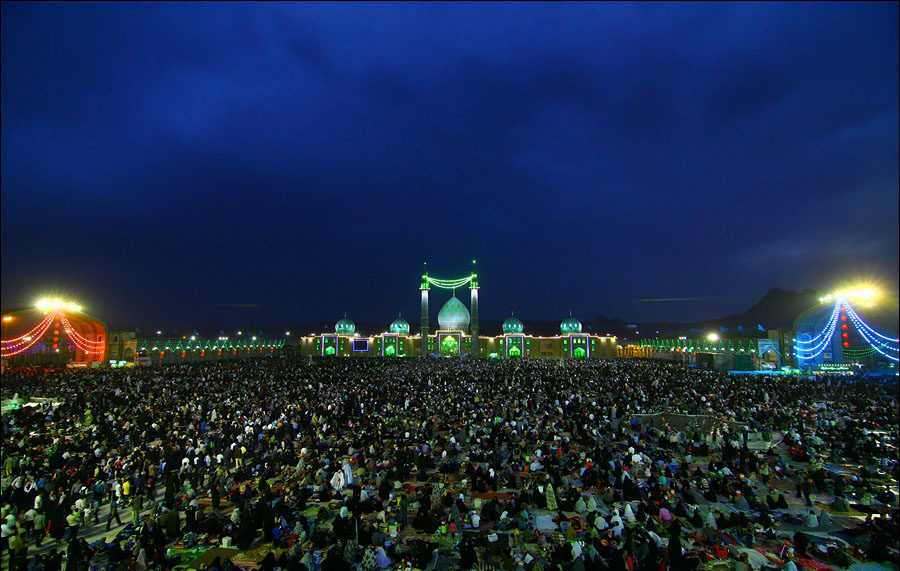 Mid-Sha'banAn Islamic night of prayer, remembrance, and seeking divine forgiveness.
 Kali PujaA Hindu festival of midnight worship and illuminated shrines honoring the goddess Kali
Good reading and sources
- Eid al-Adha 2027: Meaning, Dates & CelebrationHistory.com, Article
- Eid al-Adha 2027: Meaning, Dates & CelebrationHistory.com, Article
- Eid prayers on WikipediaEncyclopedia
- More photos on Wikimedia CommonsPhotos and video
- Wikidata recordOpen data
The facts on this page come from the Wikipedia article "Eid prayers", written by its contributors and used under the CC BY-SA 4.0 licence, and from its Wikidata record (CC0). EveryParampara rewrote the text in its own words, with AI assistance, and compares every page with the article to make sure no passage is copied. It may be reused under the same CC BY-SA 4.0 licence with a link back.
It may contain mistakes. Traditions differ from one family, village and community to the next, and the people who keep them know them best. If something is wrong, tell us. Last refreshed 2026-10-05.
More from Bangladesh
All the traditions of Bangladesh
🇮🇳 Mathura, India and 4 moreKrishna Janmashtamiकृष्णजन्माष्टमी
A Hindu festival celebrating the birth of Krishna with fasting, singing and night vigilsSpiritual
🇮🇷 Iran and 5 moreMid-Sha'banنصف شعبان
An Islamic night of prayer, remembrance, and seeking divine forgiveness.Spiritual
🇮🇳 Kolkata, India and 1 moreKali Pujaকালীপূজা
A Hindu festival of midnight worship and illuminated shrines honoring the goddess KaliSpiritual
 🇮🇳 India and 2 moreSharad Purnima
A Hindu autumn full moon festival of night vigils, moonlit sweets and sacred dancesSpiritual · Feasts and festival meals
🇮🇳 India and 2 moreSharad Purnima
A Hindu autumn full moon festival of night vigils, moonlit sweets and sacred dancesSpiritual · Feasts and festival meals
The same idea elsewhere
All of this kind 🇦🇺 Australia and 5 moreGood Friday
A solemn Christian holy day commemorating the crucifixion and death of Jesus Christ.Spiritual · Fasting and breaking the fast
🇦🇺 Australia and 5 moreGood Friday
A solemn Christian holy day commemorating the crucifixion and death of Jesus Christ.Spiritual · Fasting and breaking the fast
 🇮🇱 Jerusalem, IsraelPassoverפסח
A Jewish spring festival celebrating freedom from slavery with ritual mealsSpiritual · Dinner
🇮🇱 Jerusalem, IsraelPassoverפסח
A Jewish spring festival celebrating freedom from slavery with ritual mealsSpiritual · Dinner
 🇵🇭 Philippines and 5 moreHoly WeekἉγία καὶ Μεγάλη Ἑβδομάς
The solemn seven days leading to Easter, recalling the final week and Passion of JesusSpiritual · Fasting and breaking the fast
🇵🇭 Philippines and 5 moreHoly WeekἉγία καὶ Μεγάλη Ἑβδομάς
The solemn seven days leading to Easter, recalling the final week and Passion of JesusSpiritual · Fasting and breaking the fast
 🇮🇱 Jerusalem, IsraelYom Kippurיוֹם כִּפּוּר
The holiest day in Judaism, dedicated to fasting, prayer and atonementSpiritual · Fasting and breaking the fast
🇮🇱 Jerusalem, IsraelYom Kippurיוֹם כִּפּוּר
The holiest day in Judaism, dedicated to fasting, prayer and atonementSpiritual · Fasting and breaking the fast