Royal, civic and national ceremonyEuropeSecular and civic
German Unity Day
In its own language: Tag der Deutschen Einheit
Germany's national day, marking reunification on 3 October 1990

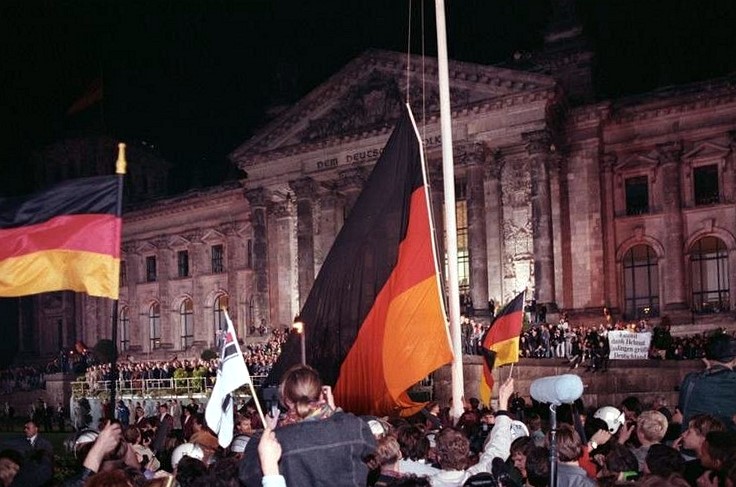
German Unity Day is Germany's national holiday, kept on 3 October each year. It remembers 1990, when the east German parliament voted to join the Federal Republic, ending the division of the country, and it has been the national day ever since.
When is German Unity Day kept?
German Unity Day is kept every year on 3 October, a fixed public holiday.
Each 3 October, Germany keeps its national day. The date remembers 1990, when the German Democratic Republic joined the Federal Republic. Since 1945 there had been two German states; after that day there was one. It is a public holiday, marked with an official ceremony and a citizens' festival that a different host city stages each year. It took the place of an earlier national holiday kept on 17 June since 1954.
What it marks
On 3 October 1990 the German Democratic Republic, the eastern state known in English as East Germany, joined the Federal Republic of Germany, the western one. East Germany had been a country since 1949. With that accession the two became a single German state, something that had not existed since 1945. The same date has been the country's national holiday ever since reunification was formally completed. For most people it is a day off work and school, and also a fixed point in the year for asking what unity means now.
Choosing the date
When the Volkskammer, the east German parliament, had to settle on a day, 9 November was one option. On that date in 1989 the Berlin Wall had opened, and it was already an anniversary of two other events: the 1918 proclamation of the German Republic, and the crushing of Hitler's coup in 1923. But the same date marked the 1938 Nazi-led pogroms against Jewish people, called Reichspogromnacht, so it was thought wrong for a national celebration. The choice fell instead on 3 October 1990, the day the accession was to take effect.
The host city
The celebrations belong to a different city each year. The host is usually a state capital, and the turn follows the presidency of the Bundesrat, an order agreed at Königstein. Bonn, which had been the capital of West Germany, hosted in 2011, and Frankfurt am Main, where the 1848 parliament met, in 2015. Both were unusual, since neither is a state capital. Berlin, the federal capital, stages its own programme every year, with events beside the Brandenburg Gate and along the Straße des 17. Juni. Munich's Oktoberfest is extended to 3 October when its final Sunday falls on 1 or 2 October.
Earlier unity days
Until 1871 the German lands were separate kingdoms and principalities, and even after the Empire was founded no single national holiday existed. The Sedantag was kept each year on 2 September, recalling a victory in the Franco-Prussian War in 1870. Emperor Wilhelm I refused 18 January, the date of his proclamation, because a Prussian coronation already fell on it. The Weimar Republic adopted 11 August, when its constitution was signed in 1919. The Nazi government made 1 May a holiday in 1933 and later named 9 November a day of remembrance. From 1954 the Federal Republic kept 17 June for the 1953 uprising in the east and called it German Unity Day, while East Germany held 7 October as Republic Day.
Attempts to move it
In 2004 the Chancellor, Gerhard Schröder, wanted the holiday shifted to the first Sunday of October, on the grounds that a free weekday costs the economy. Federal President Horst Köhler and the President of the Bundestag, Wolfgang Thierse, both objected. Part of the public read the plan as a threat to a day off and as insensitive at a moment when working hours were rising. There was a further problem of dates: a first Sunday can land on 7 October, which had been East Germany's own national day, so the occasion might have looked like a reminder of the split rather than of reunion. The proposal was abandoned.
How German Unity Day is kept
The date is a public holiday, so schools and most workplaces close. In the host city the day begins with a formal ceremony led by national and local politicians. The Bürgerfest follows: a citizens' festival with food stands, music stages and, at night, fireworks. Berlin holds separate events at the same time. Four communities from the edges of the country, List in the north, Selfkant in the west, Oberstdorf in the south and Görlitz in the east, formed the Zipfelbund at the 1999 celebration in Wiesbaden. They join the host city's events to represent Germany's present borders. Families often spend the free day on outings.
When and where
It is kept on 3 October every year. The date is fixed, so it moves through the week and falls on a different weekday each time. It has been the national holiday since 1990, the year the eastern state's accession took effect. In 2004 a plan to move it to the first Sunday of October was put forward and then dropped.
The holiday belongs to the whole country. Its centre of gravity shifts each year to whichever city is hosting, usually a state capital, taken in turn according to the presidency of the Bundesrat. Berlin, the federal capital, always has events of its own. Bonn and Frankfurt am Main have each hosted, and both are important in German political history. The four Zipfelbund communities travel to each year's host city.
What German Unity Day means
For those who keep it, the day marks the end of the split between two German states and the return of a single political community. Because the chosen date is the day the accession took legal effect, not the night the Berlin Wall opened, the emphasis falls on an agreed act between parliaments rather than on a crowd's celebration. The compass communities who join each year's festival carry the same meaning: one country, reaching to its northern, western, southern and eastern edges.

Questions people ask about German Unity Day
When is German Unity Day kept?
German Unity Day is kept every year on 3 October, a fixed public holiday.
What is German Unity Day?
It is Germany's national holiday, kept on 3 October. It marks the day in 1990 when the German Democratic Republic joined the Federal Republic of Germany, so that one German state existed again for the first time since 1945. It has been the national holiday since then.
Is it always a day off?
Yes. Since 1990 it has been a public holiday across Germany, so most workplaces and schools close. The date is fixed rather than moveable, which means the weekday changes from year to year and it can fall on any day of the week.
Where are the main celebrations held?
A different host city stages the official ceremony and the citizens' festival each year, normally the capital of the state that chairs the Bundesrat. Berlin also holds events of its own, and other towns add local festivities. In Munich the Oktoberfest sometimes runs until 3 October.
Why not 9 November, the day the Berlin Wall fell?
That date was considered and set aside. It was the anniversary of the 1918 proclamation of the German Republic and of the failed Hitler coup of 1923, but also of the 1938 Nazi pogroms against Jewish people. Because of that, it was judged unsuitable for a national holiday.
Was 3 October always the date?
No. From 1954 West Germany kept a national holiday called German Unity Day on 17 June, remembering the 1953 uprising in the east. East Germany marked 7 October as its Republic Day. In 1990 the name was used twice, on the old date and on the new one.
See also
 Olympic torch relayThe ceremonial journey of the flame from Olympia to each host city of the Olympic Games
 Victory in Europe DayThe day Nazi Germany's surrender was accepted, marking the end of the war in Europe
 Mass gamesDisciplined, large-scale gymnastic spectacles celebrating unity and national pride
 Olympic flameA flame kindled in Greece, carried by torch to light the cauldron of each Games
Good reading and sources
- German Unity Day on WikipediaEncyclopedia
- More photos on Wikimedia CommonsPhotos and video
- Wikidata recordOpen data
The facts on this page come from the Wikipedia article "German Unity Day", written by its contributors and used under the CC BY-SA 4.0 licence, and from its Wikidata record (CC0). EveryParampara rewrote the text in its own words, with AI assistance, and compares every page with the article to make sure no passage is copied. It may be reused under the same CC BY-SA 4.0 licence with a link back.
It may contain mistakes. Traditions differ from one family, village and community to the next, and the people who keep them know them best. If something is wrong, tell us. Last refreshed 2026-10-05.
More from Germany
All the traditions of Germany
🇬🇷 Olympia, Greece and 1 moreOlympic torch relay
The ceremonial journey of the flame from Olympia to each host city of the Olympic GamesCeremony
🇰🇵 Pyongyang, North Korea and 4 moreMass games
Disciplined, large-scale gymnastic spectacles celebrating unity and national prideCeremony
🇬🇷 Olympia, Greece and 5 moreOlympic flame
A flame kindled in Greece, carried by torch to light the cauldron of each GamesCeremony
🇫🇷 France and 5 moreVictory in Europe Day8 mai 1945
The day Nazi Germany's surrender was accepted, marking the end of the war in EuropeCeremony
The same idea elsewhere
All of this kind 🇺🇸 Philadelphia, United States and 1 moreIndependence Day
The United States' national day of parades, barbecues and fireworks, kept each July 4Ceremony
🇺🇸 Philadelphia, United States and 1 moreIndependence Day
The United States' national day of parades, barbecues and fireworks, kept each July 4Ceremony
 🇺🇸 Washington, United StatesState of the Union address
The US president's yearly report to Congress and the nation, given in the House chamberCeremony
🇺🇸 Washington, United StatesState of the Union address
The US president's yearly report to Congress and the nation, given in the House chamberCeremony
 🇮🇳 Kolkata, IndiaJana Gana Mana
India's national anthem, from a Bengali hymn of 1911, sung at civic occasionsCeremony
🇮🇳 Kolkata, IndiaJana Gana Mana
India's national anthem, from a Bengali hymn of 1911, sung at civic occasionsCeremony
 🇺🇸 United StatesTalking stick
A carved staff that shows who may speak at a Northwest Coast gatheringCeremony
🇺🇸 United StatesTalking stick
A carved staff that shows who may speak at a Northwest Coast gatheringCeremony