Festivals and celebrationsSouth AsiaHindu
Golu
In its own language: பொம்மை கொலு
An autumn festival display of stepped dolls and figurines in South Indian homes

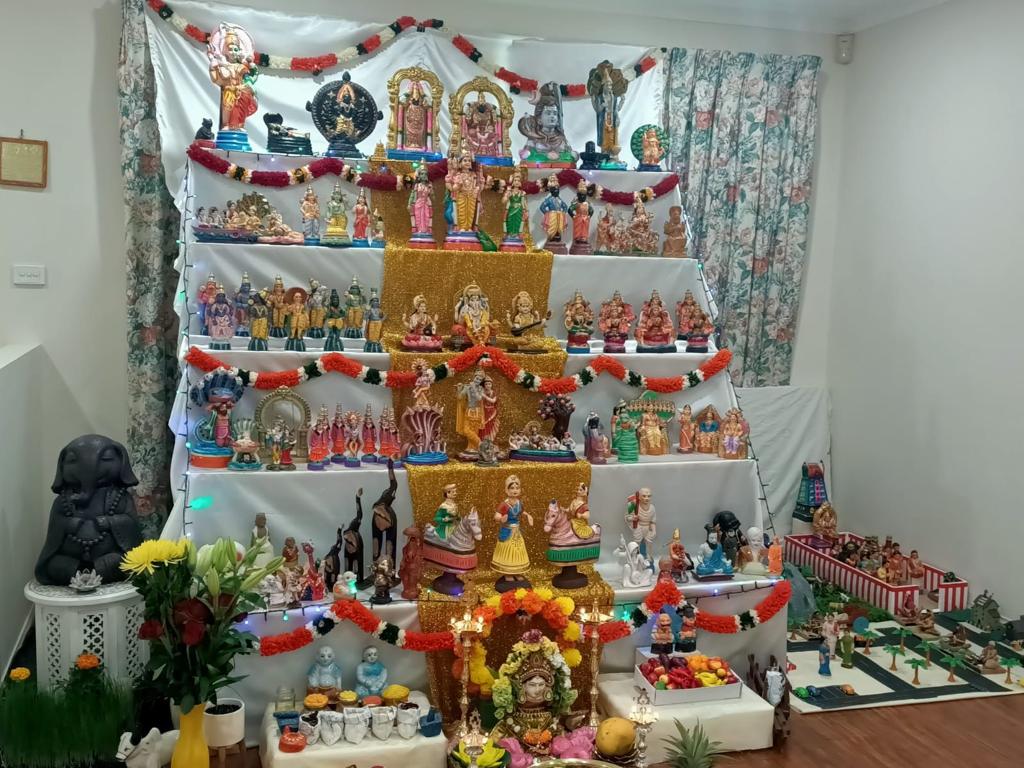
Golu is an autumn custom in South India where families assemble stepped tiers of dolls and figurines during the nine nights of Navaratri. Handcrafted figures of deities, daily life, and wedding couples are displayed at home while neighbours visit to share sweets and sing hymns.
When is Golu marked?
Golu is kept as part of Navratri, which runs from 11 to 19 October 2026.
Golu is an autumn domestic observance across South India, held throughout the nine nights of Navaratri and concluding on Vijayadashami. Households set up tiered wooden steps covered in cloth to display painted dolls, sacred deities, and miniature scenes of everyday life. The tradition brings family and neighbours together to view the arrangements, exchange gifts, sing devotional songs, and honour the divine feminine across successive festival days.
Building the stepped tiers
The centerpiece of the festival is the padi, a set of stepped wooden planks assembled inside the home. Families construct these shelves in odd numbers, usually spanning three to eleven tiers, and drape them in cloth before arranging their figurines. The highest steps hold representations of Hindu deities, while lower levels depict courtly processions, weddings, baby showers, and scenes from daily routines. Miniature kitchen sets, folk characters, and modern figures such as freedom fighters also find a place on the shelves. Rural artisans craft the figurines from clay, wood, or lightweight paper mache, finishing them in vivid colours to narrate sacred epics and everyday stories.
Heirloom figures and craft traditions
A central element of the display is a pair of wooden bride and groom figures known as Marapacchi Bommai or Pattada Gombe. Carved from woods such as teak, sandalwood, or rosewood, these figures are gifted to a bride by her parents during her wedding to begin her own household display. They are dressed in new miniature garments every autumn and passed down as cherished family heirlooms over multiple generations. Golu also sustains diverse regional craft communities across South India. Artisans create specialized figures, including dynamic bobblehead dancing dolls from Thanjavur, painted wooden sets from Kondapalli and Channapatna, and terracotta figures made by traditional potters in Vilacheri near Madurai.
Nine nights of rituals and hospitality
The observance commences on the first day of Navaratri with an elder invoking the goddesses and installing a sacred pot at an auspicious hour. The nine days are partitioned into three phases, honoring Durga during the initial three days, Lakshmi over the middle three, and Saraswati during the final stretch. On the ninth day, families perform Saraswati Puja by placing musical instruments and educational books before the altar. Throughout the festival evenings, women and children visit neighboring homes to admire the tiers, chant shlokas, and light traditional brass lamps over decorative floor art. Hosts share consecrated festival food and sweets, reinforcing community ties before concluding on Vijayadashami.
Royal roots and modern practice
Historical records trace the custom to the Vijayanagara monarchy and its grand Mahanavami festivities, where royal durbars inspired domestic displays that reflected social structures. The practice was carried across the region by the Nayakas and Polygars, flourishing in royal courts such as Thanjavur and Pudukkottai. By the late nineteenth century, the tradition spread beyond aristocratic circles into broader urban households, especially through families in Madras. Today, while maintained as a home devotion, grand public displays are also mounted in major regional shrines, such as the Meenakshi Temple in Madurai, where visitors gather to view expansive religious tableaus.
How Golu is kept
An elder begins on the first day of Navaratri with an invocation of the goddesses and the installation of a sacred pot. Family members assemble an odd number of fabric-covered steps and arrange their doll collection, placing deities at the highest level and secular scenes below. Each evening, neighbours visit to view the exhibition, light oil lamps beside decorative floor patterns, chant prayers, and share sweets. On the ninth day, books and instruments receive blessings during Saraswati Puja. The celebration concludes on Vijayadashami, when a doll is symbolically laid down to sleep and the steps are dismantled.
When and where
The observance takes place annually during the autumn festival of Navaratri, beginning at Mahalaya and extending across nine nights to the tenth day, Vijayadashami. Regional variations also see dolls displayed during Makara Sankranti in January or on Gokulashtami.
Golu is practiced in southern India, particularly across Tamil Nadu, Andhra Pradesh, and Karnataka, as well as parts of Kerala. Prominent Hindu temples, including the Meenakshi Temple in Madurai, erect large public displays alongside home exhibitions.
What Golu means
The tiered shelves reflect the order of the cosmos and human society, dedicated to the supreme goddess. Higher levels house divinity, while lower steps capture human life, crafts, and festive milestones. Handed down across generations, the wooden bridal couple embodies marital harmony, fertility, and family prosperity, linking household heritage with sacred myths.



Days Golu is marked
Questions people ask about Golu
When is Golu marked?
Golu is kept as part of Navratri, which runs from 11 to 19 October 2026.
What is Golu?
Golu is a South Indian festive tradition where families arrange an elaborate exhibition of painted dolls and figurines on stepped shelves during the autumn festival of Navaratri.
What are Marapacchi Bommai?
These are traditional wooden bride and groom dolls given to a woman by her parents during her wedding. Dressed in fresh garments each year, they represent fertility, prosperity, and family heritage.
How does the Golu display end?
On the evening of the tenth day, Vijayadashami, a doll is symbolically laid down to rest, the ceremonial water pot is shifted slightly north, and the steps are dismantled until the following year.
See also
 Bhai DoojA Hindu festival of sibling bonds marked by forehead markings, feasts and blessings
 DashainA fifteen-day festival of family gatherings, blessings, and feasts across Nepal
 Hola MohallaA three-day Sikh festival of martial arts, poetry, shared meals and grand processionsAs-salamu alaykumA traditional Arabic greeting of peace exchanged in daily life and prayer
Good reading and sources
- Golu (festival) on WikipediaEncyclopedia
- More photos on Wikimedia CommonsPhotos and video
- Wikidata recordOpen data
The facts on this page come from the Wikipedia article "Golu (festival)", written by its contributors and used under the CC BY-SA 4.0 licence, and from its Wikidata record (CC0). EveryParampara rewrote the text in its own words, with AI assistance, and compares every page with the article to make sure no passage is copied. It may be reused under the same CC BY-SA 4.0 licence with a link back.
It may contain mistakes. Traditions differ from one family, village and community to the next, and the people who keep them know them best. If something is wrong, tell us. Last refreshed 2026-10-04.
More from India
All the traditions of India 🇮🇳 Thrissur, IndiaThrissur Pooramതൃശ്ശൂര് പൂരം
A grand Kerala temple gathering with elephant pageantry, percussion, and fireworksFestival
🇮🇳 Thrissur, IndiaThrissur Pooramതൃശ്ശൂര് പൂരം
A grand Kerala temple gathering with elephant pageantry, percussion, and fireworksFestival
 🇫🇷 France and 4 morePicnic
A meal taken outdoors in a park or scenic spot, often shared with friends and family.Festival · Lunch
🇮🇳 Goa, India and 2 moreBhai Doojभाई दूज
A Hindu festival of sibling bonds marked by forehead markings, feasts and blessingsFestival · Feasts and festival meals
🇳🇵 Kathmandu, Nepal and 4 moreDashainबडादशैँ
A fifteen-day festival of family gatherings, blessings, and feasts across NepalFestival
🇫🇷 France and 4 morePicnic
A meal taken outdoors in a park or scenic spot, often shared with friends and family.Festival · Lunch
🇮🇳 Goa, India and 2 moreBhai Doojभाई दूज
A Hindu festival of sibling bonds marked by forehead markings, feasts and blessingsFestival · Feasts and festival meals
🇳🇵 Kathmandu, Nepal and 4 moreDashainबडादशैँ
A fifteen-day festival of family gatherings, blessings, and feasts across NepalFestival
The same idea elsewhere
Hospitality and welcome compared 🇰🇷 South KoreaKorean tea ceremony다례 (茶禮)
Tea served in Korea as a rite of courtesy, now mostly grain and herbal brewsTable custom · Tea, coffee and drinking ceremonies
🇰🇷 South KoreaKorean tea ceremony다례 (茶禮)
Tea served in Korea as a rite of courtesy, now mostly grain and herbal brewsTable custom · Tea, coffee and drinking ceremonies
 🇹🇷 Turkey and 5 moreEid al-Fitrعيد الفطر
The feast that ends Ramadan, opened with morning prayers, sweets and visits homeFestival · Feasts and festival meals
🇹🇷 Turkey and 5 moreEid al-Fitrعيد الفطر
The feast that ends Ramadan, opened with morning prayers, sweets and visits homeFestival · Feasts and festival meals
 🇮🇱 IsraelRosh Hashanahרֹאשׁ הַשָּׁנָה
The Jewish New Year marked by shofar horn blasts, prayer and sweet foodsSpiritual
🇮🇱 IsraelRosh Hashanahרֹאשׁ הַשָּׁנָה
The Jewish New Year marked by shofar horn blasts, prayer and sweet foodsSpiritual
 🇮🇱 Jerusalem, IsraelSukkotסוכות
A seven-day autumn Jewish festival of temporary booths, harvest prayers and hospitalitySpiritual
🇮🇱 Jerusalem, IsraelSukkotסוכות
A seven-day autumn Jewish festival of temporary booths, harvest prayers and hospitalitySpiritual