Customs of food and drinkEast AsiaBuddhist
Korean tea ceremony
In its own language: 다례 (茶禮)
Tea served in Korea as a rite of courtesy, now mostly grain and herbal brews

Korean tea ceremonies, known as darye, are rites of preparing and serving tea that have been kept in Korea for more than a thousand years, at court, in Buddhist temples and at family observances. Most Korean tea today is grain or herbal rather than leaf tea, and it is drunk without a Japanese-style ceremony.
When is Korean tea ceremony kept?
Korean tea ceremony is kept on court rites ran through the Goryeo and Joseon dynasties, with a daytime Day Tea Rite and a Special Tea Rite on set occasions. After a declin.
Darye, the Korean rite of tea, is a way of preparing and offering tea with courtesy. It has been part of life in Korea for more than a thousand years, at court and in temples, and in family rites. Today the drink is usually grain or herbal rather than leaf tea, and it is served without a Japanese-style ceremony.
What it is
Darye is the Korean practice of preparing and serving tea, and its name can be read as the manners that belong with tea, a rite of courtesy. It sits among the tea ceremonies of East Asia, yet Korean sources treat it as a form of its own. Its story runs through court ritual, offerings in temples and simple observances at home. Tea has been offered and drunk in Korea for more than a thousand years. What fills the cup is often not leaf tea at all: most Korean tea today is grain or herbal.
Early records
The oldest written trace of tea given to an ancestral spirit belongs to the year 661, when a cup was set before the spirit of King Suro, the founder of Geumgwan Gaya. In the Goryeo dynasty, which ran from 918 to 1392, monks were remembered with tea in Buddhist temples. Large state rites that involved tea drinking were led by officials of a court office called the Tabang. One of those occasions is written down in the Goryeosa Yaeji, a Goryeo official history, as part of welcoming a messenger from China.
Tea, tax and land
Tea in Korea grew in the mountains, and that shaped everything around it. The peninsula is colder than the tea districts of China or Japan, so picking came at the very edge of spring, when the slopes could still be dangerous with snow and wild animals. An old Korean name for tea, seollok or snow green, carries the image of first leaves gathered from snowy ground. The same wooded hills made good farmland, and the tea harvest fell at the same time as sowing grain. Farmers near the tea forests owed the king a heavy tea tax. Scholars and officials petitioned against it, and at the end of Goryeo some farmers chopped down or burned their tea bushes.
Court rites and decline
Under the Joseon dynasty, which lasted from 1392 to 1910, tea rites at court were polished and set down. The Tabang office ran the chief royal ceremony, while the royal family and the noble class kept simpler forms. A Day Tea Rite was held in daylight, and a Special Tea Rite was kept for particular occasions. Both were written into the National Five Rites of 1474, and the sources note that such names belong to Korea alone. Later, tea drinking faded except at anniversaries of the dead. King Seonjo, so the account goes, heard from a Ming commander named Yang Hao that fine tea bushes grew in Korea and that the crop would fetch great silver in Liaodong. The king answered that his country had no custom of tea drinking.
Tea houses and change
Modern life changed the drink and the room it was drunk in. Tea houses called dabang appeared, and the earliest one named by the sources opened in 1902 at the Sontag Hotel in Seoul. They multiplied through the years of Japanese colonial rule and spread across the country. From the 1930s to the 1980s the favourite order was ssanghwacha, a sweetened herbal brew that held no tea extract at all, with Western-style black tea, hongcha, a distant second. Neither was served with any ceremony. The cup itself changed too: the earliest teas used in the old rites were compressed cakes of black tea, in the manner of aged pu-erh, and old tea brought from China was prized at court.
How Korean tea ceremony is kept
The sources describe the old rites more than the modern ones. Officials of the Tabang office presided over the national ceremonies that included tea drinking, and tea was poured as an offering, for the spirit of a founding king and for monks remembered in temples. At court, the royal family and the nobility kept their own simpler rites: the Day Tea Rite by daylight, the Special Tea Rite when an occasion called for it. In the tea houses of the 20th century there was no ceremonial side at all, and customers simply ordered a drink.
When and where
There is no single date for darye in the sources. Court tea rites were tied to occasions rather than to one day of the year: the Day Tea Rite was a daytime ceremony, and the Special Tea Rite was reserved for particular events, such as receiving a messenger from China. Tea drinking at court faded in the middle of the Joseon period and carried on mostly in anniversary ceremonies.
Korea is its home, on the peninsula and among Korean people elsewhere. The oldest settings were the court and Buddhist temples. When tea growing was held back in Joseon times to protect farmland, the older drinking customs lasted longest in the mountain districts where tea trees grew, and among the yangban class and the royal family. Tea houses later spread the habit through the country.
What Korean tea ceremony means
The word darye is about conduct as much as about drink: the manners that belong with tea. In its recorded past the cup carried messages that had nothing to do with thirst. Tea was set before the spirit of King Suro, and in Goryeo temples it honoured monks who had died. Old vintages were respected at court, and tea brought from China was a mark of standing. Even the Korean name for the leaf, snow green, ties the drink to cold mountain ground.
Questions people ask about Korean tea ceremony
When is Korean tea ceremony kept?
Korean tea ceremony is kept on court rites ran through the Goryeo and Joseon dynasties, with a daytime Day Tea Rite and a Special Tea Rite on set occasions. After a declin.
What is a Korean tea ceremony?
It is a rite of preparing and serving tea, called darye in Korean, a word that points to the manners that go with tea. It has been kept in Korea for more than a thousand years, at court, in temples and in family observances. Most tea drunk in Korea today is grain or herbal.
Where is it kept?
In Korea, and among Korean people elsewhere. It was strongest at court during the Goryeo and Joseon dynasties and in Buddhist temples. Later, the older drinking customs survived longest in the mountain districts where tea trees grew, and tea houses spread the habit through the country.
Is it the same as a Japanese tea ceremony?
No. Korean sources say Korean tea is mostly herbal and is drunk without a Japanese-style ceremony. Korea also has its own recorded forms, among them the Day Tea Rite and the Special Tea Rite, named in the National Five Rites of 1474.
Why did tea drinking decline?
By the middle of the Joseon dynasty it had fallen away except at anniversary ceremonies. Older troubles had already slowed it: a heavy tea tax, petitions from scholars, and farmers at the end of Goryeo who destroyed their own tea bushes in protest.
See also
 HaenyeoFemale free-divers of Jeju Island who harvest seafood from the ocean.
 Tea cultureHow tea is prepared, shared and served, from Chinese tea houses to Tibetan butter tea
 Water lanternSmall lamps floated on water to honour the dead and ask for good fortune
 GutSacred rites of song, dance, and spirit communion performed by Korean shamans
Good reading and sources
- Korean tea ceremony on WikipediaEncyclopedia
- More photos on Wikimedia CommonsPhotos and video
- Wikidata recordOpen data
The facts on this page come from the Wikipedia article "Korean tea ceremony", written by its contributors and used under the CC BY-SA 4.0 licence, and from its Wikidata record (CC0). EveryParampara rewrote the text in its own words, with AI assistance, and compares every page with the article to make sure no passage is copied. It may be reused under the same CC BY-SA 4.0 licence with a link back.
It may contain mistakes. Traditions differ from one family, village and community to the next, and the people who keep them know them best. If something is wrong, tell us. Last refreshed 2026-10-05.
More from South Korea
All the traditions of South Korea
🇰🇷 Jeju, South KoreaHaenyeo해녀
Female free-divers of Jeju Island who harvest seafood from the ocean.Table custom
🇨🇳 China and 5 moreTea culture
How tea is prepared, shared and served, from Chinese tea houses to Tibetan butter teaTable custom · Tea, coffee and drinking ceremonies
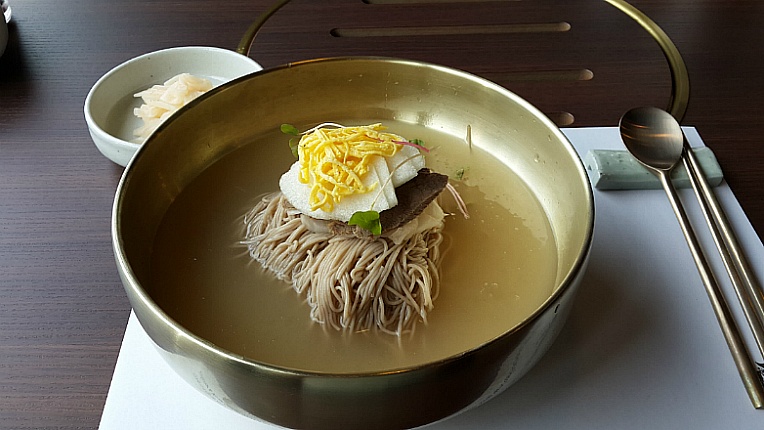 🇰🇵 Pyongyang, North Korea and 3 moreNaengmyeon냉면
Long buckwheat noodles in icy broth, born in North Korea and eaten most in summerTable custom · Dinner
🇰🇵 Pyongyang, North Korea and 3 moreNaengmyeon냉면
Long buckwheat noodles in icy broth, born in North Korea and eaten most in summerTable custom · Dinner
 🇰🇷 South KoreaGimjang김장
Korea's late-autumn work of making enough kimchi to last the winterTable custom
🇰🇷 South KoreaGimjang김장
Korea's late-autumn work of making enough kimchi to last the winterTable custom
The same idea elsewhere
Tea, coffee and the drinking ceremony compared 🇬🇷 GreeceSymposiumσυμπόσιον
An ancient Greek post-meal gathering for diluted wine, debate, music and lively gamesTable custom · Tea, coffee and drinking ceremonies
🇬🇷 GreeceSymposiumσυμπόσιον
An ancient Greek post-meal gathering for diluted wine, debate, music and lively gamesTable custom · Tea, coffee and drinking ceremonies
 🇮🇱 Jerusalem, IsraelSukkotסוכות
A seven-day autumn Jewish festival of temporary booths, harvest prayers and hospitalitySpiritual
🇮🇱 Jerusalem, IsraelSukkotסוכות
A seven-day autumn Jewish festival of temporary booths, harvest prayers and hospitalitySpiritual
 🇲🇱 Bamako, Mali and 5 moreGriotjeli, ߖߋ߬ߟߌ in N'Ko script
West Africa's hereditary keepers of spoken history, praise and musicPerformance
🇲🇱 Bamako, Mali and 5 moreGriotjeli, ߖߋ߬ߟߌ in N'Ko script
West Africa's hereditary keepers of spoken history, praise and musicPerformance
 🇵🇪 Cusco, Peru and 4 moreIntiinti (Quechua)
The Inca sun deity, honoured with temples, offerings and the June festival Inti RaymiSpiritual
🇵🇪 Cusco, Peru and 4 moreIntiinti (Quechua)
The Inca sun deity, honoured with temples, offerings and the June festival Inti RaymiSpiritual