Music, dance and storytellingSub-Saharan Africa
Griot
In its own language: jeli, ߖߋ߬ߟߌ in N'Ko script
West Africa's hereditary keepers of spoken history, praise and music

Griots are West Africa's hereditary keepers of spoken history. Griot families, known as jeli in Manding, hold genealogies, praise songs and old stories in memory and perform them aloud, often with an instrument, at weddings, naming ceremonies and public gatherings in Mali, Senegal and neighbouring countries.
No one wrote down the early history of the Mande lands. Griots carried it in memory instead, and still do. A griot is a hereditary specialist in speech and music: a reciter of genealogies, a praiser of patrons, a storyteller and an adviser. Their families have long kept the memory of kings, villages and households across West Africa.
What a griot is
A griot is a professional of the spoken word. The work takes several shapes: reciting the history of a family or a people, singing the praises of a patron, playing an instrument, and offering advice. The stories a griot tells are learned by heart rather than read from a page, so a skilled performer can use rhythm, melody and poetic turns of phrase to hold an audience. Because griots know the past of a community, people look to them for guidance. Most villages once had their own griot, who remembered births, marriages, deaths, battles and quarrels.
Names and their roots
The name griot is the English one. It may come from guiriot, a French rendering of the Portuguese criado, the word for a male servant, though the origin is uncertain. Mande speakers say jeli or jali, written ߖߋ߬ߟߌ in N'Ko script. Their noun jeliya, roughly 'musicianhood', points to a hereditary calling. Wolof speakers say gewel, Serer speakers paar or kevel, and Pulaar speakers gawlo. Hassaniya, Yoruba and Soninke each have their own words. A few of these may come from Arabic qawl, a saying. The poet Bakari Sumano preferred jeli to griot; Amiri Baraka and Balufu Bakupa-Kanyinda have used djali.
Learning in the family
Griot status usually passes down a family line. Children born into jeli households grow up among musicians and storytellers and start early. They pick up the craft by watching, copying and taking small parts in performances, not by sitting in a classroom. In Mande teaching, learners repeat short passages of real pieces rather than practice drills, and then stretch those passages into longer works. Memory is only half of it: a good griot also learns to adapt a performance to whoever is listening. Instruments often run in families too. Men are commonly linked with the kora, balafon or ngoni, while women specialise in singing.
Women who praise
Women griots, often called griottes, are known in Mande languages as jelimusow. They come from the same hereditary families and train in the same way. At weddings a griotte may dress the bride, stay close to her through the rituals and sing praise that ties the two families together. The songs carry advice about what marriage will ask of a bride. Performers who reach the highest level of historical knowledge and verbal skill can be given the title ngara, which was long reserved for men. On stage, women who are quiet in daily life take on a commanding presence, a loud voice and bright dress, marking their caste apart from noble women.
Courts, kings and patrons
For centuries griots were tied to power. A griot family served a family of warrior kings or emperors, called jatigi, and the bond ran both ways: neither side was complete without the other, and a jatigi could lend his griot out. Every king had a griot, and griots served as advisers. In the Epic of Sundiata, Naré Maghann Konaté gave his son Sundiata Keita a griot named Balla Fasséké, who is remembered as the founder of the Kouyaté line. That independence let griots speak plainly to the powerful, criticise them and step between quarrelling parties. Skilled speakers could load a sentence with more than one meaning. Not all of this brought honour: griots were set apart as a caste, and some were buried in trees rather than in the earth.
How Griot is kept
A griot is called when a family or a town has something to mark. At a wedding the griot may sing the histories of both households and remind each side of the bond between them. At a naming or a funeral, the story of the family is told again. Where two parties are in conflict, a griot can move between them and open talks, since respect for the office protects the messenger. Performances mix speech, song and instrument. In the past a griot also lived at court, advising a ruler and speaking unwelcome truths when needed.
When and where
There is no fixed day or season. Griots are called on whenever a family has something to mark, whether a birth, a naming, a wedding, a death or a public commemoration. Their work runs through the year, and a griot family may serve the same households across several generations.
Griot traditions belong to West Africa, and they are most widespread in the northern part of the region. The strongest presence is in the Mande lands of Mali, with related traditions in Senegal, Guinea, Mauritania, Gambia, Guinea-Bissau, Burkina Faso and Niger. Griots also live in cities such as Bamako, Saint-Louis, Dakar and Conakry, and in diaspora communities in the United States and France.
What Griot means
Speech itself carries power for many West African peoples, and griots are its specialists. The name jeli is linked to a word for blood, which hints at how deeply the calling is thought to run in a family. In earlier times people believed the words of nyamakala, the artisan specialists who include griots, could lift a patron above his rank or pull a noble down. Women's performance is tied to ama, a form of ritual power attached to griot status. Griots also carry the values of a people, teaching the young what their community expects.


Questions people ask about Griot
What is a griot?
A griot is a hereditary West African specialist in the spoken word. The role covers reciting the history of a family or a people, singing praise, playing an instrument and advising a patron. Griots learn their material by heart, and the history they keep is handed down in families rather than written in books.
Where do griots live and work?
Griot traditions belong to West Africa and are strongest in the north of the region, above all in the Mande lands of Mali. Related traditions are found in Senegal, Guinea, Mauritania, Gambia, Burkina Faso and elsewhere, and griot families also live in the United States and France.
Is there a fixed day for griot performances?
No. Griots work at the events of family life: naming ceremonies, weddings, funerals and public commemorations. A village griot once knew the births, marriages and deaths of everyone around, and a court griot stayed close to a ruler. Performances follow these occasions rather than a calendar.
Do you have to be born into a griot family?
The calling is usually inherited. Griots have formed an endogamous group, meaning that they mostly marry other griots, and children grow up inside the practice. Musicianship is treated as something a family carries rather than something a stranger learns at school, although skill matters as much as birth.
Can women be griots?
Yes. Women griots, called griottes, come from the same families and appear at weddings, naming ceremonies and public events. In Mali many have become leading performers. The honorific title ngara, given for deep knowledge of history and strong performance, was long thought of as a man's title but has been given to women too.
See also
 KoraA 21-string West African harp-lute played by hereditary storytellers and bards
 FantasiaA North African equestrian display of synchronized charging and simultaneous rifle fireZouglouA dance-led music style from Ivory Coast, sung in street slang and local languages
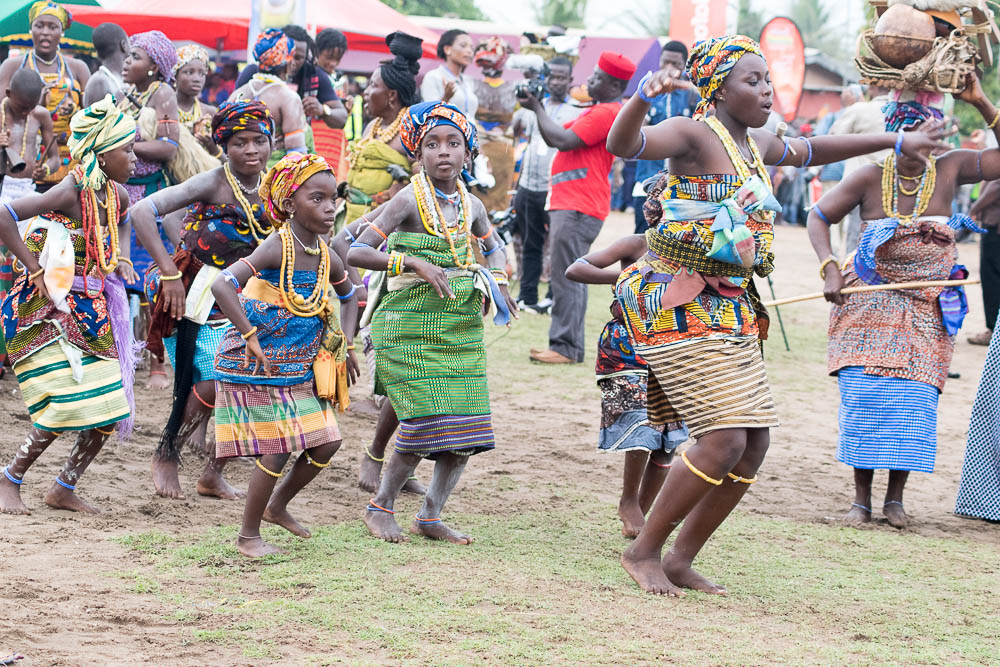 AgbadzaAn Ewe music and dance, born of war songs and kept for funerals, weddings and festivals
Good reading and sources
- Griot on WikipediaEncyclopedia
- More photos on Wikimedia CommonsPhotos and video
- Wikidata recordOpen data
The facts on this page come from the Wikipedia article "Griot", written by its contributors and used under the CC BY-SA 4.0 licence, and from its Wikidata record (CC0). EveryParampara rewrote the text in its own words, with AI assistance, and compares every page with the article to make sure no passage is copied. It may be reused under the same CC BY-SA 4.0 licence with a link back.
It may contain mistakes. Traditions differ from one family, village and community to the next, and the people who keep them know them best. If something is wrong, tell us. Last refreshed 2026-10-05.
More from Mali
All the traditions of Mali
🇬🇲 Gambia and 4 moreKoraߞߐߙߊ
A 21-string West African harp-lute played by hereditary storytellers and bardsPerformance
🇲🇦 Rabat, Morocco and 5 moreFantasiaالفانتازيا
A North African equestrian display of synchronized charging and simultaneous rifle fireGame
 🇲🇱 San, Mali and 1 moreBògòlanfinibɔgɔlanfini
A handmade Malian cotton textile dyed with iron-rich mud, worn for protection and identity.Dress
🇲🇱 MaliMahrمهر
A mandatory gift from the groom to the bride in Islamic marriages, serving as her financial security.Rite of passage
🇲🇱 San, Mali and 1 moreBògòlanfinibɔgɔlanfini
A handmade Malian cotton textile dyed with iron-rich mud, worn for protection and identity.Dress
🇲🇱 MaliMahrمهر
A mandatory gift from the groom to the bride in Islamic marriages, serving as her financial security.Rite of passage
The same idea elsewhere
Royalty and coronation compared 🇨🇳 Puyang, ChinaFeng shui風水
The Chinese spatial practice of aligning homes and graves with natural energyFolklore
🇨🇳 Puyang, ChinaFeng shui風水
The Chinese spatial practice of aligning homes and graves with natural energyFolklore
 🇲🇲 Bagan, MyanmarNat worshipနတ်
Veneration of guardian spirits and nature deities alongside Buddhism in MyanmarSpiritual
🇲🇲 Bagan, MyanmarNat worshipနတ်
Veneration of guardian spirits and nature deities alongside Buddhism in MyanmarSpiritual
 🇵🇪 Cusco, Peru and 4 moreIntiinti (Quechua)
The Inca sun deity, honoured with temples, offerings and the June festival Inti RaymiSpiritual
🇵🇪 Cusco, Peru and 4 moreIntiinti (Quechua)
The Inca sun deity, honoured with temples, offerings and the June festival Inti RaymiSpiritual
 🇧🇷 Recife, Brazil and 1 moreMaracatu
A set of Afro-Brazilian performance traditions from Pernambuco and Ceará featuring drumming, dance, and royal pageantry.Performance
🇧🇷 Recife, Brazil and 1 moreMaracatu
A set of Afro-Brazilian performance traditions from Pernambuco and Ceará featuring drumming, dance, and royal pageantry.Performance