Festivals and celebrationsSub-Saharan Africa
Guérewol
A week-long courtship ritual where Wodaabe men dance and sing to win the attention of marriageable women.

The Guérewol is an annual gathering of the Wodaabe Fula people in Niger. Young men perform intricate dances and songs to demonstrate their beauty and stamina for potential brides. The event takes place at the end of the rainy season as herders regroup before dispersing for the dry months.
When is Guérewol kept?
Guérewol is kept on annually in September, following the rainy season.
The Guérewol serves as a vital social and romantic festival for the nomadic Wodaabe community. It brings together clans after the seasonal migration cycle to celebrate beauty, endurance, and courtship through performance.
Origins and timing
This ritual occurs each year as the traditionally nomadic cattle herders regroup at the southern edge of the Sahara. They gather before dispersing southward toward their dry season pastures. The most significant meeting point is In-Gall in northwest Niger. This location hosts a larger festival known as the Cure Salée, which includes market activities and clan meetings involving both the Wodaabe and the Tuareg people. The actual dance competition is called the Yaake, but the broader week-long event encompasses bartering, dowry discussions, and camel races.
Performance and dance
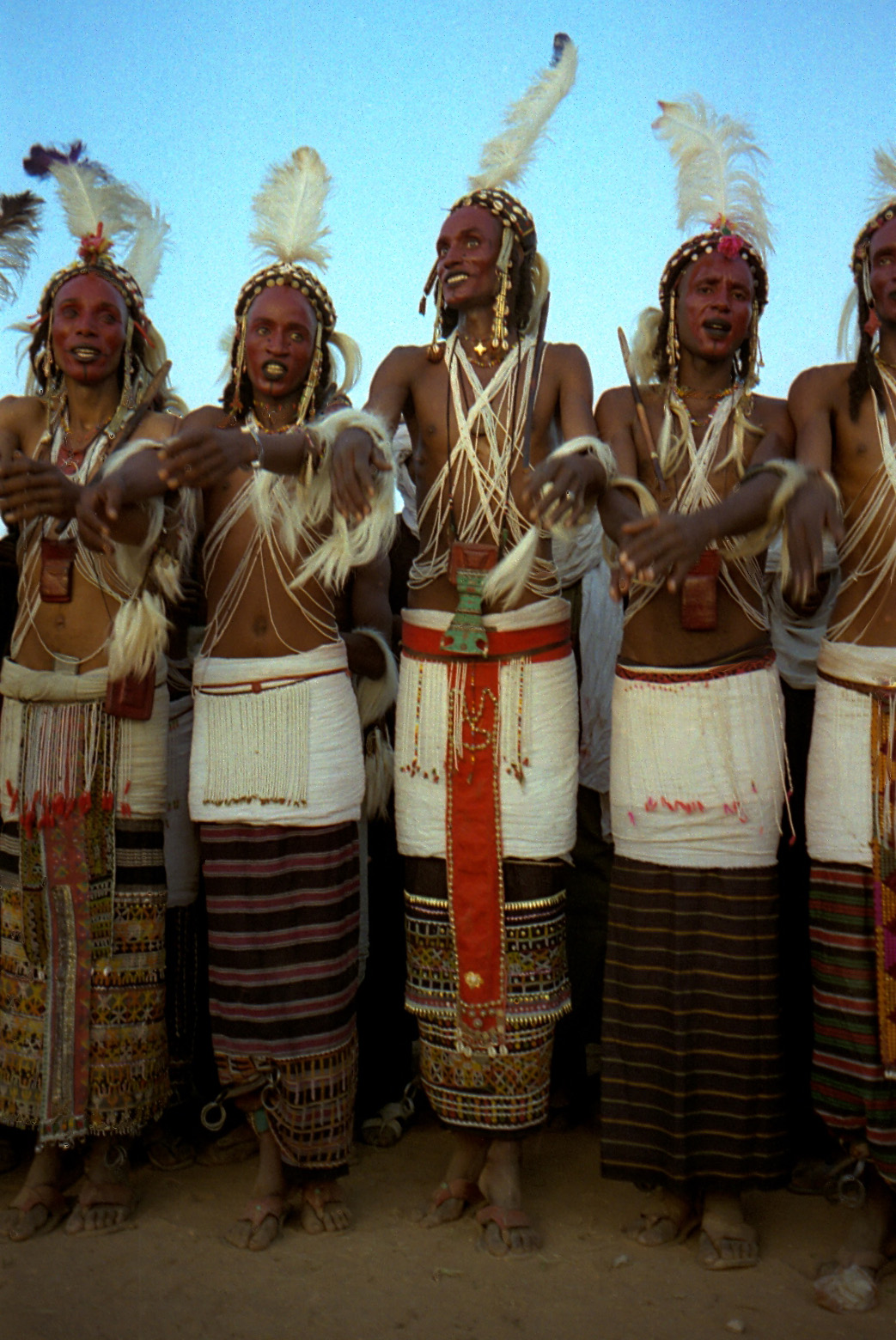
Young men line up to dance and sing while wearing elaborate ornamentation and traditional face paint. They interlink arms and sway in a hypnotic rhythm, rising and falling on their toes. The music features group singing accompanied by clapping, stomping, and bells. Men often roll their eyes and bare their teeth to highlight the physical traits valued by their culture: tallness, white eyes, and white teeth. Suitors may perform repeatedly over seven days, sometimes dancing for hours under the desert sun to prove their stamina and attractiveness.
Courtship and judgment
The core purpose of the gathering is courtship. Marriageable young women judge the beauty and suitability of the male dancers. Suitors approach the encampment of the woman they wish to impress to demonstrate their interest. To sustain their energy during these long performances, participants sometimes drink a fermented bark concoction. This beverage is reputed to have hallucinogenic effects that help them endure the physical demands of the ritual.
Cultural significance
The Guérewol preserves musical and dance traditions characteristic of the wider Fula people. These styles have largely faded among urbanized or educated Fula populations elsewhere. The festival remains one of the most famous examples of this percussive choral tradition. While originally a local custom, it has gained international attention through documentaries and magazines. Western media coverage has turned the ritual into a notable tourist attraction, drawing visitors from abroad to witness the unique cultural expression.
How Guérewol is kept
Young men dress in ornate attire and apply traditional makeup. They form lines and perform the Yaake dance, swaying and singing to rhythmic percussion. Women observe and judge the performers based on physical attributes like eye whiteness and dental health. The event lasts for several days, with men demonstrating endurance through continuous performance. Other activities include camel races and dowry negotiations alongside the main dance competition.
When and where
Held annually in September after the rainy season ends. The date aligns with the natural migration cycle of the nomadic herders.
Primarily centered in In-Gall, Niger. The ritual also appears in other locations where Wodaabe communities gather during their transhumance routes, including areas near Niamey and extending into northern Cameroon and Nigeria.
What Guérewol means
The ritual emphasizes specific aesthetic ideals within the Wodaabe culture. Physical traits such as tall stature, white eyes, and bright teeth are celebrated as markers of beauty and character. The dance tests physical stamina and social grace, serving as a public forum for selecting marriage partners. It reinforces community bonds and preserves distinct artistic traditions against modernization.
Questions people ask about Guérewol
When is Guérewol kept?
Guérewol is kept on annually in September, following the rainy season.
What is the Guérewol?
It is an annual courtship ritual and dance competition held by the Wodaabe Fula people. Young men perform to attract marriageable women through displays of beauty and endurance.
Where does the Guérewol take place?
The main gathering occurs in In-Gall, Niger. The ritual is also found in other regions where Wodaabe herders travel, including parts of Cameroon and Nigeria.
Who judges the dancers?
Marriageable young women serve as the judges. They evaluate the male suitors based on their dance skills, physical appearance, and demonstrated stamina during the week-long event.
See also
 Calabar CarnivalAn annual December street festival and cultural gathering held in Calabar, Nigeria
 GeledeA Yoruba masked dance festival honoring the spiritual power of mothers and social harmony.
 Argungu Fishing FestivalA four-day gathering in Nigeria where thousands compete to land giant river fish
 Durbar festivalAn equestrian gathering marking Muslim holidays across northern Nigerian emirates
Good reading and sources
- Guérewol on WikipediaEncyclopedia
- More photos on Wikimedia CommonsPhotos and video
- Wikidata recordOpen data
The facts on this page come from the Wikipedia article "Guérewol", written by its contributors and used under the CC BY-SA 4.0 licence, and from its Wikidata record (CC0). EveryParampara rewrote the text in its own words, with AI assistance, and compares every page with the article to make sure no passage is copied. It may be reused under the same CC BY-SA 4.0 licence with a link back.
It may contain mistakes. Traditions differ from one family, village and community to the next, and the people who keep them know them best. If something is wrong, tell us. Last refreshed 2026-10-04.
More from Niger
All the traditions of Niger 🇳🇪 In-Gall, NigerCure Salée
A yearly gathering of Tuareg and Wodaabe nomads in In-Gall to mark the end of the rainy season.Festival
🇳🇪 In-Gall, NigerCure Salée
A yearly gathering of Tuareg and Wodaabe nomads in In-Gall to mark the end of the rainy season.Festival
 🇩🇿 Djanet, Algeria and 1 moreSebibaسبيبة (Arabic), ⵙⴱⵉⴱⴰ (Tifinagh)
A Tuareg festival and dance in the Algerian Sahara marking the Islamic New Year and Ashura.Festival
🇳🇬 Ibadan, Nigeria and 1 moreYoruba naming ceremonyÌkòlọ́pọ̀ Orúkọ Yorùbá
A rite of passage where a newborn receives a destiny name through divination and family celebration.Rite of passage · Feasts and festival meals
🇩🇿 Djanet, Algeria and 1 moreSebibaسبيبة (Arabic), ⵙⴱⵉⴱⴰ (Tifinagh)
A Tuareg festival and dance in the Algerian Sahara marking the Islamic New Year and Ashura.Festival
🇳🇬 Ibadan, Nigeria and 1 moreYoruba naming ceremonyÌkòlọ́pọ̀ Orúkọ Yorùbá
A rite of passage where a newborn receives a destiny name through divination and family celebration.Rite of passage · Feasts and festival meals
 🇧🇯 Porto-Novo, Benin and 3 moreZangbeto
A traditional security institution and night-guardian cult among the Ogu people of West Africa.Ceremony
🇧🇯 Porto-Novo, Benin and 3 moreZangbeto
A traditional security institution and night-guardian cult among the Ogu people of West Africa.Ceremony
The same idea elsewhere
All of this kind 🇮🇹 Rome, Italy and 4 moreChristmas
A festival of Jesus's birth, kept on 25 December with gifts, lights and shared mealsFestival
🇮🇹 Rome, Italy and 4 moreChristmas
A festival of Jesus's birth, kept on 25 December with gifts, lights and shared mealsFestival
 🇮🇪 Ireland and 5 moreHalloween
An annual observance on 31 October marking the eve of All Saints' Day, rooted in Christian tradition and Celtic heritageFestival · Sweets given and shared
🇮🇪 Ireland and 5 moreHalloween
An annual observance on 31 October marking the eve of All Saints' Day, rooted in Christian tradition and Celtic heritageFestival · Sweets given and shared
 🇬🇧 United Kingdom and 4 moreValentine's Day
A Christian feast day and cultural celebration of love kept on February 14 in many countries.Festival
🇬🇧 United Kingdom and 4 moreValentine's Day
A Christian feast day and cultural celebration of love kept on February 14 in many countries.Festival
 🇹🇷 Turkey and 5 moreEid al-Fitrعيد الفطر
The feast that ends Ramadan, opened with morning prayers, sweets and visits homeFestival · Feasts and festival meals
🇹🇷 Turkey and 5 moreEid al-Fitrعيد الفطر
The feast that ends Ramadan, opened with morning prayers, sweets and visits homeFestival · Feasts and festival meals