Dress and adornmentMiddle East
Jambiya
In its own language: جنبية
A short curved dagger worn at the waist by Yemeni men, its handle a sign of status

The jambiya is a short dagger with a curved, ridged blade that comes from the Hadhramaut region of Yemen. Yemeni men wear it at the waist from about the age of fourteen, in a sheath on a belt, and the handle often shows the wearer's standing.
When is Jambiya kept?
Jambiya is kept on worn every day by men from about the age of fourteen, and carried at dances and gatherings.
The jambiya is a short, curved dagger from the Hadhramaut region of Yemen, worn at the waist on a belt. Yemeni men take it up from about the age of fourteen. It is more than a weapon: the sheath, belt and especially the handle mark a man's standing, and the dagger appears in traditional dances and gatherings.
What it is
A jambiya is a dagger with a short, curved, double-edged blade and a ridge running down its middle. The blade is made of steel, sometimes Damascus or wootz steel. It sits in a sheath called 'Asib, usually wood covered with metal, leather or cloth. That sheath is fixed to a belt of tanned leather or thick cloth, normally two to three inches wide, worn low around the abdomen. The Arabic word janb means side, which is where the name comes from: the dagger hangs at a man's side. Extra items often hang from the same belt, such as a small silver purse for money and loose change.
From Yemen outwards
The jambiya comes from the Hadhramaut region of Yemen. Travellers carried it to the Ottoman Empire, Persia and India, where people adopted it with small changes to the blade, the handle and the scabbard. From Yemen it reached other parts of the Middle East and the Arab world, and also parts of South Asia and Southeast Asia. Wherever it went, the basic shape stayed: a short blade that curves, so the wearer does not have to bend the wrist to use it, and a heavy edge. The Yemeni version remains the best known.
Handles and standing
The handle of a jambiya is read as a sign of the wearer's position. The most famous kind is the saifani handle, made from rhinoceros horn and used on the daggers of wealthier men. Demand for that horn has pushed the black rhinoceros towards extinction. Other handles are cut from different horns, from wood, from metal, or from elephant and walrus ivory. Ivory handles are prized for their colour: a translucent one that yellows with age is called saifani heart, a greenish yellow one asadi, a whitish yellow one zaraf, and an onion-white one albasali.
Rules of wearing
Even though the jambiya carries meaning, it is still a weapon, and custom surrounds it with limits. A man should not draw it except in extreme conflict, and doing so without cause brings shame. People have used it in disputes, and the curve and weight of the blade make it effective for stabbing. Beyond fighting, it belongs to celebrations: men carry it in traditional dances and other gatherings. In ordinary use the dagger simply stays in its sheath at the waist, part of how a man dresses rather than something he expects to use.
Today and change
Not every part of Yemen keeps the jambiya in the same way. In the southern coastal cities of Aden and Mukalla, most men gave it up after it was banned under the Yemeni Socialist Party in South Yemen. Elsewhere it is not reserved for one class: judges, well-known merchants and business owners may wear the finest pieces. Old daggers once owned by famous people sell for very large sums. Ivory now arrives through smugglers because of an international ban, and some wearers, who see the jambiya as a tool, choose a hardwood handle instead. Others are made from shrapnel left by missiles.
How Jambiya is kept
Boys in Yemen begin to wear a jambiya at about the age of fourteen, as part of their clothing. The sheath is threaded onto a wide leather or cloth belt, and the belt is tied low around the abdomen. A silver purse or other small items may hang from it. From then on the dagger is carried at the side. It stays in the sheath through daily life and comes out only in extreme conflict. Men also carry it at dances and traditional gatherings, where it is part of the dress rather than a tool.
When and where
There is no fixed date for the jambiya, and no calendar day attached to it. It is worn every day by men past about fourteen, and it appears at traditional events such as dances, which can fall at any time of year.
Yemen is its home, and the Hadhramaut region is where it began. It is strongest in the Yemeni interior; in the coastal cities of Aden and Mukalla most men stopped wearing it after the ban in South Yemen. Versions of it are also found in the Middle East, the Arab world and parts of South and Southeast Asia.
What Jambiya means
A jambiya says something about the man who wears it. The material of the handle, the detail of the work and the ornaments on the sheath all point to his wealth and social position, so the dagger is worn as much for standing as for use. Yemeni custom also ties it to restraint: it should leave the sheath only in extreme conflict, and drawing it without cause brings shame. For many men it is part of how they dress from their teens onwards.


Questions people ask about Jambiya
When is Jambiya kept?
Jambiya is kept on worn every day by men from about the age of fourteen, and carried at dances and gatherings.
What is a jambiya?
It is a short dagger with a curved, double-edged blade that has a ridge down the middle. It comes from the Hadhramaut region of Yemen. Men above fourteen wear it as part of how they dress, held in a sheath fixed to a belt at the waist.
Where is it worn?
Its home is Yemen, and it began in the Hadhramaut region. Travellers took it to the Ottoman Empire, Persia and India, and it spread to other parts of the Middle East, the Arab world, South Asia and Southeast Asia. In Yemen it is now less common in Aden and Mukalla.
What are the handles made from?
Handles come from rhinoceros horn, other horns, wood, metal, and elephant or walrus ivory. The saifani handle is rhinoceros horn and belongs to wealthier wearers. Colour names mark different ivories: saifani heart, asadi, zaraf and albasali. Some who treat the dagger as a working tool prefer hardwood.
Is it only a weapon?
No. It is worn as part of a man's clothing and shows his social standing, and it is carried in traditional dances. Custom keeps it in its sheath except in extreme conflict. Its curved, heavy blade does make it a weapon, effective for stabbing.
See also
 TzitzitKnotted ritual fringes worn on a four-cornered garment, a reminder of the commandments
 PaithaniA handwoven silk sari from Maharashtra, with a squared border and a peacock pallu
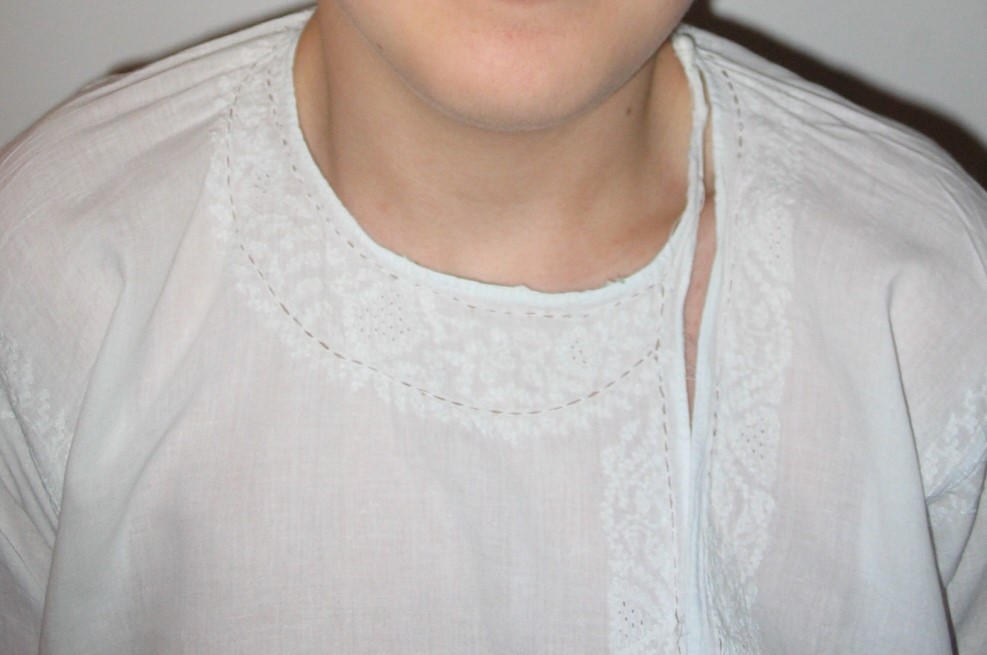 KurtaA loose collarless tunic from South Asia, worn plain or embroidered over pyjamas or jeans
 DiwaliA five-day festival of lights celebrated across India and its diaspora to mark the victory of light over darkness.
Good reading and sources
- Jambiya on WikipediaEncyclopedia
- More photos on Wikimedia CommonsPhotos and video
- Wikidata recordOpen data
The facts on this page come from the Wikipedia article "Jambiya", written by its contributors and used under the CC BY-SA 4.0 licence, and from its Wikidata record (CC0). EveryParampara rewrote the text in its own words, with AI assistance, and compares every page with the article to make sure no passage is copied. It may be reused under the same CC BY-SA 4.0 licence with a link back.
It may contain mistakes. Traditions differ from one family, village and community to the next, and the people who keep them know them best. If something is wrong, tell us. Last refreshed 2026-10-05.
More from Yemen
All the traditions of Yemen
🇮🇱 Israel and 1 moreTzitzitצִיצִית
Knotted ritual fringes worn on a four-cornered garment, a reminder of the commandmentsDress
 🇩🇿 Algeria and 4 moreFoutaفوطة
A thin patterned cotton or linen cloth, worn as a wrap at the baths and as dressDress
🇩🇿 Algeria and 4 moreFoutaفوطة
A thin patterned cotton or linen cloth, worn as a wrap at the baths and as dressDress
 🇸🇦 Riyadh, Saudi Arabia and 4 moreMajlis
A traditional sitting room and community assembly for hospitality and civic counselEtiquette
🇸🇦 Riyadh, Saudi Arabia and 4 moreMajlis
A traditional sitting room and community assembly for hospitality and civic counselEtiquette
 🇮🇱 Israel and 5 moreKaddishקַדִּישׁ
A Jewish hymn of sanctification recited during prayer services and mourning rituals.Spiritual
🇮🇱 Israel and 5 moreKaddishקַדִּישׁ
A Jewish hymn of sanctification recited during prayer services and mourning rituals.Spiritual
The same idea elsewhere
All of this kind
🇮🇳 Paithan, IndiaPaithani
A handwoven silk sari from Maharashtra, with a squared border and a peacock palluDress
 🇳🇴 Norway and 3 moreGákti
A traditional coat worn by the Sámi people across northern Scandinavia and Russia, signaling origin and status through cDress
🇳🇴 Norway and 3 moreGákti
A traditional coat worn by the Sámi people across northern Scandinavia and Russia, signaling origin and status through cDress
 🇼🇸 Samoa and 1 moreʻIe tōga
Precious woven mats exchanged in Samoan ceremonies to honor family ties and chiefly status.Dress
🇼🇸 Samoa and 1 moreʻIe tōga
Precious woven mats exchanged in Samoan ceremonies to honor family ties and chiefly status.Dress
 🇪🇬 Egypt and 5 moreTraditional tattooing
The ancient custom of marking the skin for protection, healing, status and sacred ritesDress
🇪🇬 Egypt and 5 moreTraditional tattooing
The ancient custom of marking the skin for protection, healing, status and sacred ritesDress