Festivals and celebrationsEuropeChristianIndigenous and traditional
Julebukking
In its own language: Gå julebukk
A Scandinavian Christmas custom where masked visitors go door to door for songs and treats.

Julebukking is a festive tradition from Scandinavia kept between Christmas and New Year. People wear costumes and masks to visit neighbors, who try to guess their identities. The practice involves singing, sharing sweets, and sometimes inviting the household to join the group as they move to the next home.
When is Julebukking marked?
Julebukking is kept as part of Christmas, which is on Friday, 25 December 2026.
Julebukking is a lively Scandinavian custom practiced during the winter holidays. Participants don masks and costumes to visit neighbors, creating a playful atmosphere of mystery and community connection. It blends ancient Yule rituals with modern holiday cheer.
What it is
This custom takes place in the days between Christmas and New Year. Groups of people, known as Julebukkers, dress in elaborate disguises and face masks. They travel from house to house, engaging with residents in a game of identification. Neighbors attempt to guess who is hiding behind the masks. In some versions, the visitors sing Christmas carols before receiving treats like candy or drinks. A unique rule in one variation requires at least one member of the visited household to join the group and continue the journey to the next home.
Origins and history
The tradition has roots in pre-Christian Yule celebrations. Historically, participants wore goatskins and carried goat heads while visiting homes. Christian missionaries later adapted the practice, separating it from its pagan origins. The Yule Goat became a lasting symbol of Scandinavian Christmas, often appearing as a straw ornament with a red ribbon under the tree. German and Scandinavian immigrants brought the custom to America, where it persists in rural areas with strong Nordic heritage.
How it is kept
Visitors disguise their voices and body language to maintain the masquerade. The goal is to entertain the hosts while keeping their identities secret until the treats are consumed. Offering holiday snacks and beverages is a standard courtesy. Once the guests are identified and the food is eaten, the group moves on. This practice shares similarities with modern Halloween trick-or-treating but is distinct in its seasonal timing and specific cultural context within Scandinavia and immigrant communities.
How Julebukking is kept
Groups of costumed individuals visit homes between Christmas and New Year. They wear masks and disguise their voices to hide their identities. Neighbors try to guess who is under the costume. Visitors may sing carols or simply socialize. Hosts offer candy and drinks. In some cases, a family member joins the group to visit the next house. The custom ends when identities are revealed and treats are shared.
When and where
It occurs annually between Christmas and New Year's Day. The exact dates vary slightly by year but always fall within this winter holiday period.
The tradition originated in Scandinavia. It was once common across all Nordic countries. Today, it is mostly observed in rural American communities with large Scandinavian populations, such as parts of Alaska and Minnesota.
What Julebukking means
The custom evolved from pagan Yule rituals involving goat skins. Christian influence transformed it into a secular holiday activity. The Yule Goat remains a key symbol, representing the transition from ancient traditions to modern Christmas celebrations. It emphasizes community bonding and playful mystery during the darkest time of the year.

Days Julebukking is marked
Questions people ask about Julebukking
When is Julebukking marked?
Julebukking is kept as part of Christmas, which is on Friday, 25 December 2026.
What is Julebukking?
Julebukking is a Scandinavian Christmas tradition where people wear masks and costumes to visit neighbors. The visitors sing or play games, and hosts try to identify them. Treats are exchanged, and the practice fosters community spirit during the winter holidays.
Where does it come from?
Julebukking originates in Scandinavia. It has roots in pre-Christian Yule customs involving goatskins. Christian missionaries modified the ritual, and the tradition spread to America through immigration, where it survives in certain rural communities today.
See also
 ChristmasA festival of Jesus's birth, kept on 25 December with gifts, lights and shared meals
 HalloweenAn annual observance on 31 October marking the eve of All Saints' Day, rooted in Christian tradition and Celtic heritage
 Christmas treeA decorated evergreen or artificial tree placed indoors to mark the Christmas season.
 HanukkahAn eight-day Jewish festival marking the rededication of the Second Temple in Jerusalem and the miracle of a single day'
Good reading and sources
The facts on this page come from the Wikipedia article "Julebukking", written by its contributors and used under the CC BY-SA 4.0 licence, and from its Wikidata record (CC0). EveryParampara rewrote the text in its own words, with AI assistance, and compares every page with the article to make sure no passage is copied. It may be reused under the same CC BY-SA 4.0 licence with a link back.
It may contain mistakes. Traditions differ from one family, village and community to the next, and the people who keep them know them best. If something is wrong, tell us. Last refreshed 2026-10-04.
More from Norway
All the traditions of Norway 🇩🇪 Germany and 5 moreAdvent calendarAdventskalender
A daily countdown to Christmas using doors, images, or small gifts.Festival
🇩🇪 Germany and 5 moreAdvent calendarAdventskalender
A daily countdown to Christmas using doors, images, or small gifts.Festival
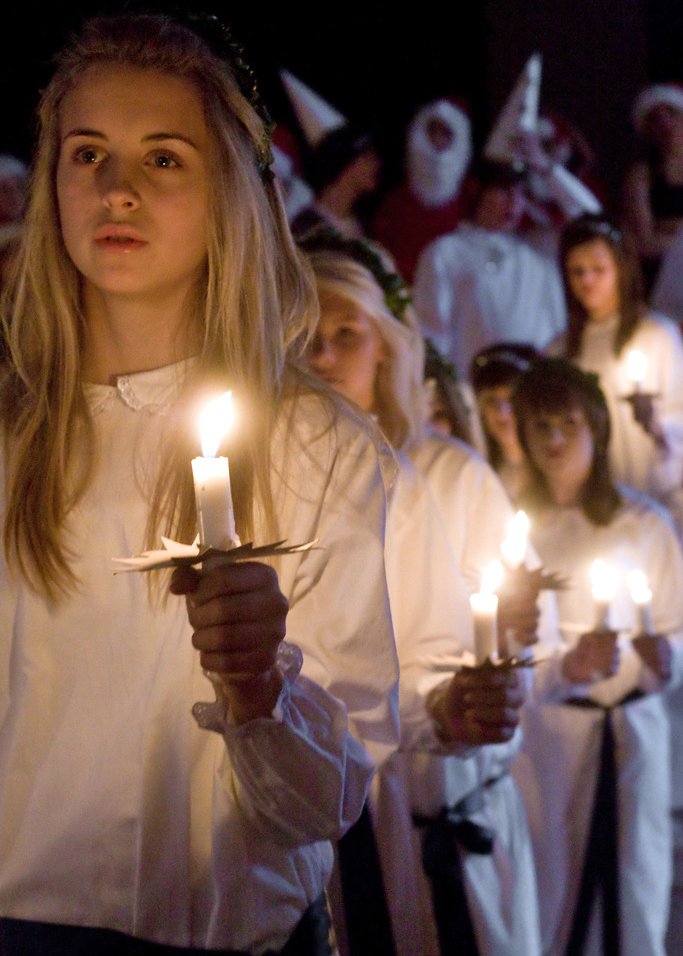 🇸🇪 Stockholm, Sweden and 4 moreSaint Lucy's Day
A December festival of light and song held across Scandinavia and Italy to honour a Christian martyr.Festival · Breakfast
🇸🇪 Stockholm, Sweden and 4 moreSaint Lucy's Day
A December festival of light and song held across Scandinavia and Italy to honour a Christian martyr.Festival · Breakfast
 🇩🇰 Copenhagen, Denmark and 5 moreFastelavn
A pre-Lenten carnival in Northern Europe where children dress up, sing for treats, and break candy-filled barrels.Festival · Sweets given and shared
🇩🇰 Copenhagen, Denmark and 5 moreFastelavn
A pre-Lenten carnival in Northern Europe where children dress up, sing for treats, and break candy-filled barrels.Festival · Sweets given and shared
 🇳🇴 Oslo, Norway and 3 moreConstitution DaySyttende mai
A national public holiday in Norway marked by children's parades, flags, and traditional food.Festival · Tea-time and snacking customs
🇳🇴 Oslo, Norway and 3 moreConstitution DaySyttende mai
A national public holiday in Norway marked by children's parades, flags, and traditional food.Festival · Tea-time and snacking customs
The same idea elsewhere
New Year compared 🇮🇳 Ayodhya, India and 7 moreDiwaliदीपावली (Dīpāvalī)
A five-day festival of lights celebrated across India and its diaspora to mark the victory of light over darkness.Festival · Feasts and festival meals
🇮🇳 Ayodhya, India and 7 moreDiwaliदीपावली (Dīpāvalī)
A five-day festival of lights celebrated across India and its diaspora to mark the victory of light over darkness.Festival · Feasts and festival meals
 🇮🇷 Iran and 7 moreNowruzنوروز
The Iranian new year at the March equinox, kept with fire, greenery and picnicsSeasonal
🇮🇱 Jerusalem, Israel and 1 moreHanukkahחֲנֻכָּה
An eight-day Jewish festival marking the rededication of the Second Temple in Jerusalem and the miracle of a single day'Festival
🇮🇷 Iran and 7 moreNowruzنوروز
The Iranian new year at the March equinox, kept with fire, greenery and picnicsSeasonal
🇮🇱 Jerusalem, Israel and 1 moreHanukkahחֲנֻכָּה
An eight-day Jewish festival marking the rededication of the Second Temple in Jerusalem and the miracle of a single day'Festival
 🇪🇬 Egypt and 5 moreMawlidمولد (Mawlid)
An annual festival marking the birth of the Prophet Muhammad, marked by poetry, processions and feasts.Festival · Feasts and festival meals
🇪🇬 Egypt and 5 moreMawlidمولد (Mawlid)
An annual festival marking the birth of the Prophet Muhammad, marked by poetry, processions and feasts.Festival · Feasts and festival meals