Spiritual and religiousMiddle EastMuslim
Kandil
In its own language: قنديل
Five holy nights marked by illuminated minarets and prayers in Turkey and the Balkans
Kandil refers to five holy nights observed across Turkey and Muslim communities in the Balkans. Rooted in Ottoman times, these evenings honour key moments in Islamic history through illuminated mosque towers, prayer gatherings, and savoury rings of bread.
When is Kandil kept?
Kandil is kept on five distinct holy nights across the Islamic calendar.
Kandil marks five sacred evenings in the Islamic calendar observed in Turkey and parts of the Balkans. Dating back to the Ottoman Empire, these nights celebrate milestones connected to the Prophet Muhammad and Islamic teaching. Communities mark each occasion by lighting mosque minarets, gathering for special prayers, and sharing small ring-shaped breads known as kandil simidi.
Origins and history
The tradition of Kandil began in the sixteenth century during the reign of the Ottoman ruler Sultan Selim II. Supported by the Shaykh al-Islam, the empire's chief jurisconsult at the time, the sultan decided it was appropriate to light up minarets on mosques for these occasions. The name itself comes from the Arabic word qindil, meaning an oil lamp or candelabra. Although these holy nights play a less significant role than the major Bayram festivals, they remain an important part of religious life.
The five holy nights
Five separate nights make up the Kandil observances. Mevlid Kandili marks the birth of the Prophet Muhammad, while Regaip Kandili is associated with divine mercy and the giving of aid and donations. Miraç Kandili commemorates the ascent of Muhammad to heaven. Berat Kandili, falling in mid-Sha'ban, focuses on seeking forgiveness for sins and the determining of destiny for the year ahead. Lastly, Kadir Gecesi marks the Night of Power, commemorating the initial revelation of the Quran.
Observance and food
On each Kandil, mosques illuminate their minarets to signal the arrival of the sacred evening to the local community. Worshippers come together for dedicated prayer services and spiritual reflection. Beyond the mosque, the observance extends into everyday life through traditional foods. In Turkey, vendors and shops sell kandil simidi, a smaller variety of simit bread, which people purchase and share with relatives, friends, and neighbours across the neighbourhood.
How Kandil is kept
During each Kandil night, minarets on mosques are illuminated to mark the sacred occasion. Worshippers gather to recite special prayers and take part in religious devotion related to the life of the Prophet Muhammad and key events in the Islamic faith. In Turkey, people also buy and share small rings of kandil simidi bread with their neighbours and family.
When and where
Kandil is observed across five distinct holy nights scattered throughout the Islamic calendar year. Each night corresponds to a specific sacred event, from the birth of Muhammad to the revelation of the Quran.
The tradition is observed in Turkey as well as among Muslim communities across the Balkans, rooted in the shared heritage of the Ottoman Empire where the custom was first introduced.
What Kandil means
The illuminating of minarets with oil lamps honours key milestones in Islamic history. Each night carries distinct spiritual significance, encompassing divine mercy and charity on Regaip Kandili, heavenly ascent on Miraç Kandili, forgiveness and destiny on Berat Kandili, and divine revelation on Kadir Gecesi.
Questions people ask about Kandil
When is Kandil kept?
Kandil is kept on five distinct holy nights across the Islamic calendar.
What is Kandil?
Kandil refers to five holy nights in the Islamic calendar, remembered with illuminated mosque minarets, special prayers, and the sharing of small bread rings.
Where is Kandil observed?
Kandil is primarily kept in Turkey and among Muslim communities throughout the Balkan region. The practice originated under the Ottoman Empire and continues across these regions today.
How did Kandil get its name?
The name comes from the Arabic word qindil, meaning an oil lamp or chandelier. It refers to the historical practice of lighting lamps on mosque minarets.
What are the five Kandil nights?
The five nights are Mevlid Kandili, Regaip Kandili, Miraç Kandili, Berat Kandili, and Kadir Gecesi, each marking a distinct event in Islamic history.
See also
 Eid al-FitrThe feast that ends Ramadan, opened with morning prayers, sweets and visits home
 Ramadan in TurkeyA holy month of fasting, prayer, and community meals, observed across Turkey with unique local customs.
 Mevlevi OrderA Sufi tradition from Konya known for its whirling ceremony and devotion to Rumi's teachings.
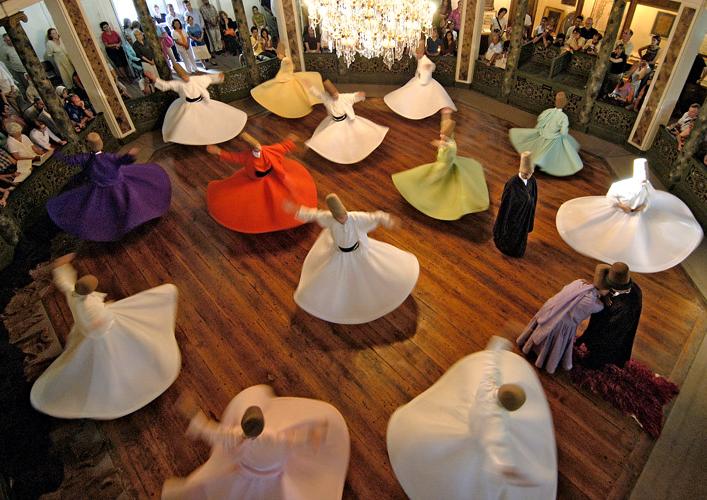 SamaA Sufi rite of listening, music and turning, kept by Mevlevi and other Sufi orders
Good reading and sources
The facts on this page come from the Wikipedia article "Kandil", written by its contributors and used under the CC BY-SA 4.0 licence, and from its Wikidata record (CC0). EveryParampara rewrote the text in its own words, with AI assistance, and compares every page with the article to make sure no passage is copied. It may be reused under the same CC BY-SA 4.0 licence with a link back.
It may contain mistakes. Traditions differ from one family, village and community to the next, and the people who keep them know them best. If something is wrong, tell us. Last refreshed 2026-10-06.
More from Turkey
All the traditions of Turkey
🇹🇷 Konya, Turkey and 4 moreMevlevi OrderMevlevilik
A Sufi tradition from Konya known for its whirling ceremony and devotion to Rumi's teachings.Spiritual
🇹🇷 TurkeyRamadan in Turkey
A holy month of fasting, prayer, and community meals, observed across Turkey with unique local customs.Spiritual · Fasting and breaking the fast
🇹🇷 Turkey and 1 moreSamaSema (Turkish); سَماع (Persian)
A Sufi rite of listening, music and turning, kept by Mevlevi and other Sufi ordersSpiritual
 🇦🇲 Yerevan, Armenia and 6 moreArmenian Genocide Remembrance DayՄեծ Եղեռնի զոհերի հիշատակի օր
An annual day of mourning and remembrance for the victims of the 1915 Armenian Genocide.Spiritual
🇦🇲 Yerevan, Armenia and 6 moreArmenian Genocide Remembrance DayՄեծ Եղեռնի զոհերի հիշատակի օր
An annual day of mourning and remembrance for the victims of the 1915 Armenian Genocide.Spiritual
The same idea elsewhere
All of this kind 🇦🇺 Australia and 5 moreGood Friday
A solemn Christian holy day commemorating the crucifixion and death of Jesus Christ.Spiritual · Fasting and breaking the fast
🇦🇺 Australia and 5 moreGood Friday
A solemn Christian holy day commemorating the crucifixion and death of Jesus Christ.Spiritual · Fasting and breaking the fast
 🇵🇭 Philippines and 5 moreHoly WeekἉγία καὶ Μεγάλη Ἑβδομάς
The solemn seven days leading to Easter, recalling the final week and Passion of JesusSpiritual · Fasting and breaking the fast
🇵🇭 Philippines and 5 moreHoly WeekἉγία καὶ Μεγάλη Ἑβδομάς
The solemn seven days leading to Easter, recalling the final week and Passion of JesusSpiritual · Fasting and breaking the fast
 🇺🇸 United States and 3 moreFeast of the Ascension
A Christian holy day marking Jesus Christ's bodily ascent into Heaven, kept forty days after Easter.Spiritual
🇺🇸 United States and 3 moreFeast of the Ascension
A Christian holy day marking Jesus Christ's bodily ascent into Heaven, kept forty days after Easter.Spiritual
 🇪🇸 Valencia, Spain and 5 moreFeast of Corpus ChristiCorpus Domini
A Christian feast celebrating the presence of Christ in the bread and wine of the EucharistSpiritual
🇪🇸 Valencia, Spain and 5 moreFeast of Corpus ChristiCorpus Domini
A Christian feast celebrating the presence of Christ in the bread and wine of the EucharistSpiritual