Spiritual and religiousMiddle EastMuslim
Mevlevi Order
In its own language: Mevlevilik
A Sufi tradition from Konya known for its whirling ceremony and devotion to Rumi's teachings.

The Mevlevi Order is a Sufi path founded in the thirteenth century by followers of Jalaluddin Muhammad Balkhi Rumi. It centers on the sema ceremony, where initiates whirl in remembrance of God. The community maintains its headquarters in Konya, Turkey, and preserves Rumi's literary and spiritual legacy.
When is Mevlevi Order marked?
Mevlevi Order is kept as part of Seb-i Arus, which runs from 17 to 26 December 2026.
The Mevlevi Order is a Sufi tradition rooted in the teachings of the Persian poet and mystic Jalaluddin Muhammad Balkhi Rumi. Originating in Konya during the thirteenth century, the order emphasizes love and spiritual realization over strict legalism. Its most visible practice is the sema ceremony, where participants whirl in a ritual of divine remembrance that continues to this day.
Founding and history
Jalaluddin Muhammad Balkhi Rumi established the spiritual foundation of the order in the thirteenth century. After his death in 1273, his son Sultan Veled and his friend Husameddin Chelebi formally organized the group. They built a mausoleum in Konya, which remains a pilgrimage site. During the Ottoman era, the order expanded across the Balkans, Syria, Lebanon, Egypt, and Palestine. A descendant of Sultan Veled married into the imperial family, securing state support and establishing numerous lodges throughout the empire.
The sema ceremony
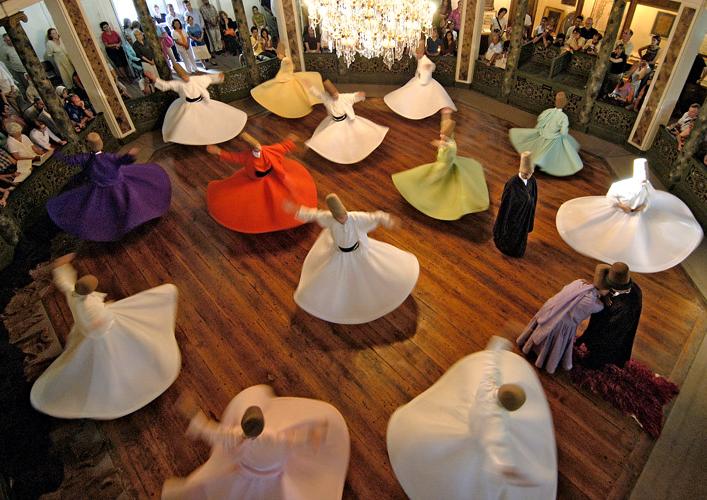
The sema is a formal ritual involving whirling, known as dhikr or remembrance of God. Participants, called semazens, wear a black cloak representing death and a tall brown hat symbolizing the tombstone. They remove the cloak to reveal white robes, signifying resurrection. The ceremony begins with a eulogy and ney flute music, followed by rhythmic walking and four distinct musical movements. Each turn involves chanting the name of God while receiving grace from above and sending it to the world below.
Core practices
Members prioritize the study of the Quran and Rumi's works, particularly the Masnavi-e-Ma'navi. Meditation, known as muraqabah, is central to their daily life. Initiates engage in sohbet, guided conversations led by a sheikh, to deepen their understanding. Adab, the cultivation of courtesy and mindfulness, shapes their interactions. These practices aim to move faith from mere imitation to direct realization, placing love at the center of Islamic devotion.
Modern status
Sufism was banned in Turkey in 1925, forcing lodges to close. The Konya lodge became a museum, and ceremonies are now presented as cultural events rather than religious worship within the country. Despite this, the order continues privately. Leadership remains with the Çelebi descendants of Rumi, currently Faruk Hemdem. The tradition has also spread to Western nations, including France, Canada, and the United States, maintaining its artistic and spiritual heritage.
How Mevlevi Order is kept
Initiates gather in a ritual hall to perform the sema. They begin wearing black cloaks, which they remove to show white garments. The ceremony includes poetry recitation, ney flute improvisation, and rhythmic walking. Semazens then whirl counter-clockwise around their leader, chanting God's name. The event concludes with Quranic verses. Members also study sacred texts, meditate, and participate in guided spiritual discussions led by their sheikh.
When and where
The order observes Seb-i Arus annually, marking the anniversary of Rumi's death. This week-long celebration draws pilgrims to Konya. Regular ceremonies occur throughout the year, though public performances in Turkey are restricted to cultural contexts due to legal bans on Sufi worship.
The order originated in Konya, Turkey, which serves as its headquarters. It historically spread through the Ottoman Empire to the Balkans, Syria, Lebanon, Egypt, and Palestine. Today, communities exist in Turkey and have established presence in Western countries like France, Canada, and the United States.
What Mevlevi Order means
The black cloak represents death and the grave, while the white robe signifies resurrection and the death of the ego. The tall hat symbolizes a tombstone. Whirling mirrors celestial movement, with the right hand receiving divine grace and the left channeling it to the earth. The ney flute represents the divine breath that gives life to all things. The entire ritual aims to achieve unity with the Divine through love and submission.


Days Mevlevi Order is marked
Questions people ask about Mevlevi Order
When is Mevlevi Order marked?
Mevlevi Order is kept as part of Seb-i Arus, which runs from 17 to 26 December 2026.
What is the Mevlevi Order?
It is a Sufi tradition founded by followers of Rumi in the thirteenth century. Known for its whirling ceremony, the order focuses on spiritual love, meditation, and the study of Rumi's poetry. It originated in Konya, Turkey, and continues today under the leadership of Rumi's descendants.
Where is the main headquarters located?
The headquarters is in Konya, Turkey. This city was the capital of the Sultanate of Rum and contains Rumi's mausoleum, which serves as a central pilgrimage site for members and visitors from around the world.
What happens during the sema ceremony?
Participants whirl in a circle while chanting God's name. They start in black cloaks, symbolizing death, and remove them to wear white robes, symbolizing resurrection. The ceremony includes music, poetry, and specific movements that represent spiritual stages from birth to unity with the Divine.
How is the order led today?
Leadership passes through Rumi's male descendants, who hold the title Çelebi. The current head is Faruk Hemdem. He oversees the order's activities and appoints sheikhs to teach practices. The International Mevlana Foundation also plays a key role in managing the order's cultural and educational efforts.
See also
 Eid al-FitrThe feast that ends Ramadan, opened with morning prayers, sweets and visits homeHamadshaA Moroccan possession rite kept by Muslim fraternities to cure affliction and restore social balance through music and d
 Ramadan in TurkeyA holy month of fasting, prayer, and community meals, observed across Turkey with unique local customs.
 Tisha B'AvA solemn fast day in July or August to mourn the destruction of the Jerusalem Temples and other Jewish tragedies.
Good reading and sources
- Encyclopaedia BritannicaArticle
- Afghanistan: The escape of the whirling dancerBBC, Article
- Afghanistan: The escape of the whirling dancerBBC, Article
- Mevlevi Order on WikipediaEncyclopedia
- More photos on Wikimedia CommonsPhotos and video
- Wikidata recordOpen data
The facts on this page come from the Wikipedia article "Mevlevi Order", written by its contributors and used under the CC BY-SA 4.0 licence, and from its Wikidata record (CC0). EveryParampara rewrote the text in its own words, with AI assistance, and compares every page with the article to make sure no passage is copied. It may be reused under the same CC BY-SA 4.0 licence with a link back.
It may contain mistakes. Traditions differ from one family, village and community to the next, and the people who keep them know them best. If something is wrong, tell us. Last refreshed 2026-10-05.
More from Turkey
All the traditions of Turkey
🇹🇷 TurkeyRamadan in Turkey
A holy month of fasting, prayer, and community meals, observed across Turkey with unique local customs.Spiritual · Fasting and breaking the fast
 🇹🇷 Turkey and 1 moreSamaSema (Turkish); سَماع (Persian)
A Sufi rite of listening, music and turning, kept by Mevlevi and other Sufi ordersSpiritual
🇹🇷 Turkey and 1 moreSamaSema (Turkish); سَماع (Persian)
A Sufi rite of listening, music and turning, kept by Mevlevi and other Sufi ordersSpiritual
 🇦🇲 Yerevan, Armenia and 6 moreArmenian Genocide Remembrance DayՄեծ Եղեռնի զոհերի հիշատակի օր
An annual day of mourning and remembrance for the victims of the 1915 Armenian Genocide.Spiritual
🇦🇲 Yerevan, Armenia and 6 moreArmenian Genocide Remembrance DayՄեծ Եղեռնի զոհերի հիշատակի օր
An annual day of mourning and remembrance for the victims of the 1915 Armenian Genocide.Spiritual
 🇮🇷 Iran and 5 moreMid-Sha'banنصف شعبان
An Islamic night of prayer, remembrance, and seeking divine forgiveness.Spiritual
🇮🇷 Iran and 5 moreMid-Sha'banنصف شعبان
An Islamic night of prayer, remembrance, and seeking divine forgiveness.Spiritual
The same idea elsewhere
All of this kind 🇦🇺 Australia and 5 moreGood Friday
A solemn Christian holy day commemorating the crucifixion and death of Jesus Christ.Spiritual · Fasting and breaking the fast
🇦🇺 Australia and 5 moreGood Friday
A solemn Christian holy day commemorating the crucifixion and death of Jesus Christ.Spiritual · Fasting and breaking the fast
 🇵🇭 Philippines and 5 moreHoly WeekἉγία καὶ Μεγάλη Ἑβδομάς
The solemn seven days leading to Easter, recalling the final week and Passion of JesusSpiritual · Fasting and breaking the fast
🇵🇭 Philippines and 5 moreHoly WeekἉγία καὶ Μεγάλη Ἑβδομάς
The solemn seven days leading to Easter, recalling the final week and Passion of JesusSpiritual · Fasting and breaking the fast
 🇺🇸 New York, United States and 4 moreFeast of the Ascension
The fortieth day of Easter, when Christians remember Jesus being taken up into heavenSpiritual
🇺🇸 New York, United States and 4 moreFeast of the Ascension
The fortieth day of Easter, when Christians remember Jesus being taken up into heavenSpiritual
 🇪🇸 Valencia, Spain and 5 moreFeast of Corpus ChristiCorpus Domini
A Christian feast celebrating the presence of Christ in the bread and wine of the EucharistSpiritual
🇪🇸 Valencia, Spain and 5 moreFeast of Corpus ChristiCorpus Domini
A Christian feast celebrating the presence of Christ in the bread and wine of the EucharistSpiritual