Spiritual and religiousSouth AsiaBuddhistHindu
Esala Perahera
A Sri Lankan procession of sacred relics, drummers and elephants honouring the Buddha
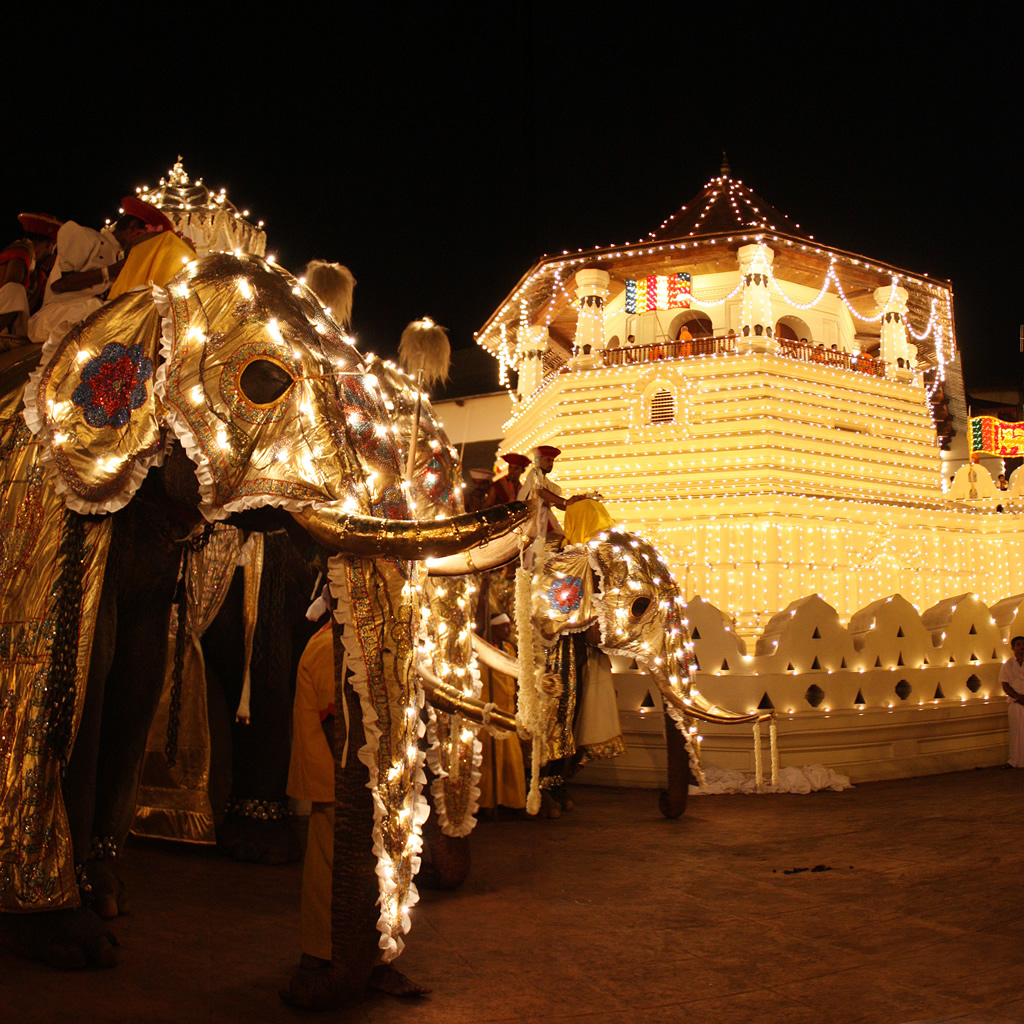
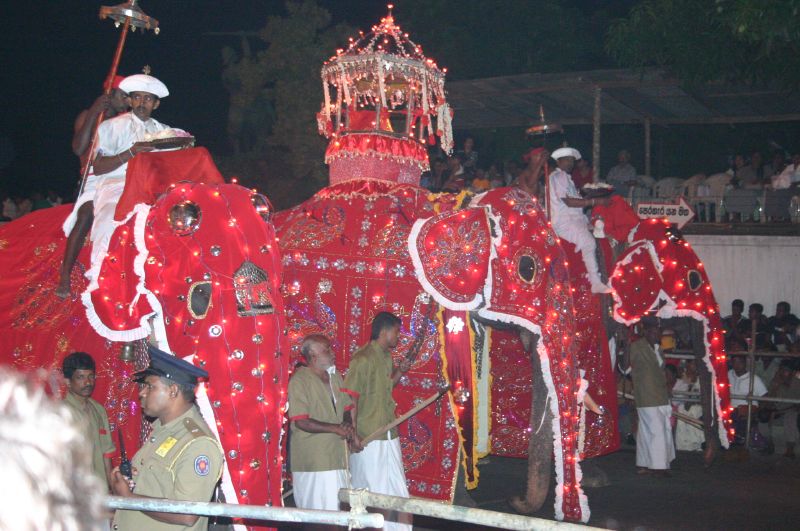
The Esala Perahera is a multi-day festival held every July or August in Kandy, Sri Lanka. Buddhist monks, lay officials, drummers, dancers, and decorated elephants parade through the city streets to honour the sacred tooth relic of the Buddha and invoke rain.
When is Esala Perahera in 2027?
Esala Perahera 2027 runs from 8 to 18 July 2027. The date follows the moon or a local calendar, so it can move by a day. Other years: 2026, 19 to 29 July 2026; 2028, 26 June to 6 July 2028.
The Esala Perahera in Kandy is one of Sri Lanka's most revered gatherings. Staged across several nights each July and August, the festival honours the Sacred Tooth Relic of the Buddha, kept at the Sri Dalada Maligawa. It brings together monastic rituals, rhythmic Kandyan drumming, whip cracking, acrobatic fire displays, and a grand parade of tuskers bearing sacred canopies through the city.
origins and history
The festival joins two ancient observances. The earlier Esala ritual dates to the third century BCE as an appeal to deities for rain. In the fourth century CE, the Dalada procession arose after the Buddha's tooth relic reached Sri Lanka from India. While the practice of carrying the relic is more than fifteen centuries old, the modern pageant took form during the Kandyan kingdom. Following guidance from the monk Upali Thera, royal decrees placed the Buddha at the heart of the ceremonies ahead of guardian deities. When the kingdom fell to the British in 1815, administrative care shifted to a chief lay custodian, the Diyawadana Nilame.
the unfolding processions
The event opens with the planting of a sanctified jackfruit sapling at four sacred shrines dedicated to Natha, Vishnu, Kataragama, and goddess Pattini. Five nights of private shrine rituals follow before public street parades begin. The Kumbal Perahera lasts five evenings, leading into the grander Randoli Perahera, named after the historical palanquins of Kandyan queens. Cannons fire across the city to signal each key stage. In the final stretch, the lead temple tusker carries a replica casket of the relic beneath a domed canopy, escorted by musicians, singers dressed in white, and the lay custodian.
shrines and performances
Five separate contingents merge during the nightly march. The main temple group leads, cleared by whip crackers and fire acrobats, followed by the four shrine processions. Each section brings unique elements. The Kataragama contingent features the Kavadi dance, where pilgrims carry arched wooden frames lined with peacock feathers. The Pattini shrine parade, invoking protection against illness and drought, is the only group featuring female dancers. Senior officials coordinate the drumming groups, and temple staff arrange privately owned elephants whose appearance is prepared weeks in advance.
the closing ceremonies
The festival concludes after the final Randoli procession on the Nikini full moon night. The following morning, participants gather at Getambe on the Mahaweli River for Diya Kepeema, a water-cutting ritual accompanied by a daytime parade. To formally close the season, the chief lay custodian leads a delegation of shrine officials to the President's Pavilion. There, they deliver a traditional letter known as the Perahera Sandeshaya to the head of state, confirming that all sacred duties and festival ceremonies were successfully completed.
How Esala Perahera is kept
The festival opens with planting a consecrated jackfruit sapling at four regional shrines. Five nights of internal shrine rites lead into five nights of the public Kumbal procession, followed by five nights of the grand Randoli procession. Temple tuskers, dancers, acrobats, and drummers escort the sacred replica casket through Kandy. Cannon fire marks key ritual moments. The celebration finishes at the Mahaweli River with the Diya Kepeema water-cutting rite and a formal message presented to the country's president.
When and where
The festival takes place every year during the months of July and August. Astrologers calculate the exact dates for auspicious beginnings, with the final night of the Randoli procession typically taking place on the Nikini full moon Poya day.
The festival is held in Kandy, Sri Lanka. Processions move from the Sri Dalada Maligawa and nearby guardian shrines through the city streets, ending at the Mahaweli River in Getambe.
What Esala Perahera means
The festival combines deep devotion to the Buddha with traditional appeals for prosperity and rainfall. Parading the tooth relic honours Buddhist teachings at the centre of civic life, while rituals at the four guardian shrines seek divine protection against drought and illness. The ceremonial water-cutting and sapling planting reflect continuous hopes for seasonal rains and communal well-being.


Esala Perahera dates: 2026, 2027, 2028
| Year | Esala Perahera date |
|---|---|
| 2026 | 19 to 29 July 2026 |
| 2027 | 8 to 18 July 2027 |
| 2028 | 26 June to 6 July 2028 |
This date follows the moon or a local calendar and can move by a day, so check with a local source nearer the time.
Questions people ask about Esala Perahera
When is Esala Perahera in 2027?
Esala Perahera 2027 runs from 8 to 18 July 2027. The date follows the moon or a local calendar, so it can move by a day. Other years: 2026, 19 to 29 July 2026; 2028, 26 June to 6 July 2028.
What is the Kandy Esala Perahera?
It is an annual Sri Lankan Buddhist festival honouring the Buddha's Sacred Tooth Relic. The celebration features grand evening processions with traditional drummers, dancers, fire performers, and decorated elephants.
What is the Diya Kepeema ceremony?
Diya Kepeema is a traditional water-cutting ritual conducted on the Mahaweli River at Getambe. It marks the final morning of the festival following the night processions.
Who organises the festival?
The chief lay custodian, known as the Diyawadana Nilame, oversees the organisation alongside monks from the Malwatte and Asgiriya monastic chapters and custodians of the four guardian shrines.
See also
 KathinaA Buddhist season of offering new robes and gifts to monks after the rains retreat
 DashainA fifteen-day festival of family gatherings, blessings, and feasts across Nepal
 Royal Ploughing CeremonyA royal agricultural rite opening the rice season across mainland Southeast Asia
 Rosh HashanahThe Jewish New Year marked by shofar horn blasts, prayer and sweet foods
Good reading and sources
- Kandy Esala Perahera on WikipediaEncyclopedia
- More photos on Wikimedia CommonsPhotos and video
- Wikidata recordOpen data
The facts on this page come from the Wikipedia article "Kandy Esala Perahera", written by its contributors and used under the CC BY-SA 4.0 licence, and from its Wikidata record (CC0). EveryParampara rewrote the text in its own words, with AI assistance, and compares every page with the article to make sure no passage is copied. It may be reused under the same CC BY-SA 4.0 licence with a link back.
It may contain mistakes. Traditions differ from one family, village and community to the next, and the people who keep them know them best. If something is wrong, tell us. Last refreshed 2026-10-04.
More from Sri Lanka
All the traditions of Sri Lanka
🇹🇭 Thailand and 5 moreKathina
A Buddhist season of offering new robes and gifts to monks after the rains retreatSpiritual
 🇱🇰 Sri LankaSanni Yakuma
A Sinhalese rite where masked dancers summon eighteen illness demons and banish themSpiritual
🇱🇰 Sri LankaSanni Yakuma
A Sinhalese rite where masked dancers summon eighteen illness demons and banish themSpiritual
 🇮🇳 Palani, India and 5 moreKavadi Aattamகாவடி ஆட்டம்
Tamil devotees of Murugan carry burdens as a vow during ThaipusamSpiritual
🇮🇳 Palani, India and 5 moreKavadi Aattamகாவடி ஆட்டம்
Tamil devotees of Murugan carry burdens as a vow during ThaipusamSpiritual
 🇨🇳 China and 5 moreLife release放生
A Buddhist practice of freeing captive animals to spare their lives and gain meritSpiritual
🇨🇳 China and 5 moreLife release放生
A Buddhist practice of freeing captive animals to spare their lives and gain meritSpiritual
The same idea elsewhere
Royalty and coronation compared 🇬🇧 United Kingdom and 5 moreTwelfth Night
The closing evening of the Christmas season, kept with cake, carols and wassailSpiritual · Feasts and festival meals
🇬🇧 United Kingdom and 5 moreTwelfth Night
The closing evening of the Christmas season, kept with cake, carols and wassailSpiritual · Feasts and festival meals
 🇬🇭 Cape Coast, GhanaFetu Afahye
A harvest festival of cleansing, boat races and royal durbars in Cape Coast, GhanaFestival · Feasts and festival meals
🇬🇭 Cape Coast, GhanaFetu Afahye
A harvest festival of cleansing, boat races and royal durbars in Cape Coast, GhanaFestival · Feasts and festival meals
 🇮🇩 Yogyakarta, IndonesiaSekatenꦱꦼꦏꦠꦺꦤ꧀
A week-long Javanese royal festival and market honouring the birth of the ProphetFestival
🇮🇩 Yogyakarta, IndonesiaSekatenꦱꦼꦏꦠꦺꦤ꧀
A week-long Javanese royal festival and market honouring the birth of the ProphetFestival
 🇸🇩 SudanJirtigالجَرْتِقْ
A Sudanese wedding ritual of regal adornment, protection, and blessings of fertilityRite of passage
🇸🇩 SudanJirtigالجَرْتِقْ
A Sudanese wedding ritual of regal adornment, protection, and blessings of fertilityRite of passage