Dress and adornmentSouth AsiaBuddhist
Kasaya
In its own language: काषाय
The traditional patchwork robes worn by ordained Buddhist monastics

Kasaya are the sacred patchwork robes worn by ordained Buddhist monastics. Stemming from ancient India and adapted across Asia, these garments are pieced together from cloth strips to reflect a life of spiritual dedication and simplicity.
When is Kasaya kept?
Kasaya is kept on worn daily and during ceremonies by ordained monastics.
Kasaya are the traditional vestments worn by ordained Buddhist monks and nuns. First established in ancient India from discarded cloth remnants, these garments express a monastic dedication to simplicity. While styles, stitching patterns and dyes have shifted across different Buddhist schools in India, China and Japan, the patchwork robe remains an enduring badge of monastic ordination and religious discipline.
The three garments
According to early monastic rules in the Theravada Vinaya, a full set of robes, known as the ticivara, consists of three pieces. The antarvasa serves as an inner garment, wrapped like a skirt around the waist and lower body. Above this rests the uttarasanga, which covers the upper torso. For colder days or formal occasions, monastics add the samghati, a double-layered outer cloak resembling the classical Greek himation in ancient Gandharan art. Monastics could also wear a waist cloth known as a kushalaka and secure their robes using a buckled belt called a samakaksika.
Colors and Indian schools
In ancient India, robe colors identified the different Buddhist traditions. Monastic sects adopted hues ranging from ochre and saffron to deep red, blue or black. Texts translated into Chinese between the second and fourth centuries recorded these distinctive sectarian shades. Within traditions that follow the Mulasarvastivada rules, such as Tibetan Buddhism, red garments became standard. Certain groups, like the Mahasamghika, required their robes to be assembled from between seven and twenty-three pieces of fabric, often adorned with auspicious emblems such as the conch shell and the endless knot.
Adaptations in China
When monastic traditions arrived in China, the Sanskrit term was transliterated as jiasha. Chinese monastics wore this patchwork mantle draped over a long, cross-collared gown called a zhiduo. Early monks during the Han and Wei periods favored red robes, according to later historical records. By the Tang dynasty, greyish-black garments became standard, earning monastics the popular moniker of 'those of the black robes.' Over time, as a single ordination lineage prevailed in China, robe colors came to indicate regional customs rather than sectarian divisions.
Forms in Japan
In Japan, the garment is known as the kesa. Japanese monastics wear this rectangular patchwork wrap over a Chinese-style belted robe known as a jikitotsu. In the Zen tradition, formal attire involves layering two kimono underneath the jikitotsu before adding the kesa on top. Monastics sew these vestments from five, seven, nine, or even more panels of fabric. While early practitioners covered both shoulders, standard practice evolved to drape the cloth over the left shoulder, leaving the right shoulder exposed to express veneration for the Buddha.
How Kasaya is kept
Monastics assemble and wear these rectangular patchwork vestments over their undergarments or long robes. The garment is draped around the body according to established monastic guidelines. During daily tasks, assemblies and ceremonies, monastics adjust their robes to suit the setting. In East Asian traditions, the outer cloth is typically fastened over the left shoulder, leaving the right shoulder uncovered when making offerings, chanting, or showing reverence before images of the Buddha.
When and where
Monastics wear these garments every day as their standard attire. Specific layers, such as the heavier outer cloak or formal multi-panel vestments, are brought out during communal ceremonies, ordination rituals, meditation sessions and formal teachings.
Originating in ancient India, the practice of wearing these robes spread alongside Buddhism. Today, it is observed in Buddhist monastic communities across the world, with prominent historical traditions maintained throughout India, China, Japan and the Himalayan region.
What Kasaya means
The stitched grid of the robe resembles the rectangular plots of an Asian rice field, symbolizing fertility and spiritual nourishment. Originally gathered from discarded rags, the fabric represents humility and detachment from worldly luxury. Wearing the robe with the right shoulder uncovered acts as a physical gesture of respect toward the Buddha, while sewn emblems like the conch and endless knot convey auspicious blessings.


Questions people ask about Kasaya
When is Kasaya kept?
Kasaya is kept on worn daily and during ceremonies by ordained monastics.
What is a kasaya?
It is the traditional patchwork vestment worn by ordained Buddhist monks and nuns. Emerging in ancient India, it serves as the defining attire of Buddhist monastic life.
What are the three parts of the triple robe?
The traditional Indian set includes an undergarment skirt (antarvasa), an upper body wrap (uttarasanga), and a heavier outer cloak (samghati) worn for extra warmth or formal occasions.
Why is the right shoulder often left bare?
In many traditions, including Japanese Buddhism, exposing the right shoulder while covering the left is a traditional posture called hendan-uken. It demonstrates humility and deep reverence toward the Buddha.
Why are the robes made of patchwork panels?
Early Buddhist monastics stitched their garments from discarded scraps of cloth to practice frugality. The resulting pattern of sewn rectangles came to resemble the layout of agricultural rice fields.
See also
 Traditional tattooingThe ancient custom of marking the skin for protection, healing, status and sacred rites
 PaithaniA handwoven silk sari from Maharashtra, with a squared border and a peacock pallu
 QizhuangThe traditional attire of the Manchu people, characterized by riding coats, trousers, and horse-hoof cuffs.
 SherwaniA long buttoned coat for men, worn at weddings and state occasions in South Asia
Good reading and sources
- Kasaya (clothing) on WikipediaEncyclopedia
- More photos on Wikimedia CommonsPhotos and video
- Wikidata recordOpen data
The facts on this page come from the Wikipedia article "Kasaya (clothing)", written by its contributors and used under the CC BY-SA 4.0 licence, and from its Wikidata record (CC0). EveryParampara rewrote the text in its own words, with AI assistance, and compares every page with the article to make sure no passage is copied. It may be reused under the same CC BY-SA 4.0 licence with a link back.
It may contain mistakes. Traditions differ from one family, village and community to the next, and the people who keep them know them best. If something is wrong, tell us. Last refreshed 2026-10-07.
More from India
All the traditions of India
🇮🇳 Paithan, IndiaPaithani
A handwoven silk sari from Maharashtra, with a squared border and a peacock palluDress
 🇾🇪 Hadhramaut, Yemen and 1 moreJambiyaجنبية
A short curved dagger worn at the waist by Yemeni men, its handle a sign of statusDress
🇮🇳 Lucknow, India and 3 moreSherwani
A long buttoned coat for men, worn at weddings and state occasions in South AsiaDress
🇾🇪 Hadhramaut, Yemen and 1 moreJambiyaجنبية
A short curved dagger worn at the waist by Yemeni men, its handle a sign of statusDress
🇮🇳 Lucknow, India and 3 moreSherwani
A long buttoned coat for men, worn at weddings and state occasions in South AsiaDress
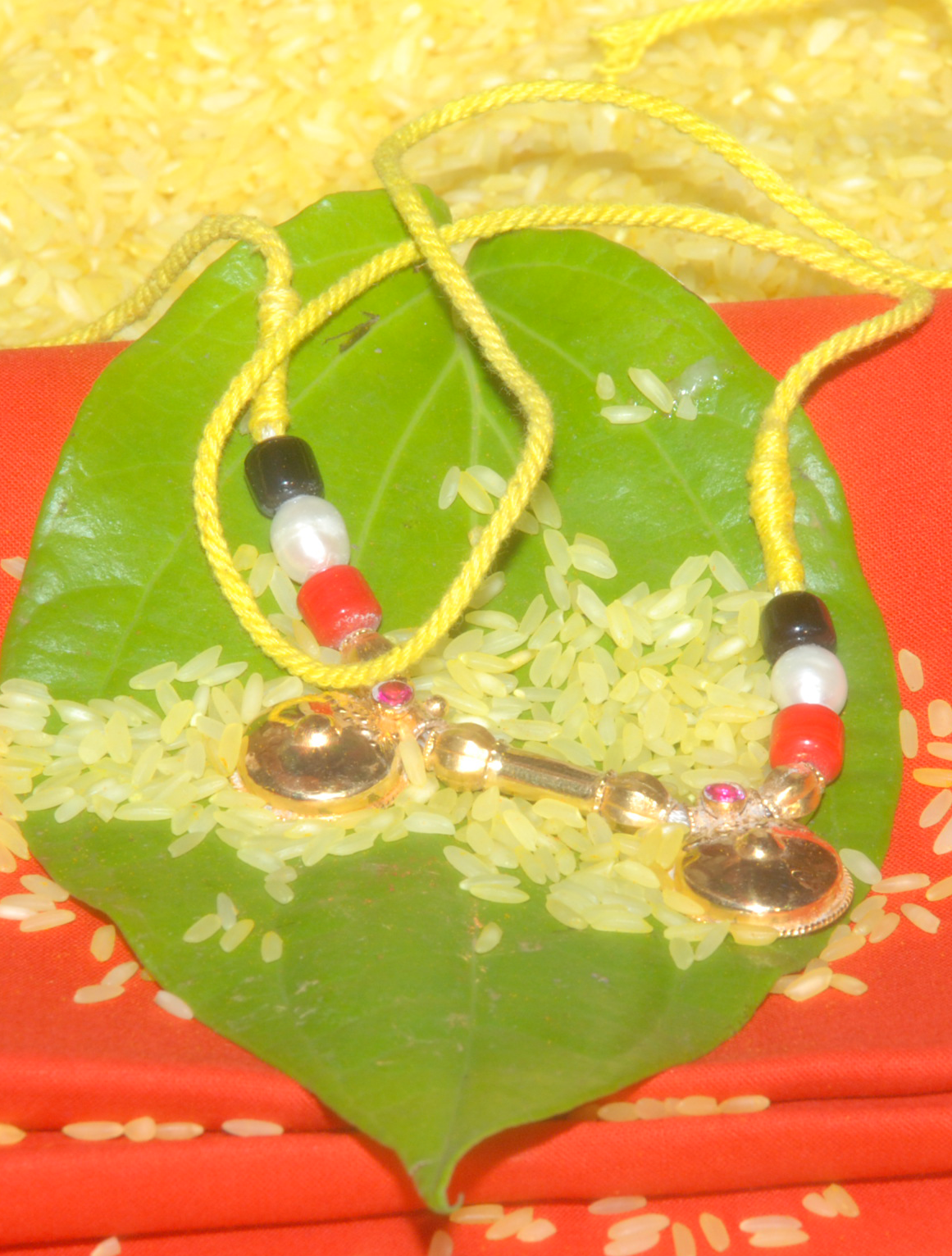 🇮🇳 India and 2 moreMangalasutraमङ्गलसूत्रम् (maṅgalasūtram)
A necklace tied by the groom at a wedding, worn through married lifeDress
🇮🇳 India and 2 moreMangalasutraमङ्गलसूत्रम् (maṅgalasūtram)
A necklace tied by the groom at a wedding, worn through married lifeDress
The same idea elsewhere
All of this kind 🇳🇴 Norway and 3 moreGákti
A traditional coat worn by the Sámi people across northern Scandinavia and Russia, signaling origin and status through cDress
🇳🇴 Norway and 3 moreGákti
A traditional coat worn by the Sámi people across northern Scandinavia and Russia, signaling origin and status through cDress
 🇮🇱 Israel and 1 moreTzitzitצִיצִית
Knotted ritual fringes worn on a four-cornered garment, a reminder of the commandmentsDress
🇮🇱 Israel and 1 moreTzitzitצִיצִית
Knotted ritual fringes worn on a four-cornered garment, a reminder of the commandmentsDress
 🇼🇸 Samoa and 1 moreʻIe tōga
Precious woven mats exchanged in Samoan ceremonies to honor family ties and chiefly status.Dress
🇪🇬 Egypt and 5 moreTraditional tattooing
The ancient custom of marking the skin for protection, healing, status and sacred ritesDress
🇼🇸 Samoa and 1 moreʻIe tōga
Precious woven mats exchanged in Samoan ceremonies to honor family ties and chiefly status.Dress
🇪🇬 Egypt and 5 moreTraditional tattooing
The ancient custom of marking the skin for protection, healing, status and sacred ritesDress