Dress and adornmentSouth AsiaHinduJain
Mangalasutra
In its own language: मङ्गलसूत्रम् (maṅgalasūtram)
A necklace tied by the groom at a wedding, worn through married life
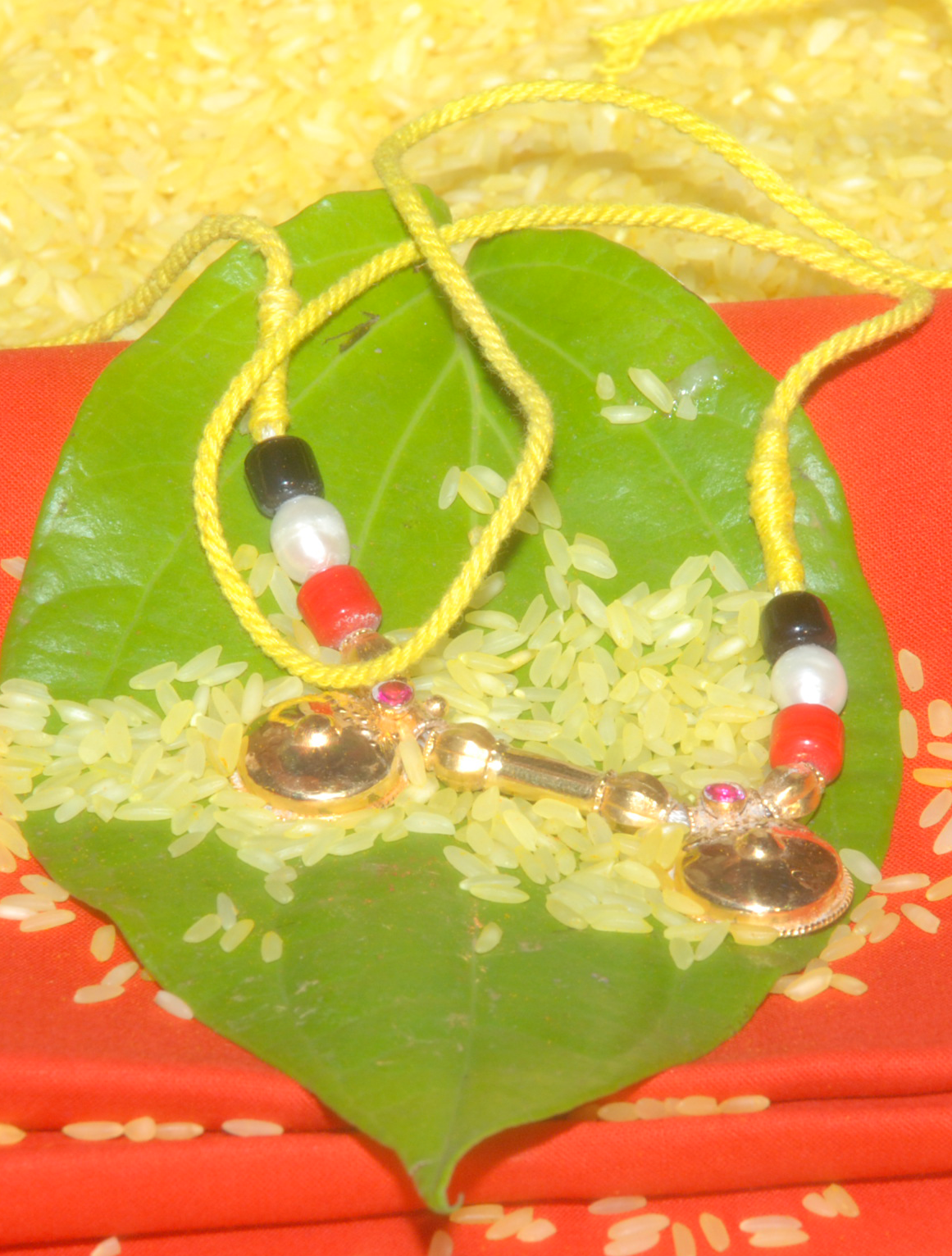
A mangalasutra is a necklace that a groom ties around his bride's neck in a rite called Mangalya Dharanam, found in South Asian weddings. Married women keep it on as a sign that they are married, and it is worn widely in India, Nepal and Sri Lanka, including by some Jain, Christian, Muslim and Jewish families.
When is Mangalasutra kept?
Mangalasutra is kept on tied on the wedding day, then worn by the bride for the rest of the marriage.
The mangalasutra is a necklace of black beads strung on a turmeric-yellow or black thread, tied by a groom around his bride's neck. From that moment it marks her as married, and many women wear it for the rest of their lives. It belongs above all to Hindu weddings in India, Sri Lanka and Nepal, and some Jain, Christian, Muslim and Jewish communities tie similar chains.
What it is
The name comes from Sanskrit and means an auspicious thread. In its common form it is a chain of black beads on a black or yellow thread that has been prepared with turmeric, and gold, white or red beads are sometimes added. Regions differ. In South India, the word tali often means just the pendant, while mangalasutra or mangalyam names the whole necklace. The groom's family usually chooses the design, following local custom. Whatever its shape, the necklace does one plain job: it tells anyone who sees it that the woman wearing it is married.
Origins and history
The earliest trace the sources give is the fourth century CE, when the Lalita Sahasranama speaks of a mangalya sutra. The Sangam poem Purananuru mentions a sacred marriage tali on the necks of women of the Ay country. Two centuries later, in the sixth century, a single yellow thread was tied on a bride, the sources say, to guard her from other men and from evil spirits. Usha Balakrishnan, a historian of Indian jewellery, notes that the term once meant a literal thread rather than an ornament. Over the centuries the thread became jewellery, and the practice spread among many communities.
Names and design
Different languages give the necklace different names. Marathi and Kannada speakers say mangalasutra or mangalyasutra; in Telugu it is mangalyamu, mangalasutramu or pustelu; Tamil has mangalyam, thirumangalyam and tali; Tulu and Malayalam use tali, and Sinhala uses thella. Designs vary too. Telugu families in Telangana and Andhra Pradesh favour the Lakshmi tali, which carries images of the goddess Lakshmi. Malayali families in Kerala use the ela tali, also called minnu. Marathis wear two vati, tiny bowl-shaped pieces, while Kannadigas usually wear one. Konkani families, including Goans and Mangaloreans, wear three chains together: dharemani, mangalasutra and kasitali.
Who wears it
Beyond Hindu weddings, other communities tie a chain of the same kind. Tamil Jains, known as Nainars, wear one. So do Mappilas in Kerala and Dakhni Muslims around Hyderabad, whose kali poath is built from black beads. Syrian Christians wear the minnu, a pendant shaped as a cross. Among Indian Jews, the Bene Israel of the Konkan and the Malabari and Paradesi Jews of Cochin used such necklaces too. The meanings differ: in some Muslim families the ornament passes from mother-in-law to daughter-in-law, and among Cochin Jews from sister-in-law to wife. Large parts of North India do not use it at all, marking marriage instead with sindoor, toe rings and bangles.
Today and change
The mangalasutra is still tied at weddings across India, Nepal and Sri Lanka, and families often keep the traditional design. Change shows in the weight and the styling. Many families now choose lighter necklaces with a single vati, or a more contemporary look, and some Gujarati and Marwari families wear a diamond pendant on a gold chain that is ornamental rather than a formal mangalasutra. The wider meaning has not shifted. It remains the sign a woman carries of the marriage she entered, worn long after the wedding guests have gone home.
How Mangalasutra is kept
At the wedding, the bride's family and the groom's family gather, and the necklace is brought out in the design the groom's household has chosen. During a rite called Mangalya Dharanam, the groom ties it around the bride's neck. Guests bless the couple, and from that point the bride wears the chain for the rest of the marriage. In some communities the piece is handed on rather than bought: a mother-in-law may give it to her son's wife, and among Cochin Jews a sister-in-law may give it to the new wife.
When and where
There is no fixed calendar date. The mangalasutra is tied on the wedding day itself, during the ceremony called Mangalya Dharanam, at the moment the families and the officiant have arranged. Once tied, it stays on. Women keep it for the whole of the marriage rather than taking it out for a yearly festival.
It is kept in India, Nepal and Sri Lanka, and it is strongest in South India, among Tamil, Telugu, Kannada, Tulu, Malayali, Marathi and Konkani families. Other communities in the same regions use similar chains. In much of North India the necklace is not part of marriage at all: sindoor, toe rings and glass bangles do that work instead.
What Mangalasutra means
The necklace means an auspicious thread, and people wear it for the well-being and long life of the husband, as Hindu custom describes it. It also works as a plain, visible sign of married status. In earlier times bridal jewellery served as a woman's financial security against old age or widowhood, even where women held property. Adi Shankara writes of its importance in the Soundarya Lahari. For the families who keep it, it is both a blessing and a marker.
On the table
Flavours: Turmeric


Questions people ask about Mangalasutra
When is Mangalasutra kept?
Mangalasutra is kept on tied on the wedding day, then worn by the bride for the rest of the marriage.
What is a mangalasutra?
It is a necklace worn by married women in South Asia. A groom ties it around his bride's neck at the wedding, in a rite called Mangalya Dharanam. The name is Sanskrit for an auspicious thread. It usually has black beads on a black or turmeric-yellow thread, sometimes with gold, white or red beads.
Where is it worn?
In India, Nepal and Sri Lanka, and it is most common in South India. It is not used everywhere in the region. Many North Indian communities mark marriage with sindoor, toe rings or bangles instead.
Do only Hindus wear it?
No. Tamil Jains wear one, Mappilas and Dakhni Muslims wear similar chains, Syrian Christians wear the minnu with a cross, and Indian Jewish communities used them too. The rituals and what they mean differ from Hindu practice, and the sources describe them as similar rather than the same.
How is the design chosen?
The groom's family usually decides, following the custom of the community. Telugu families may choose the Lakshmi tali with images of the goddess Lakshmi, Malayali families the minnu, Marathis two bowl-shaped vati. Today many families pick lighter versions with one vati or a contemporary style.
See also
 SherwaniA long buttoned coat for men, worn at weddings and state occasions in South Asia
 PhulkariGeometric and floral threadwork embroidered by Punjabi women on handwoven cotton.
 IkatA resist-dyeing craft from Southeast Asia, where yarns are tied and dyed before weaving
 Persian gardenAn ancient tradition of creating walled, geometric sanctuaries of shade and flowing water
Good reading and sources
- How the concept of Mangal Sutra has evolved over the centuriesThe Indian Express, Article
- How the concept of Mangal Sutra has evolved over the centuriesThe Indian Express, Article
- Mangalasutra on WikipediaEncyclopedia
- More photos on Wikimedia CommonsPhotos and video
- Wikidata recordOpen data
The facts on this page come from the Wikipedia article "Mangalasutra", written by its contributors and used under the CC BY-SA 4.0 licence, and from its Wikidata record (CC0). EveryParampara rewrote the text in its own words, with AI assistance, and compares every page with the article to make sure no passage is copied. It may be reused under the same CC BY-SA 4.0 licence with a link back.
It may contain mistakes. Traditions differ from one family, village and community to the next, and the people who keep them know them best. If something is wrong, tell us. Last refreshed 2026-10-05.
More from India
All the traditions of India 🇮🇳 Srinagar, India and 3 morePashmina
Ultra-fine wool of Himalayan goats, hand-woven in Kashmir into shawls of rankDress
🇮🇳 Srinagar, India and 3 morePashmina
Ultra-fine wool of Himalayan goats, hand-woven in Kashmir into shawls of rankDress
 🇮🇳 Mumbai, India and 1 moreDhoti
A long unstitched cloth men wrap like trousers, for worship and formal daysDress
🇮🇳 Lucknow, India and 3 moreSherwani
A long buttoned coat for men, worn at weddings and state occasions in South AsiaDress
🇮🇳 Mumbai, India and 1 moreDhoti
A long unstitched cloth men wrap like trousers, for worship and formal daysDress
🇮🇳 Lucknow, India and 3 moreSherwani
A long buttoned coat for men, worn at weddings and state occasions in South AsiaDress
 🇮🇳 India and 4 moreSariसाड़ी
An unstitched length of cloth that women drape around the body, worn across South AsiaDress
🇮🇳 India and 4 moreSariसाड़ी
An unstitched length of cloth that women drape around the body, worn across South AsiaDress
The same idea elsewhere
Weddings compared 🇼🇸 Samoa and 1 moreʻIe tōga
Precious woven mats exchanged in Samoan ceremonies to honor family ties and chiefly status.Dress
🇼🇸 Samoa and 1 moreʻIe tōga
Precious woven mats exchanged in Samoan ceremonies to honor family ties and chiefly status.Dress
 🇹🇱 Timor-LesteUma Lulik
Sacred ancestral clan houses and ritual shrines in East TimorSpiritual
🇹🇱 Timor-LesteUma Lulik
Sacred ancestral clan houses and ritual shrines in East TimorSpiritual
 🇮🇩 Indonesia and 2 moreKenduri
A communal prayer meal and gathering shared across Indonesia, Malaysia and BruneiSpiritual · Feasts and festival meals
🇺🇬 UgandaKwanjula
A formal marriage introduction ritual of the Baganda people in Uganda, where families meet to exchange gifts and seek blRite of passage
🇮🇩 Indonesia and 2 moreKenduri
A communal prayer meal and gathering shared across Indonesia, Malaysia and BruneiSpiritual · Feasts and festival meals
🇺🇬 UgandaKwanjula
A formal marriage introduction ritual of the Baganda people in Uganda, where families meet to exchange gifts and seek blRite of passage