Music, dance and storytellingEurope
Khorovod
In its own language: хоровод
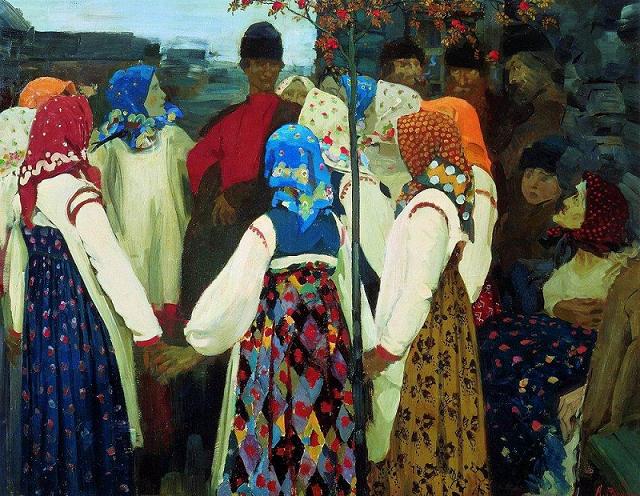
A Slavic circle dance with singing, danced with linked hands or little fingers

This is the Slavic name for a folk dance that joins a circle dance with chorus singing. It is kept in Russia, Belarus and Ukraine, and it is related to the Greek choreia, the Balkan hora and the South Slavic kolo.
Khorovod is a Slavic folk dance in which people join in a ring and sing as they move. The name covers the Russian хоровод, the Ukrainian хоровод and корогод, and the Polish korowód, and the dance is counted among East Slavic folk forms in Russia, Belarus and Ukraine. Its relatives are other circle dances, among them the Greek choreia, the Balkan hora and the South Slavic kolo.
What it is
Khorovod is the name, in Slavic languages, for a folk dance that is danced in a circle while the dancers sing together. It is an East Slavic form, and the Polish korowód, the Ukrainian корогод and the Russian хоровод all point to the same kind of moving ring. What holds it together is simple: people stand in a circle and link up, then move. The sources describe one detail of the linking clearly, that each dancer holds the hand or the little finger of the person beside them.
Origins and history
The word is usually traced to the Greek choreia, a circle dance of ancient Greece. The sources present the link as likely rather than certain, and explain it through the strong influence of Greek culture on Rus'. They also describe khorovod as an East Slavic folk dance, and tie it to Russia, Belarus and Ukraine. The name is not confined to one language, since Polish has korowód and Ukrainian uses both хоровод and корогод. No date of origin is given in the material, so none is offered here, and the sources describe the form rather than a founder or a first performance.
How it is kept
Dancers form a ring and sing as they move. The sources name one part of the pattern: each person links hands, or little fingers, with the dancer beside them, which keeps the ring joined. Because the dance brings movement and song together, the singing is part of the dance rather than something played alongside it. That pairing of a circle with a chorus is what the name itself describes. Beyond this the material is brief. It does not record costumes, instruments, songs or the occasions on which the dance is performed, and this page does not add them.
Related circle dances
Khorovod sits in a wider family of dances where people move in a ring. The sources name several relatives: choreia in ancient Greece, kolo among South Slavic peoples, which they say began in Serbia, Croatia and Bosnia, hora in the Balkans, and kochari, which is Armenian and Azerbaijani. These carry their own names and their own histories. The sources treat them as related forms rather than as one shared tradition, and they do not say that any of them grew out of khorovod or that khorovod grew out of them.
How Khorovod is kept
Dancers stand in a circle and sing while they move. Each person links hands, or little fingers, with the dancer beside them, and the ring stays joined as it turns. The sources describe the form as a circle dance joined to chorus singing, so the song and the circling belong together. The material does not set out steps, songs, dress, instruments or occasions, and this outline does not supply them. The dance is classed as East Slavic and as a folk form, and it is tied in the sources to Russia, Belarus and Ukraine.
When and where
The sources do not give a season, a date or a fixed occasion for khorovod. It is described as a folk dance rather than as a festival or calendar custom, so nothing in the material ties it to one day of the year or one day of the week.
Khorovod is recorded as an East Slavic folk dance. The sources tie it to Russia, Belarus and Ukraine, and Russian, Ukrainian and Polish each have their own word for it. Its relatives are spread more widely, from Greece and the Balkans to Armenia and Azerbaijan, but those are separate dances with their own names.
What Khorovod means
The sources do not explain a meaning attached to khorovod, so this page claims none. What the form itself shows is a group moving as one ring, with the singing shared by everyone in it. The name joins the circle and the chorus into a single idea, and the linked hands or little fingers keep the ring unbroken as it turns. Nothing in the material says what the dance is performed for, or what those taking part understand it to mean.
Questions people ask about Khorovod
What is a khorovod?
It is a Slavic folk dance in which people move in a circle and sing together. The name covers the Russian хоровод, the Ukrainian хоровод and корогод, and the Polish korowód. It is classed as an East Slavic folk dance and compared to the Greek choreia.
Where is it kept?
The sources tie it to Russia, Belarus and Ukraine and describe it as an East Slavic folk dance. Related circle dances under other names are found in Greece, the Balkans, Armenia and Azerbaijan.
When is it danced?
The sources give no date, season or fixed occasion. Khorovod is described as a folk dance rather than a calendar or festival custom, so no day of the year can be named from this material.
Where does the name come from?
The sources trace it, probably rather than certainly, to the Greek choreia, a circle dance of ancient Greece. They explain the link by the strong influence of Greek culture on Rus'.
How do the dancers hold on?
The sources say dancers hold the hand or the little finger of the person beside them as they move. That linking keeps the circle joined while the group sings.
See also
 BanduraA Ukrainian plucked string instrument played to accompany epic songs and folk ballads
 Tuvan throat singingA style of singing from Tuva where one voice sounds a drone and a melody at once
 LezginkaA fast dance of the North Caucasus, solo or in pairs, named for the Lezgin people
 KlezmerAn Ashkenazi Jewish instrumental tradition of lively dance tunes and ritual melodies
Good reading and sources
- Khorovod on WikipediaEncyclopedia
- More photos on Wikimedia CommonsPhotos and video
- Wikidata recordOpen data
The facts on this page come from the Wikipedia article "Khorovod", written by its contributors and used under the CC BY-SA 4.0 licence, and from its Wikidata record (CC0). EveryParampara rewrote the text in its own words, with AI assistance, and compares every page with the article to make sure no passage is copied. It may be reused under the same CC BY-SA 4.0 licence with a link back.
It may contain mistakes. Traditions differ from one family, village and community to the next, and the people who keep them know them best. If something is wrong, tell us. Last refreshed 2026-10-05.
More from Russia
All the traditions of Russia
🇷🇺 Russia and 1 moreLezginkaЛезгинка (Russian) · Лезги кьуьл (Lezgian)
A fast dance of the North Caucasus, solo or in pairs, named for the Lezgin peoplePerformance
 🇲🇳 Mongolia and 5 moreThroat singing
Several deep, guttural singing styles, each named and kept by its own peoplePerformance
🇷🇺 Russia and 1 moreTuvan throat singing
A style of singing from Tuva where one voice sounds a drone and a melody at oncePerformance
🇲🇳 Mongolia and 5 moreThroat singing
Several deep, guttural singing styles, each named and kept by its own peoplePerformance
🇷🇺 Russia and 1 moreTuvan throat singing
A style of singing from Tuva where one voice sounds a drone and a melody at oncePerformance
 🇩🇪 Germany and 5 moreDelphic Games of the modern era
Global competitions and exhibitions across the arts, modelled on ancient Greek gamesPerformance
🇩🇪 Germany and 5 moreDelphic Games of the modern era
Global competitions and exhibitions across the arts, modelled on ancient Greek gamesPerformance
The same idea elsewhere
All of this kind 🇹🇷 Kayseri, Turkey and 4 moreHalay
A traditional line and circle folk dance kept across Turkey, Azerbaijan, Armenia, Iran, and Syria.Performance
🇹🇷 Kayseri, Turkey and 4 moreHalay
A traditional line and circle folk dance kept across Turkey, Azerbaijan, Armenia, Iran, and Syria.Performance
 🇳🇿 Auckland, New ZealandPoi
A Māori performing art of swinging tethered weights in rhythmical patterns.Performance
🇳🇿 Auckland, New ZealandPoi
A Māori performing art of swinging tethered weights in rhythmical patterns.Performance
 🇵🇭 Philippines and 1 morePangalay
A traditional fingernail dance of the Tausūg and Bajau peoples in the Sulu Archipelago and Sabah.Performance
🇵🇭 Philippines and 1 morePangalay
A traditional fingernail dance of the Tausūg and Bajau peoples in the Sulu Archipelago and Sabah.Performance