Muslin
A fine handwoven cotton from Bengal, once famed worldwide and woven again today

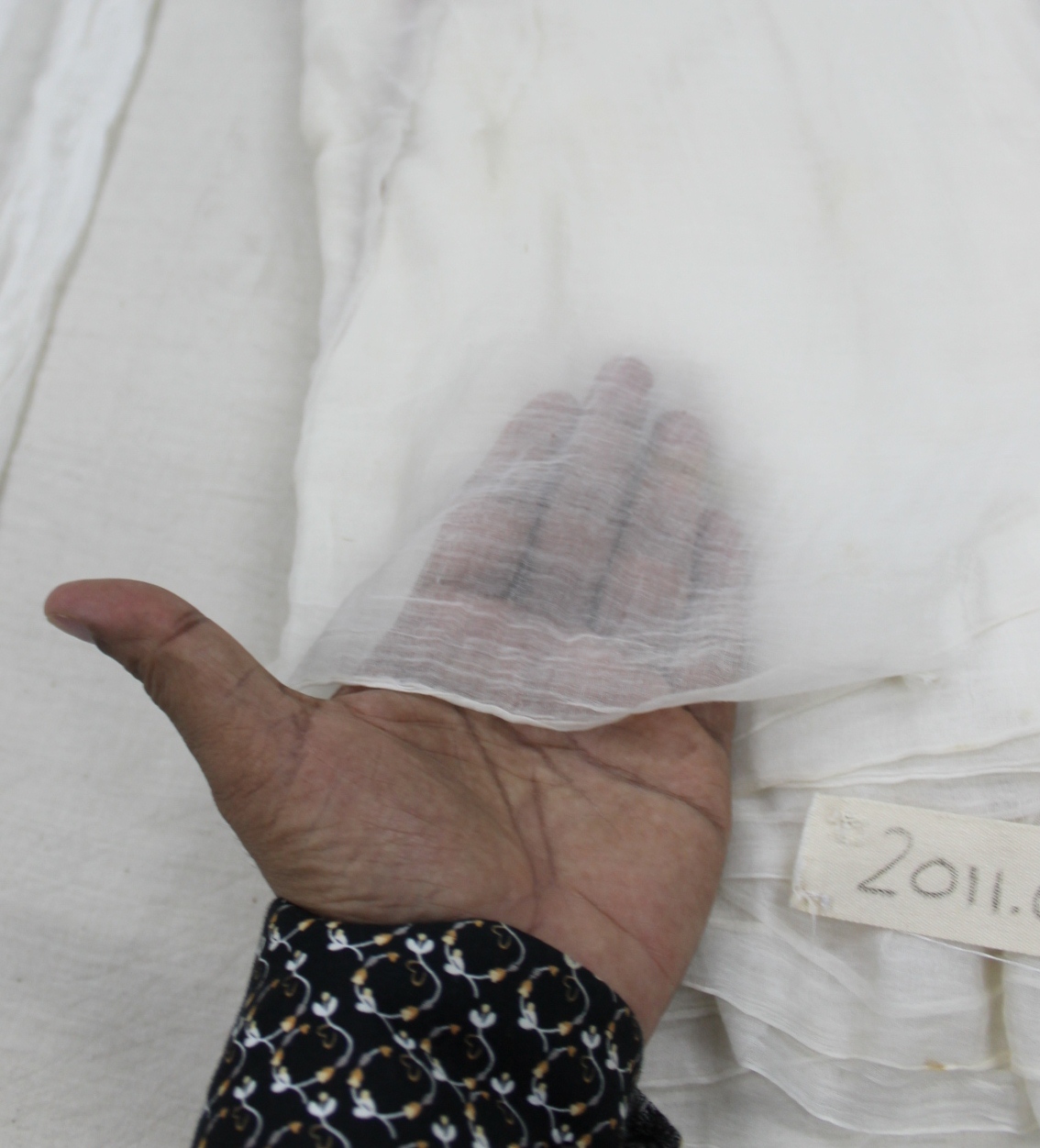
Muslin is a handwoven cotton cloth of plain weave, made in weights from gauze-like sheers to coarse sheeting. It grew famous in Bengal, with Dhaka at the centre of a worldwide trade, and after nearly dying out in the 18th century it is woven again today in Bangladesh and West Bengal.
When is Muslin kept?
Muslin is kept on made by hand through the year; the finest weaving was traditionally set in the rainy season, when damp air protected the yarn.
Muslin is a handwoven cotton cloth of plain weave, spun so fine that a whole piece could once be drawn through a ring. Bengal, and above all Dhaka, made the finest of it, and for two centuries the city ruled a worldwide trade. Cheap cloth from England, backed by the East India Company, ended that. Today weavers in Bangladesh and West Bengal are spinning and weaving it again.
What it is
Muslin is a plain-woven cotton cloth that comes in many weights, from gauzy sheers to coarse sheeting. The celebrated Dhaka cloth was spun from a local cotton called phuti carpus, found only in Bangladesh, on yarn of at least 300 count, so sheer that writers compared it to glass. Old accounts list some 28 varieties of Bengal muslin; jamdani, one of them, is still widely woven today. Because every step was done by hand, a single length could take more than five months, and the finest work was set in the rainy season, when damp air kept the threads supple and few snapped.
A borrowed name
Europeans met the cloth under a name they took from trade. The usual story, recorded in Hobson-Jobson, the dictionary compiled by Henry Yule and S. C. Burnell, traces muslin to Mosul in Iraq, a trading city that made very fine cloth of its own in the 12th century and later, which Arab merchants carried west. Marco Polo described Mosul cloth in 1298. Other scholars point instead to Masulipatnam, now Machilipatnam, a port on India's Coromandel Coast that shipped light cottons to Arab, Persian and European buyers, much as calico recalls Calicut and denim recalls Nîmes. Either way, the name names a marketplace, not the Bengal looms that made the cloth famous.
The Dhaka centuries
Fine cotton was woven in Bengal long before Europe took notice. In the ninth century the Arab merchant Sulaiman al-Tajir described a kingdom there, Ruhma, whose cloth was delicate enough to slip through a ring. Ibn Battuta praised the cloth of Sonargaon in the fourteenth century, and Chinese writers did the same a hundred years later; the Englishman Ralph Fitch, visiting in 1583, ranked Sonargaon's cloth the finest in India. Abul Fazl, a courtier of Akbar, praised the muslin of Sonargaon for its fineness and abundance, and when the Mughal capital moved from Rajmahal to Dhaka in 1610 the city became the hub of Bengal's trade. Through the seventeenth and eighteenth centuries Mughal Bengal led the world trade, and the cloth caught on in France before spreading across much of the West.
How it is woven
Every stage was manual. Fibres were cleaned and combed with a boalee, the upper jaw of a catfish, before spinning. Spinners drew out yarn of extraordinary fineness; counts of 300 and more were usual for the Dhaka cloth. Weavers worked in the rainy season, when the damp gave the yarn elasticity and saved it from breaking, and a single piece could occupy them for over five months. At least fifty different tools were needed, and when the craft died out in Bengal those tools vanished with it. Revival teams in Bangladesh had to reconstruct them, working from samples of old cloth held in India and Britain and from the genetic record of the cotton plant itself.
Decline and return
Under the East India Company, British cloth flooded into India and could not outsell Bengal's muslin, so the company turned to policies that suppressed the local industry; weaving all but ceased in the late eighteenth century. Stories that weavers had their thumbs cut off still circulate, but historians have dismissed them as a misreading of a 1772 report by William Bolts. Many weavers fled East Bengal for the eastern districts of West Bengal. India's revival began in the 1950s, when Kalicharan Sharma's six-spindle Ambar Charkha managed 500-count yarn, and West Bengal's Project Muslin, launched in 2013, has weavers reaching 700 counts. Bangladesh declared its fine Dhaka muslin officially revived in April 2022, and Dhakai Muslin gained Geographical Indication status in 2020.
How Muslin is kept
Spinners, ginners and weavers, all working by hand, pass the cloth from stage to stage. Fibres of phuti carpus cotton are cleaned and combed, then spun into very fine yarn, which is woven on handlooms, ideally in the rainy season; one length may take five months. In Bangladesh the Bangladesh Handloom Board oversees the revival: cotton is grown on a Meghna island, spun with Indian partners into 200 and 300 count yarn, and woven near Dhaka, where the Dhakai Muslin House opened at Rupganj in 2022. In West Bengal, trained weavers in seven districts produce muslin up to 700 count.
When and where
Muslin is a craft rather than a dated festival. Traditionally the fine weaving was done in the rainy season, when humid air made the yarn elastic and less likely to snap. In the revival, seeds of the rediscovered cotton were sown on a Meghna island in 2015, the first cotton was harvested that year, and Bangladesh announced the official revival of Dhaka muslin in April 2022.
Bengal is the historic home. Sonargaon, east of Dhaka, produced the finest cloth, and Dhaka grew into the trade's capital; in Central Asia the finest cloth was known simply as Daka, after the city. Today the craft is strongest around Dhaka and Narayanganj in Bangladesh, and in West Bengal, where Chowk Islampur in Murshidabad district spins and weaves.
What Muslin means
To the weavers who rebuilt it, muslin stands for a Bengali skill the world once knew by name and nearly lost under colonial rule. Its return is treated as heritage work rather than commerce: Bangladesh listed Dhakai Muslin as a Geographical Indication in 2020, West Bengal followed with Banglar Muslin in 2024, and UNESCO honoured jamdani weaving in 2013. A new 300-count sari is not yet the old Dhaka cloth, but weavers see it as proof that the thread is unbroken.



Questions people ask about Muslin
When is Muslin kept?
Muslin is kept on made by hand through the year; the finest weaving was traditionally set in the rainy season, when damp air protected the yarn.
What is muslin?
A cotton cloth of plain weave, made in weights that run from sheer gauze to coarse sheeting. The celebrated Dhaka muslin was handwoven from a cotton called phuti carpus on yarn of at least 300 count, so fine that the finished cloth was compared to glass.
Where does the name come from?
Most accounts, including the dictionary Hobson-Jobson by Henry Yule and S. C. Burnell, trace it to Mosul in Iraq, whose fine cloth Arab traders carried to Europe; Marco Polo described it in 1298. Some scholars prefer Masulipatnam, an Indian port, since fabrics were often named for their trading towns.
Where is it made today?
In Bangladesh and West Bengal. Bangladesh declared its fine Dhaka muslin officially revived in April 2022, with work centred near Dhaka and Narayanganj, where the Dhakai Muslin House opened at Rupganj in 2022. In India, Project Muslin supports weavers across seven West Bengal districts, including Murshidabad and Nadia.
Why did it nearly disappear?
In the late eighteenth century the East India Company brought in cheap British cloth, could not compete with Bengal's weavers, and adopted policies that suppressed the industry. Weaving ceased, and many weavers fled East Bengal for West Bengal, taking their skills with them.
What is jamdani?
One of about 28 varieties of Bengal muslin, and the one still widely woven. UNESCO inscribed the jamdani weaving art of Bangladesh on its intangible heritage list in 2013, recognising it as part of the world's living heritage.
See also
 Kolhapuri chappalHandcrafted braided leather slip-on sandals from western India
 IkatA resist-dyeing craft from Southeast Asia, where yarns are tied and dyed before weaving
 South Asian truck artThe craft of painting and adorning cargo trucks and buses across India and Pakistan.
 PhulkariGeometric and floral threadwork embroidered by Punjabi women on handwoven cotton.
Good reading and sources
- Encyclopaedia BritannicaArticle
- Legendary fabricDeccan Herald, Article
- The ancient fabric that no one knows how to makeBBC, Article
- Legendary fabricDeccan Herald, Article
- The ancient fabric that no one knows how to makeBBC, Article
- Muslin on WikipediaEncyclopedia
- More photos on Wikimedia CommonsPhotos and video
- Wikidata recordOpen data
The facts on this page come from the Wikipedia article "Muslin", written by its contributors and used under the CC BY-SA 4.0 licence, and from its Wikidata record (CC0). EveryParampara rewrote the text in its own words, with AI assistance, and compares every page with the article to make sure no passage is copied. It may be reused under the same CC BY-SA 4.0 licence with a link back.
It may contain mistakes. Traditions differ from one family, village and community to the next, and the people who keep them know them best. If something is wrong, tell us. Last refreshed 2026-10-08.
More from Bangladesh
All the traditions of Bangladesh 🇧🇩 Dhaka, Bangladesh and 1 moreNakshi kanthaনকশি কাঁথা
A traditional embroidered quilt from Bengal, made by stitching layers of old cloth into colourful, patterned textiles.Craft
🇧🇩 Dhaka, Bangladesh and 1 moreNakshi kanthaনকশি কাঁথা
A traditional embroidered quilt from Bengal, made by stitching layers of old cloth into colourful, patterned textiles.Craft
 🇧🇩 Dhaka, Bangladesh and 1 moreJamdaniজামদানি
A fine handwoven cotton cloth of Bengal, patterned with motifs worked in by handCraft
🇧🇩 Dhaka, Bangladesh and 1 moreJamdaniজামদানি
A fine handwoven cotton cloth of Bengal, patterned with motifs worked in by handCraft
 🇮🇳 India and 1 moreRangoliरंगोली
Floor patterns of rice flour, sand or petals, drawn at the doorstep for festivalsCraft
🇮🇳 India and 1 moreRangoliरंगोली
Floor patterns of rice flour, sand or petals, drawn at the doorstep for festivalsCraft
 🇹🇷 Turkey and 5 moreEid al-Fitrعيد الفطر
The feast that ends Ramadan, opened with morning prayers, sweets and visits homeFestival · Feasts and festival meals
🇹🇷 Turkey and 5 moreEid al-Fitrعيد الفطر
The feast that ends Ramadan, opened with morning prayers, sweets and visits homeFestival · Feasts and festival meals
The same idea elsewhere
All of this kind 🇮🇷 Shiraz, Iran and 1 moreKhatamخاتم
A Persian inlay craft that builds geometric patterns from thousands of tiny cut piecesCraft
🇮🇷 Shiraz, Iran and 1 moreKhatamخاتم
A Persian inlay craft that builds geometric patterns from thousands of tiny cut piecesCraft
 🇮🇪 Galway, Ireland and 1 moreBrigid's crossCros Bhríde
A cross of woven rushes or straw, made for Saint Brigid's Day on the first of FebruaryCraft
🇮🇪 Galway, Ireland and 1 moreBrigid's crossCros Bhríde
A cross of woven rushes or straw, made for Saint Brigid's Day on the first of FebruaryCraft
 🇦🇺 AustraliaBark painting
Ochre pictures on flattened tree bark, an Aboriginal art form of northern AustraliaCraft
🇦🇺 AustraliaBark painting
Ochre pictures on flattened tree bark, an Aboriginal art form of northern AustraliaCraft
 🇺🇸 United States and 1 moreDreamcatcherᐊᓴᐱᑫᔒᓐᐦ (asabikeshiinh)
A hand-woven hoop from Anishinaabe tradition, hung above a cradle to protect a childCraft
🇺🇸 United States and 1 moreDreamcatcherᐊᓴᐱᑫᔒᓐᐦ (asabikeshiinh)
A hand-woven hoop from Anishinaabe tradition, hung above a cradle to protect a childCraft