Spiritual and religiousEuropeChristian
Oktav
In its own language: Muttergottesoktav
A two-week annual Marian pilgrimage and festival in Luxembourg City

The Oktav is a fortnight-long pilgrimage and religious observance held in Luxembourg City to honour the Virgin Mary as Comforter of the Afflicted. Catholics from Luxembourg and neighbouring border regions attend special masses, join a grand closing street procession, and visit traditional market stalls.
When is Oktav kept?
Oktav is kept on annually for two weeks from the third to the fifth Sunday after Easter.
The Oktav is an annual two-week Catholic pilgrimage and festival held in Luxembourg in honour of the Virgin Mary, revered locally as the Comforter of the Afflicted. Taking place between the third and fifth Sundays after Easter, the observance combines solemn cathedral liturgies with civic celebrations. Worshippers from Luxembourg and nearby regions in Belgium, France, and Germany travel to the capital to pray, join processions, and gather at seasonal market stalls.
Origins and history
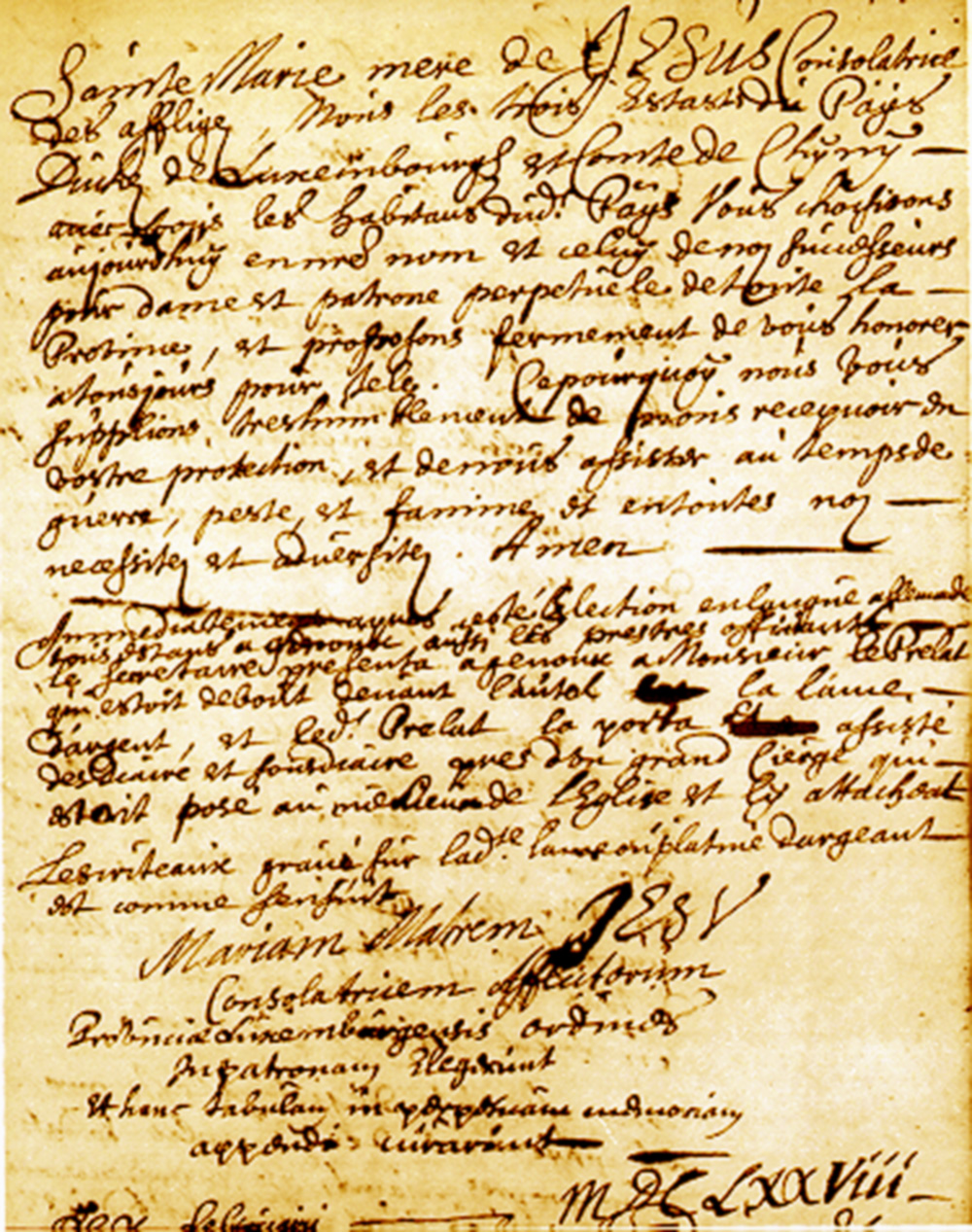
The tradition began in 1624 under Jesuit priest Jacques Brocquart, who led students carrying a small wooden statue of Mary outside the city ramparts. At a time marked by plague and the Thirty Years War, locals sought solace in the image, naming her Comforter of the Afflicted. Mary was formally chosen as patroness of Luxembourg City in 1666, and of the entire duchy in 1678. Despite disruptions during the French Revolution, the observance grew over the nineteenth century into a key element of national identity. In 1921, church authorities doubled its length to two weeks to accommodate growing numbers of visiting parishes.
Pilgrimage and liturgies
During the two weeks of the double octave, Notre-Dame Cathedral hosts a dense schedule of daily services. Over eighty separate masses cater to specific groups, including schools, regional parishes, civic authorities, the armed forces, police, and charitable guilds. Inside the cathedral, the seventeenth-century wooden figure rests upon a rocaille wrought-iron votive altar, presented during the centenary in 1766. The Archbishop conducts a Pontifical High Mass attended by the Grand Duke and Grand Duchess, during which the historical act of consecrating the nation to the patroness is formally recited and renewed.
The closing procession
The festival culminates on the fifth Sunday after Easter with a solemn procession through the streets of Luxembourg City. Clergy, civic groups, and ordinary citizens accompany the decorated statue of the Virgin Mary as it travels from the cathedral to the Grand Ducal Palace and back. Members of the Grand Ducal Family walk the route on foot alongside the public. Following the return to the cathedral for closing prayers, the royal family appears on the palace balcony to greet spectators while the municipal orchestra performs an aubade.
Market stalls and food
Alongside the religious devotions sits the Mäertchen, a bustling temporary fair set up on Constitution Square and the Knuedler. Originally established in earlier centuries to feed visiting pilgrims who had walked from distant villages, the market now features roughly eighty stalls selling handmade crafts, keepsakes, and snacks. Visitors of all ages gather after church services to socialise. The defining food of the fair is the Gromperekichelcher, a fried potato pancake prepared hot at outdoor stands and eaten by hand throughout the festivities.
How Oktav is kept
For two weeks, pilgrims travel to Luxembourg City to attend scheduled masses and pray before the Marian statue on its wrought-iron altar in Notre-Dame Cathedral. Various civic, religious, and parish groups take turns participating in services each day. The Grand Duke and Grand Duchess join the Archbishop for a Pontifical High Mass. On the final Sunday, a major procession carries the statue through the city streets with the royal family walking among the crowd. Afterwards, people gather at the Mäertchen market stalls in town squares to eat freshly fried potato pancakes and socialise.
When and where
The Oktav takes place every year during the Month of Mary, opening on the third Sunday after Easter and concluding on the fifth Sunday after Easter. Because its dates rely on the Easter calendar, the exact fortnight varies each spring, usually falling in May.
The main events take place at Notre-Dame Cathedral, the city streets, and public squares like the Knuedler and Constitution Square in Luxembourg City. Pilgrims also travel in from the Belgian province of Luxembourg, Lorraine in France, and the Eifel region of Germany.
What Oktav means
The devotion represents spiritual protection and comfort in times of crisis, rooted in historical recoveries from seventeenth-century epidemics and wartime sieges. Beyond its religious meaning, the celebration became an expression of Luxembourgish national cohesion and perseverance, especially during foreign occupations and conflicts in the nineteenth and twentieth centuries.



Questions people ask about Oktav
When is Oktav kept?
Oktav is kept on annually for two weeks from the third to the fifth Sunday after Easter.
What is the Oktav?
It is an annual two-week Catholic pilgrimage and festival in Luxembourg City. Originating in the seventeenth century, it honours the Virgin Mary under the title Comforter of the Afflicted, uniting church liturgies with civic street markets and processions.
Where do the celebrations occur?
The central ceremonies occur in Luxembourg City at Notre-Dame Cathedral, along central streets, and at squares like Constitution Square and the Knuedler. Pilgrims arrive from across Luxembourg as well as nearby parts of Belgium, France, and Germany.
What is the Mäertchen?
The Mäertchen is a seasonal street market held in Luxembourg City during the pilgrimage. Originally set up to feed travelling pilgrims, it now features dozens of stalls offering crafts, local treats, and traditional potato pancakes.
See also
 Camino de SantiagoA Christian walking pilgrimage across Europe to the shrine of Saint James in Spain
 Saint Nicholas DayThe feast day of Saint Nicholas, kept in Advent with gifts, shoes and church services
 Twelfth NightThe closing evening of the Christmas season, kept with cake, carols and wassail
 Procession of the Holy BloodAn annual sacred parade and historical pageant through the streets of Bruges, Belgium.
Good reading and sources
- Oktav on WikipediaEncyclopedia
- More photos on Wikimedia CommonsPhotos and video
- Wikidata recordOpen data
The facts on this page come from the Wikipedia article "Oktav", written by its contributors and used under the CC BY-SA 4.0 licence, and from its Wikidata record (CC0). EveryParampara rewrote the text in its own words, with AI assistance, and compares every page with the article to make sure no passage is copied. It may be reused under the same CC BY-SA 4.0 licence with a link back.
It may contain mistakes. Traditions differ from one family, village and community to the next, and the people who keep them know them best. If something is wrong, tell us. Last refreshed 2026-10-05.
More from Luxembourg
All the traditions of Luxembourg
🇪🇸 Santiago de Compostela, Spain and 7 moreCamino de SantiagoEl Camino de Santiago
A Christian walking pilgrimage across Europe to the shrine of Saint James in SpainSpiritual
 🇱🇺 Echternach, LuxembourgDancing procession of EchternachIechternacher Sprangprëssioun
A Roman Catholic hopping pilgrimage honouring Saint Willibrord in eastern LuxembourgSpiritual
🇱🇺 Echternach, LuxembourgDancing procession of EchternachIechternacher Sprangprëssioun
A Roman Catholic hopping pilgrimage honouring Saint Willibrord in eastern LuxembourgSpiritual
 🇫🇷 France and 5 moreCandlemas
A Christian feast of candle blessings marking the end of the Christmas seasonSpiritual
🇫🇷 France and 5 moreCandlemas
A Christian feast of candle blessings marking the end of the Christmas seasonSpiritual
 🇮🇹 Rome, Italy and 2 moreAssumption of Mary
A feast on 15 August, when Christians remember Mary taken up into heavenSpiritual
🇮🇹 Rome, Italy and 2 moreAssumption of Mary
A feast on 15 August, when Christians remember Mary taken up into heavenSpiritual
The same idea elsewhere
Pilgrimage compared 🇲🇲 Bagan, MyanmarNat worshipနတ်
Veneration of guardian spirits and nature deities alongside Buddhism in MyanmarSpiritual
🇲🇲 Bagan, MyanmarNat worshipနတ်
Veneration of guardian spirits and nature deities alongside Buddhism in MyanmarSpiritual
 🇲🇦 Rabat, Morocco and 5 moreFantasiaالفانتازيا
A North African equestrian display of synchronized charging and simultaneous rifle fireGame
🇲🇦 Rabat, Morocco and 5 moreFantasiaالفانتازيا
A North African equestrian display of synchronized charging and simultaneous rifle fireGame
 🇮🇳 India and 4 moreProstration
Bowing the whole body to the ground, in prayer and as a sign of respectSpiritual
🇮🇳 India and 4 moreProstration
Bowing the whole body to the ground, in prayer and as a sign of respectSpiritual
 🇪🇬 Thebes, EgyptBeautiful Festival of the Valleyhb nfr n jnt
An ancient Egyptian festival honouring the dead with river processions across ThebesSpiritual
🇪🇬 Thebes, EgyptBeautiful Festival of the Valleyhb nfr n jnt
An ancient Egyptian festival honouring the dead with river processions across ThebesSpiritual