Spiritual and religiousEuropeChristian
Royal Maundy
A Church of England service where the monarch gives silver Maundy coins to older people

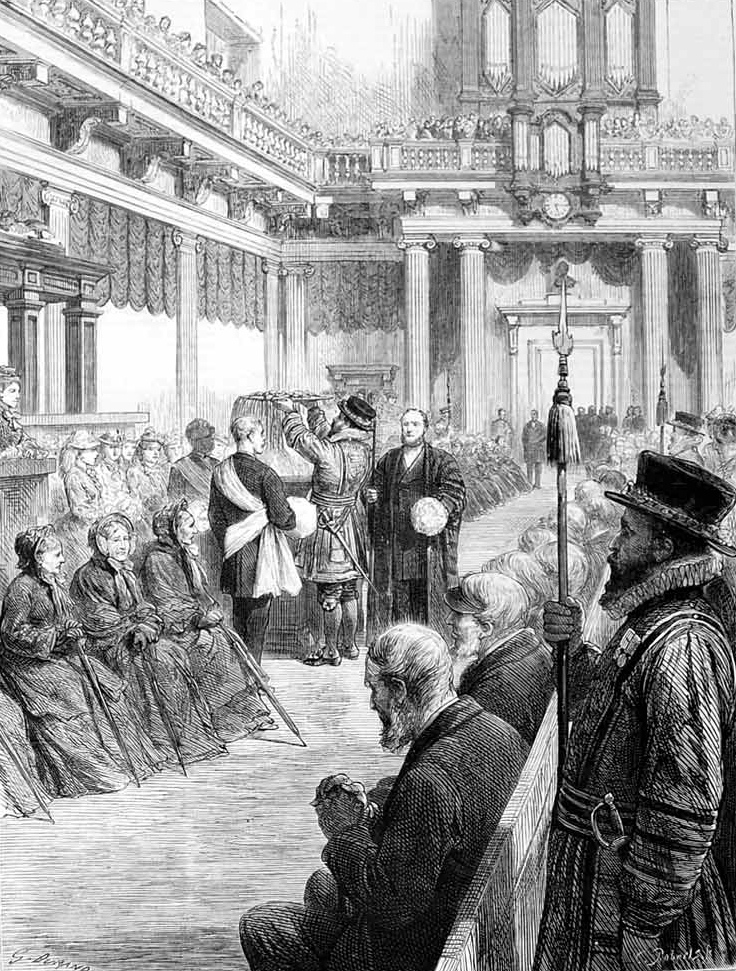
Royal Maundy is a Church of England service kept on Maundy Thursday, when the British sovereign or a deputy hands small silver coins to a group of older recipients. It descends from Jesus washing his disciples' feet, and it now travels each year to a different cathedral or church, usually outside London.
When is Royal Maundy marked?
Royal Maundy is kept as part of Good Friday, which is on Friday, 26 March 2027.
Every year, on the Thursday of Holy Week, a Church of England service brings the British monarch or a royal deputy together with a group of older people for a ceremony of giving. Small silver coins, called Maundy money, are handed over as symbolic alms. The custom grows out of Jesus washing his disciples' feet, and from the command to love one another that gives the day its name.
Origins and history
Maundy takes its name from mandatum, Latin for a command. The Gospels describe Jesus eating with his disciples on the night before his death, washing their feet, and telling them to do the same for each other. From that instruction grew a church rite called the pedilavium, in which senior clergy washed the feet of poor people after Holy Communion on Maundy Thursday. It appears by the fourth or fifth century. Some monasteries carried it out every day. In 992, Bishop Oswald of Worcester is recorded as dying while taking part.
Kings and queens
English rulers made the rite their own. John is the first whose alms at a Maundy service are recorded, at Knaresborough in Yorkshire in 1210, and the first noted for giving silver pennies to poor men, at Rochester in 1213. Edward I narrowed the occasion to Maundy Thursday itself. Edward III, then fifty, matched his age with fifty pence to fifty men in 1363, and Henry IV ruled that the number of pence should follow the sovereign's years. Nobles copied the practice. Mary I and Elizabeth I both kept elaborate ceremonies, and Elizabeth replaced the gift of her gown with a pound in a red purse.
Washing and its traces
For centuries the ruler or a deputy knelt and washed the feet of the poor, a task church leaders had performed long before. Records from 1556 describe Mary I on her knees before forty-one women. Scented water masked any smell, and helpers cleaned each pair of feet in advance. Sweet nosegays were held against the odour, and they are still carried in the procession. When plague threatened, an official went instead of the sovereign. James II is generally said to be the last monarch to do the washing himself, in 1685. The Lord High Almoner continued it until 1737.
Maundy money
The coins are struck in four values, from a penny up to fourpence. Older examples came from ordinary circulating money; only in the later 1700s did the four pieces become a set of their own that nobody spends. Each bears the reigning monarch on one side. On the other sits a crowned number inside a wreath, a design traced to William III and Mary II and barely changed since 1822. Two leather purses carry the gift: the white one holds as many pence as the sovereign has years, the red one a five-pound coin and a fifty-pence coin. Sets are few, under two thousand most years, and collectors prize them.
Today and change
The ceremony lapsed as a royal occasion for more than two centuries, until Princess Marie Louise attended in 1931 and urged her cousin George V to take part the next year. He did, and monarchs have returned since. Elizabeth II was present nearly every year of her reign. The venue now changes annually, mostly to cathedrals away from London, though it once sat almost always in or near the capital. In 2020 and 2021 the pandemic forced cancellation, and gifts went by post. In 2024 Queen Camilla stood in for Charles III while he was treated for cancer.
How Royal Maundy is kept
At the service, which follows Holy Communion, the sovereign or a stand-in leads. Officials carry in nosegays and linen towels. Purses are handed to each recipient: a white one with coins worth as many pence as the monarch's age, and a red one holding a five-pound coin and a fifty-pence coin. Ordinary cash comes too, replacing the cloth and food of earlier centuries. Recipients are older people put forward each year by clergy for what they have given to their churches or communities, and they usually come from the hosting diocese.
When and where
Maundy Thursday sets the date, so the service moves with Easter each spring. It falls in Holy Week, on the Thursday that comes just before Good Friday. A monarch could once postpone it by a day, and in 1510 it was moved to Good Friday by royal order. In 2020 and 2021 it did not take place at all.
The service is kept in the United Kingdom by the Church of England. Early on it followed the court, appearing at Windsor, Eton, Richmond or Greenwich, wherever the king or queen happened to be at Easter. It later settled in London, first at the Chapel Royal in Whitehall and then at Westminster Abbey. Since the mid twentieth century it has usually travelled to a different cathedral.
What Royal Maundy means
The rite turns on humility and mutual care. Jesus told his followers to love one another, and the washing of feet enacts that command in public. A monarch who kneels to serve poor people is both lowered and honoured. According to Virginia Cole, a scholar of the medieval ceremony, the act of humbling himself proclaimed the ruler's greatness. For recipients, the coins are a token of recognition rather than charity, given for what they have contributed over many years.



Days Royal Maundy is marked
Questions people ask about Royal Maundy
When is Royal Maundy marked?
Royal Maundy is kept as part of Good Friday, which is on Friday, 26 March 2027.
What is Royal Maundy?
It is a Church of England service at which the British monarch, or someone standing in, gives small silver coins to a group of older people. The coins are known as Maundy money and serve as symbolic alms. The ceremony takes its name from Christ's command that his followers love one another.
Where is it held?
Early services followed the royal court around England. Later the ceremony sat in London, at the Chapel Royal in Whitehall and then at Westminster Abbey. Since the mid twentieth century it has generally gone to a different cathedral each year, usually away from the capital. Recipients come from the diocese that hosts it.
Who receives Maundy money?
Older men and women, chosen fresh each year for what they have done for their churches or communities, put forward by clergy from several Christian denominations. In earlier times poverty was the qualification, and a recipient kept the place for life. Usually they belong to the diocese hosting that year's service.
What do the coins look like?
There are four, worth a penny, twopence, threepence and fourpence. The reigning monarch appears on the front. On the back a crowned numeral sits inside a wreath, a design going back to William III and Mary II and hardly altered since 1822. They rarely circulate.
See also
 Twelfth NightThe closing evening of the Christmas season, kept with cake, carols and wassail
 Chelsea Flower ShowA five-day May horticultural festival held in London by the Royal Horticultural Society
 Trooping the ColourThe annual British military parade marking the official birthday of the monarch.
 Saint David's DayThe national feast day of Wales, marked with parades, poetry contests and daffodils
Good reading and sources
- Isle of Man people to receive the Queen's Maundy almsBBC, Article
- Prince Charles stands in for Queen at Maundy ServiceBBC, Article
- Isle of Man people to receive the Queen's Maundy almsBBC, Article
- Prince Charles stands in for Queen at Maundy ServiceBBC, Article
- Royal Maundy on WikipediaEncyclopedia
- More photos on Wikimedia CommonsPhotos and video
- Wikidata recordOpen data
The facts on this page come from the Wikipedia article "Royal Maundy", written by its contributors and used under the CC BY-SA 4.0 licence, and from its Wikidata record (CC0). EveryParampara rewrote the text in its own words, with AI assistance, and compares every page with the article to make sure no passage is copied. It may be reused under the same CC BY-SA 4.0 licence with a link back.
It may contain mistakes. Traditions differ from one family, village and community to the next, and the people who keep them know them best. If something is wrong, tell us. Last refreshed 2026-10-05.
More from the United Kingdom
All the traditions of the United Kingdom
🇬🇧 United Kingdom and 5 moreTwelfth Night
The closing evening of the Christmas season, kept with cake, carols and wassailSpiritual · Feasts and festival meals
 🇺🇸 New York, United States and 4 moreFeast of the Ascension
The fortieth day of Easter, when Christians remember Jesus being taken up into heavenSpiritual
🇺🇸 New York, United States and 4 moreFeast of the Ascension
The fortieth day of Easter, when Christians remember Jesus being taken up into heavenSpiritual
 🇮🇱 Jerusalem, Israel and 5 morePresentation of Jesus at the TempleIn praesentatione Domini
A February feast of candles and welcome, kept forty days after ChristmasSpiritual
🇮🇱 Jerusalem, Israel and 5 morePresentation of Jesus at the TempleIn praesentatione Domini
A February feast of candles and welcome, kept forty days after ChristmasSpiritual
 🇪🇸 Spain and 5 moreSt John's Eve
Bonfires, feasting and worship on the short night before John the Baptist's feastSpiritual
🇪🇸 Spain and 5 moreSt John's Eve
Bonfires, feasting and worship on the short night before John the Baptist's feastSpiritual
The same idea elsewhere
Royalty and coronation compared 🇮🇱 IsraelRosh Hashanahרֹאשׁ הַשָּׁנָה
The Jewish New Year marked by shofar horn blasts, prayer and sweet foodsSpiritual
🇮🇱 IsraelRosh Hashanahרֹאשׁ הַשָּׁנָה
The Jewish New Year marked by shofar horn blasts, prayer and sweet foodsSpiritual
 🇵🇪 Cusco, Peru and 4 moreIntiinti (Quechua)
The Inca sun deity, honoured with temples, offerings and the June festival Inti RaymiSpiritual
🇹🇭 ThailandThai solar calendarปฏิทินสุริยคติไทย
The official solar calendar of Thailand, numbered in the Buddhist EraSeasonal
🇵🇪 Cusco, Peru and 4 moreIntiinti (Quechua)
The Inca sun deity, honoured with temples, offerings and the June festival Inti RaymiSpiritual
🇹🇭 ThailandThai solar calendarปฏิทินสุริยคติไทย
The official solar calendar of Thailand, numbered in the Buddhist EraSeasonal
 🇺🇸 United StatesTalking stick
A carved staff that shows who may speak at a Northwest Coast gatheringCeremony
🇺🇸 United StatesTalking stick
A carved staff that shows who may speak at a Northwest Coast gatheringCeremony