Festivals and celebrationsMiddle EastJewish
Simchat Beit HaShoeivah
In its own language: שמחת בית השואבה
Nightly music and dancing during the intermediate days of the festival of Sukkot

Simchat Beit HaShoeivah is a joyful Jewish evening gathering held during the intermediate days of Sukkot. Originating in ancient Jerusalem, it brings people together in synagogues and study halls for lively dancing, live music and food shared in a sukkah.
When is Simchat Beit HaShoeivah marked?
Simchat Beit HaShoeivah is kept as part of Sukkot, which runs from 16 to 22 October 2027.
Simchat Beit HaShoeivah is a spirited Jewish observance held at night during the middle days of the autumn festival of Sukkot. Marking an ancient Temple ceremony linked to seasonal rains, communities gather in synagogues, study halls and courtyards. Participants spend hours singing, dancing to live music and sharing food inside the holiday booth, recalling one of the happiest celebrations recorded in traditional Jewish history.
Ancient Temple roots
In the era of the Jerusalem Temple, priests conducted a daily morning ritual during Sukkot called Nisukh HaMayim, where fresh water was poured out on the altar. Jewish tradition teaches that the world is judged for rainfall at this time of year, making the ritual an appeal for timely showers. Each night following the libation, huge crowds assembled in the outer Temple court. Leading figures danced with blazing torches while Levite musicians played harps, lyres, cymbals and trumpets. Ancient texts note that Rabban Shimon ben Gamliel could juggle eight lit torches at once, capturing the unmatched joy of the occasion.
Revival and spread
After the destruction of the Temple, the grand celebration faded into memory. In 1726, Rabbi Hayyim ben Jacob Abulafia established a structured community observance in İzmir to keep the memory of the sanctuary alive. When he relocated to the Land of Israel in 1740, the revived custom gained traction among local congregations. Travelers carried the tradition outward across Europe, reaching Lithuanian communities before the end of the eighteenth century. Today, Sephardic, Ashkenazi, Hasidic and Misnagdic congregations around the globe hold their own nightly festivities during the holiday week.
How nights are celebrated
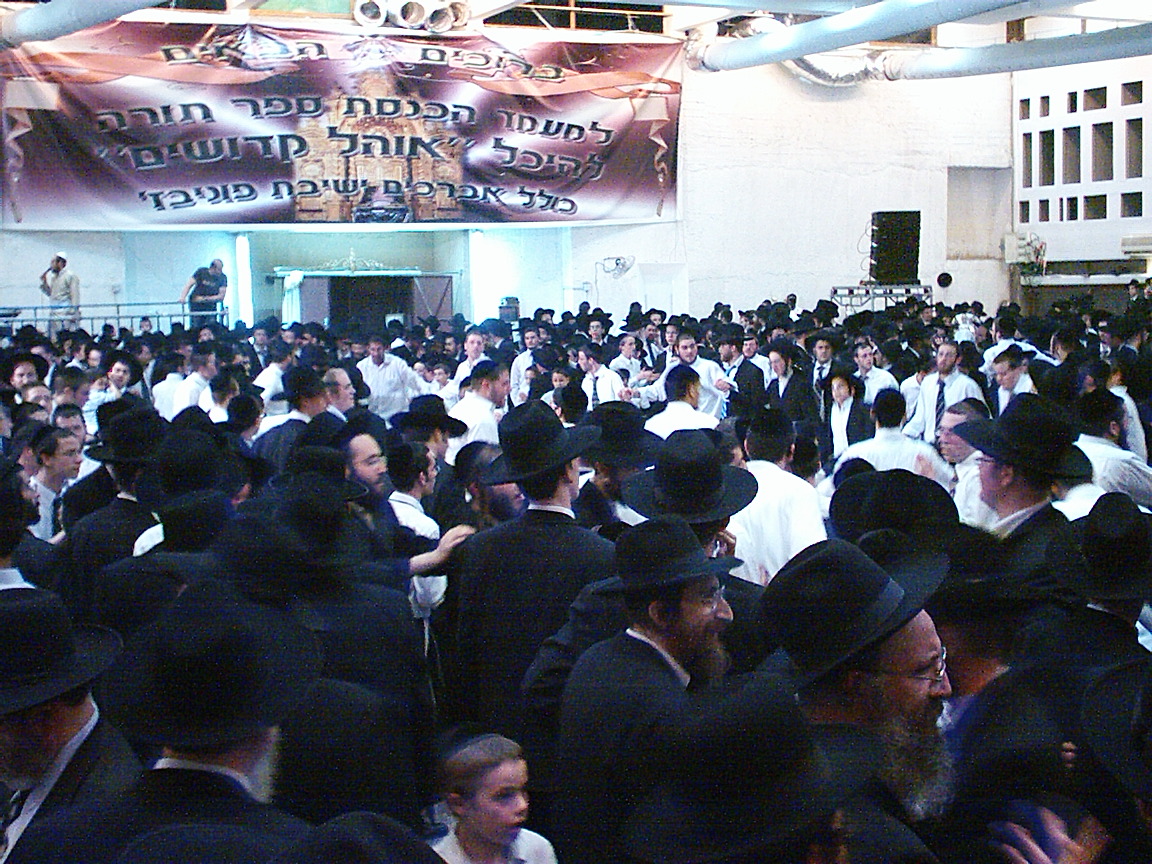
Modern events usually begin late in the evening and continue deep into the night. Congregants meet at major study houses or synagogues, where live ensembles play uplifting tunes. Circles of dancers move vigorously through the hall, often led by community elders and teachers. A temporary wall or partition is set up to provide distinct spaces for men and women. Between dance sets, guests step into an adjacent sukkah to eat light refreshments, converse and study sacred texts together, maintaining a warm festive mood until the early morning hours.
Festivities in Jerusalem
Jerusalem remains the central hub for these night gatherings. Hasidic communities across the city host celebrations on nearly every intermediate night of the holiday. The neighbourhood of Meah Shearim becomes especially active, with huge crowds filling the main synagogues of groups such as Karlin, Breslov, Toldos Avrohom Yitzchok, Dushinsky and Belz. The gathering at Toldos Aharon is the largest of these events, drawing vast numbers of onlookers and dancers who pack the sanctuary galleries to participate in the energetic songs and dances.
How Simchat Beit HaShoeivah is kept
In the late evening during intermediate festival days, people gather at synagogues, yeshivas or study centers. Live musical bands play traditional songs while crowds dance in energetic circles. A divider separates men and women in the hall. Spectators watch from surrounding areas, while active participants sing praises and dance for hours. Light food and drinks are offered in the neighboring sukkah, allowing visitors to rest, socialize and reflect on the holiday before returning to dance.
When and where
The celebrations take place each night during the intermediate days of Sukkot, known as Chol HaMoed, starting late in the evening and often continuing until dawn.
Celebrations happen worldwide in synagogues and study halls across Ashkenazi, Sephardi and Hasidic communities. The largest and most crowded gatherings take place in Jerusalem, particularly in the Meah Shearim district.
What Simchat Beit HaShoeivah means
The event recalls the ancient Temple water pouring ceremony, which sought divine blessings for seasonal rains. It also acts as a living memorial to the extraordinary happiness and unity that marked the holiday pilgrimage in Jerusalem, connecting modern worshippers to the devotional joy of earlier generations.

Days Simchat Beit HaShoeivah is marked
Questions people ask about Simchat Beit HaShoeivah
When is Simchat Beit HaShoeivah marked?
Simchat Beit HaShoeivah is kept as part of Sukkot, which runs from 16 to 22 October 2027.
What is Simchat Beit HaShoeivah?
It is a Jewish celebration featuring music, dance and food during the intermediate nights of Sukkot. It commemorates an ancient Temple ceremony connected with prayers for rain.
Where are the biggest gatherings held?
While celebrated globally in synagogues and yeshivas, the largest events occur in Jerusalem, especially within Hasidic synagogues located in the Meah Shearim neighbourhood.
Why was water significant in the ancient ritual?
According to the Talmud, Sukkot is the time when the world is judged for rainfall. Pouring water on the altar served as an invocation for seasonal rains.
See also
 Christmas EveThe evening before Christmas, marked by church services, family meals, and gift preparations across Christian cultures.
 PassoverA Jewish spring festival celebrating freedom from slavery with ritual meals
 SukkotA seven-day autumn Jewish festival of temporary booths, harvest prayers and hospitality
 Holy FireA fire ceremony in Jerusalem each year, kept by Orthodox Christians before Easter
Good reading and sources
- Simchat Beit HaShoeivah on WikipediaEncyclopedia
- More photos on Wikimedia CommonsPhotos and video
- Wikidata recordOpen data
The facts on this page come from the Wikipedia article "Simchat Beit HaShoeivah", written by its contributors and used under the CC BY-SA 4.0 licence, and from its Wikidata record (CC0). EveryParampara rewrote the text in its own words, with AI assistance, and compares every page with the article to make sure no passage is copied. It may be reused under the same CC BY-SA 4.0 licence with a link back.
It may contain mistakes. Traditions differ from one family, village and community to the next, and the people who keep them know them best. If something is wrong, tell us. Last refreshed 2026-10-06.
More from Israel
All the traditions of Israel 🇮🇱 Jerusalem, Israel and 1 moreHanukkahחֲנֻכָּה
An eight-day Jewish festival marking the rededication of the Second Temple in Jerusalem and the miracle of a single day'Festival
🇮🇱 Jerusalem, Israel and 1 moreHanukkahחֲנֻכָּה
An eight-day Jewish festival marking the rededication of the Second Temple in Jerusalem and the miracle of a single day'Festival
 🇮🇱 Jerusalem, Israel and 1 morePurimפּוּרִים
A lively Jewish festival of storytelling, shared food, masks and charityFestival · Feasts and festival meals
🇮🇱 Jerusalem, Israel and 1 morePurimפּוּרִים
A lively Jewish festival of storytelling, shared food, masks and charityFestival · Feasts and festival meals
 🇲🇦 Morocco and 4 moreMimounaמִימוּנָה
A Maghrebi Jewish celebration marking the end of Passover with sweets and open doorsFestival · Dinner
🇲🇦 Morocco and 4 moreMimounaמִימוּנָה
A Maghrebi Jewish celebration marking the end of Passover with sweets and open doorsFestival · Dinner
The same idea elsewhere
Pilgrimage compared 🇺🇸 United States and 5 moreMother's Day
A worldwide annual celebration dedicated to mothers, maternal bonds and family careHome
🇵🇱 Poland and 5 moreChristmas Eve
The evening before Christmas, marked by church services, family meals, and gift preparations across Christian cultures.Festival · Dinner
🇺🇸 United States and 5 moreMother's Day
A worldwide annual celebration dedicated to mothers, maternal bonds and family careHome
🇵🇱 Poland and 5 moreChristmas Eve
The evening before Christmas, marked by church services, family meals, and gift preparations across Christian cultures.Festival · Dinner
 🇮🇳 India and 1 moreKailash Mansarovar Yatraकैलाश मानसरोवर यात्रा (Hindi); ཀཱའི་ལ་ཤ་མན་ས་རོ་ཝར་ཡ་ཏྲ། (Tibetan)
A high-altitude pilgrimage to Mount Kailash and Lake Manasarovar in TibetSpiritual
🇮🇳 India and 1 moreKailash Mansarovar Yatraकैलाश मानसरोवर यात्रा (Hindi); ཀཱའི་ལ་ཤ་མན་ས་རོ་ཝར་ཡ་ཏྲ། (Tibetan)
A high-altitude pilgrimage to Mount Kailash and Lake Manasarovar in TibetSpiritual
 🇵🇭 Marinduque, PhilippinesMoriones Festival
A Holy Week reenactment in Marinduque where masked participants search for the Roman centurion Longinus.Festival
🇵🇭 Marinduque, PhilippinesMoriones Festival
A Holy Week reenactment in Marinduque where masked participants search for the Roman centurion Longinus.Festival