Crafts and makingEuropePagan and ancient
Topping out
A builders' rite for the day the last beam goes up, marked with a tree, a flag and a toast

Topping out is a builders' rite held when the final beam, or the last brick in a masonry job, goes into a new building and the frame is complete. It grew out of an old Scandinavian custom of setting a tree on a new roof, and it is still kept in Britain, Germany, the Netherlands and many other countries.
When is Topping out kept?
Topping out is kept on when the topmost beam or the final block is set, or when a roof is closed against the weather.
A topping out is the moment a building's frame is finished, and the small ceremony that marks it. The last beam, or the last brick in a masonry job, goes into place, and the crew pauses. A tree or a leafy branch may go up with it, flags fly, and there is often a drink and a meal. The custom is old, and it is still kept on building sites around the world.
What it is
Topping out is a builders' rite. It happens when the highest part of a new structure is reached, usually as the final beam of the frame is fixed, or, in brick and stone work, as the last block is bedded. In recent times the word is also used without any ceremony at all, simply to mean that the shell of a building is finished. Engineers use a similar phrase when they measure wind at the top of a tall structure. Since the late twentieth century, builders and developers have often turned the occasion into a press event.
Origins and history
The rite is usually traced back to an old religious practice in Scandinavia. A tree was set on a newly raised building so that the spirits living in it, driven out by the work, could be settled again. Builders of timber frames kept the habit for centuries. From there it reached England and other parts of northern Europe, and later crossed to the Americas. Where walls were raised in brick or stone instead of wood, the same idea attached itself to the laying of the final block. The ceremony has always taken different shapes in different places.
How it is kept
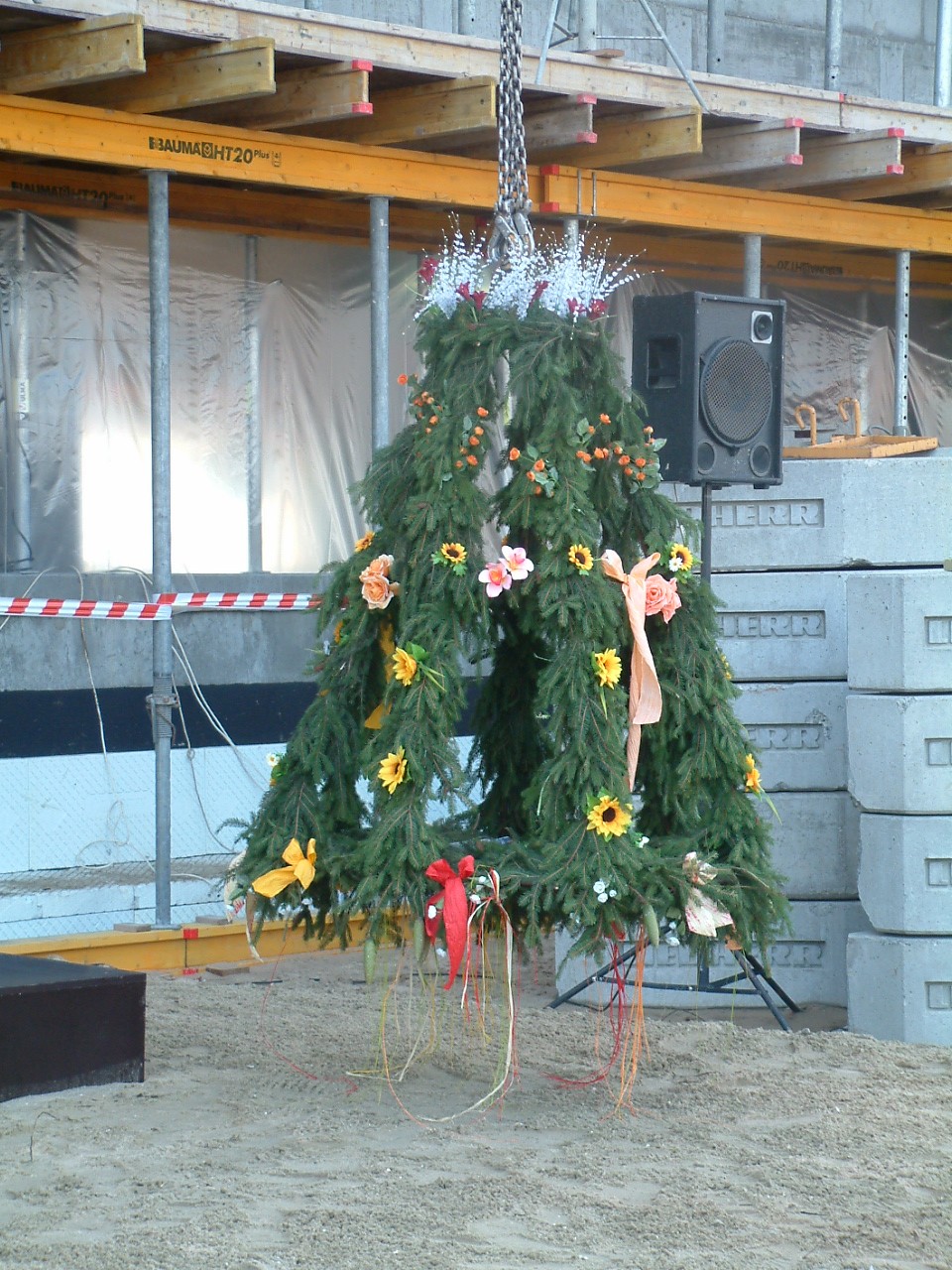
On the day, the crew gathers as the topmost beam or the last block goes in. A tree or a leafy branch, sometimes with flags and paper streamers tied on, is set on the highest wood or iron work. Someone gives a short speech. A drink is passed round, and often the workers are treated to a meal. The flag custom in the Netherlands and Flanders works in the same spirit: the flag stays up until the beer arrives. In New Zealand the crew gets cake and beer once the roof keeps out the rain.
Where it is kept
Britain keeps the custom widely, and so do Commonwealth countries such as Canada and Australia. Germany and Austria have their own version of it, and it is known too in Slovenia, Iceland, and further east in Poland, Hungary, Slovakia, the Czech Republic and the Baltic countries. Chile has it as well. American steel crews mark the day by painting the final beam white and adding their signatures. Dutch and Flemish builders raise a flag, and New Zealand roofers hold a roof shout. A topping out may also be held partway through the job, when a roof is closed in.
What it means
The old meaning had to do with unseen neighbours. The tree stood for the woodland cut down to raise the frame, and the point of setting it back on the roof was to calm whatever lived there and had been pushed out. Today the feeling is closer to thanks than to fear. The rite gives the crew a moment of pride in a job that is not finished, lets the client show appreciation, and marks a turn: from then on the building can be closed against the weather.
How Topping out is kept
Workers gather at the top of the structure as the final piece of the frame is fixed, or, on a masonry job, as the last brick or block is set. A tree or a leafy branch goes up on the highest beam, sometimes with flags and streamers tied to it. Speeches are made, a drink is shared, and the crew is often given a meal. In the Netherlands and Flanders a flag goes up once the frame is finished and stays there until the owner supplies free beer. In New Zealand the roof shout brings cake and beer.
When and where
There is no fixed date. The rite happens on the day the top of the frame is reached, which may come months or years after the ground is first broken. Some crews hold it at a halfway point instead, when the roof is closed in. The phrase is also used now for the milestone itself, ceremony or not.
The custom is strong in Britain and in Commonwealth countries such as Canada, Australia and New Zealand. It is kept in Germany and Austria, in Slovenia and Iceland, in the Netherlands and Flanders, in Poland, Hungary, Slovakia, the Czech Republic and the Baltic countries, and in Chile. American steel crews have their own version.
What Topping out means
A building takes wood, and the old rite answered the woods it took. Putting a tree, or a branch, back at the highest point was a way of making peace with the spirits thought to live in the timber. That idea is faint now, but the shape of it survives: the tree, the flag, the shared drink, and a pause to notice that something lasting has been raised.


Questions people ask about Topping out
When is Topping out kept?
Topping out is kept on when the topmost beam or the final block is set, or when a roof is closed against the weather.
What is topping out?
It is the point at which the highest part of a building's frame is finished, and the small builders' ceremony that marks it. The final beam goes in, or the last brick is laid, and the crew often shares a drink or a meal.
Where is it kept?
It is common in Britain and in Canada, Australia and New Zealand. It is known in Germany, Austria, Slovenia, Iceland, Chile, the Netherlands and Flanders, and in Poland, Hungary, Slovakia, the Czech Republic and the Baltic countries. American crews mark the final beam in their own way.
Why is a tree put on the roof?
The tree comes from an old Scandinavian religious practice. A tree or leafy branch was set on a new building to calm the spirits believed to live in the wood felled for it. The branch is kept today as a sign, even where the old belief has faded.
What is a roof shout?
It is the New Zealand way of celebrating a roof that has been made waterproof, with cake and beer for the roofers. The Dutch and Flemish pannenbier custom is close in spirit: a flag flies until the owner hands out free beer to the crew.
See also
 Brigid's crossA cross of woven rushes or straw, made for Saint Brigid's Day on the first of February
 DreamcatcherA hand-woven hoop from Anishinaabe tradition, hung above a cradle to protect a child
 Bark paintingOchre pictures on flattened tree bark, an Aboriginal art form of northern Australia
 Barn raisingA communal tradition where neighbours assemble to erect a farm barn in a few days
Good reading and sources
- Topping out on WikipediaEncyclopedia
- More photos on Wikimedia CommonsPhotos and video
- Wikidata recordOpen data
The facts on this page come from the Wikipedia article "Topping out", written by its contributors and used under the CC BY-SA 4.0 licence, and from its Wikidata record (CC0). EveryParampara rewrote the text in its own words, with AI assistance, and compares every page with the article to make sure no passage is copied. It may be reused under the same CC BY-SA 4.0 licence with a link back.
It may contain mistakes. Traditions differ from one family, village and community to the next, and the people who keep them know them best. If something is wrong, tell us. Last refreshed 2026-10-05.
More from the United Kingdom
All the traditions of the United Kingdom
🇮🇪 Galway, Ireland and 1 moreBrigid's crossCros Bhríde
A cross of woven rushes or straw, made for Saint Brigid's Day on the first of FebruaryCraft
 🇮🇹 Rome, Italy and 4 moreChristmas
A festival of Jesus's birth, kept on 25 December with gifts, lights and shared mealsFestival
🇮🇹 Rome, Italy and 4 moreChristmas
A festival of Jesus's birth, kept on 25 December with gifts, lights and shared mealsFestival
 🇬🇧 United Kingdom and 4 moreValentine's Day
A Christian feast day and cultural celebration of love kept on February 14 in many countries.Festival
🇬🇧 United Kingdom and 4 moreValentine's Day
A Christian feast day and cultural celebration of love kept on February 14 in many countries.Festival
 🇺🇸 United States and 5 moreMother's Day
A worldwide annual celebration dedicated to mothers, maternal bonds and family careHome
🇺🇸 United States and 5 moreMother's Day
A worldwide annual celebration dedicated to mothers, maternal bonds and family careHome
The same idea elsewhere
All of this kind 🇮🇷 Shiraz, Iran and 1 moreKhatamخاتم
A Persian inlay craft that builds geometric patterns from thousands of tiny cut piecesCraft
🇺🇸 United States and 1 moreDreamcatcherᐊᓴᐱᑫᔒᓐᐦ (asabikeshiinh)
A hand-woven hoop from Anishinaabe tradition, hung above a cradle to protect a childCraft
🇦🇺 AustraliaBark painting
Ochre pictures on flattened tree bark, an Aboriginal art form of northern AustraliaCraft
🇮🇷 Shiraz, Iran and 1 moreKhatamخاتم
A Persian inlay craft that builds geometric patterns from thousands of tiny cut piecesCraft
🇺🇸 United States and 1 moreDreamcatcherᐊᓴᐱᑫᔒᓐᐦ (asabikeshiinh)
A hand-woven hoop from Anishinaabe tradition, hung above a cradle to protect a childCraft
🇦🇺 AustraliaBark painting
Ochre pictures on flattened tree bark, an Aboriginal art form of northern AustraliaCraft
 🇯🇵 Tokyo, Japan and 1 moreBonsai盆栽
A Japanese craft of keeping small trees in shallow pots, shaped for contemplationCraft
🇯🇵 Tokyo, Japan and 1 moreBonsai盆栽
A Japanese craft of keeping small trees in shallow pots, shaped for contemplationCraft