Games, sport and playSouth AsiaHindu
Vallam Kali
In its own language: vaḷḷaṃ kaḷi
A traditional canoe racing festival held across the waters of Kerala during Onam

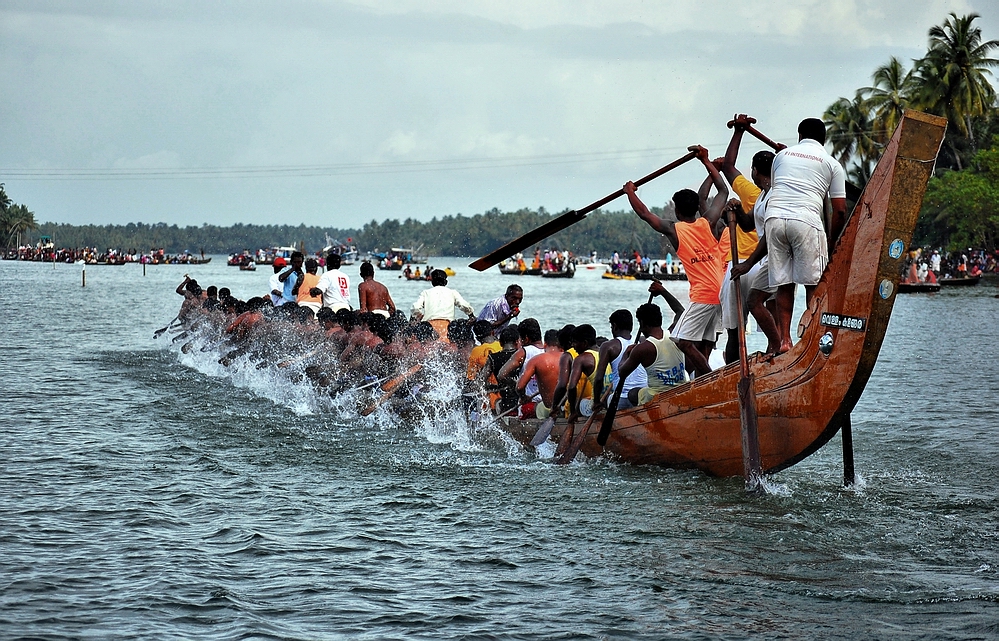
Vallam Kali is a traditional canoe racing festival held on the lakes and rivers of Kerala, India, during the monsoon season. Village teams paddle long war boats to the rhythm of sung poetry, honouring Hindu deities and celebrating the Onam festival.
When is Vallam Kali marked?
Vallam Kali is kept as part of Onam, which runs from 12 to 21 September 2027.
Vallam Kali is a traditional boat racing practice from Kerala in southern India, taking place during the monsoon months alongside the festival of Onam. Paddlers propel elongated wooden war canoes across rivers and lakes in high-spirited contests. Rooted in medieval military history and temple rituals, the races bring local communities together in tests of strength, precise rowing cadence, and devotion.
Origins and history
The craft behind the snake boat began during a thirteenth-century conflict between the kingdoms of Chembakassery and Kayamkulam. King Devanarayana commissioned a master carpenter to build the first chundan vallam as a vessel for war. Over the succeeding centuries, these canoes shifted into ceremonial and sporting roles across Kerala waterways. Some events, such as the gathering at Aranmula, began as sacred offerings to Hindu deities and legendary rulers like King Mahabali. In 1952, the tradition gained wider sporting prominence when Prime Minister Jawaharlal Nehru attended a contest on Punnamada Lake, later establishing a silver trophy that inspired one of the most famous modern races.
Vessels and craftsmanship
Snake boats, or chundan vallam, are long wooden canoes patterned after historic war vessels. Village carpenters maintain the hulls year-round, applying a blend of ash, crushed coconut shell, and fish oil to strengthen the timber against water damage. Before entering the water for a major event, crews ornament their boats with brass lamps and brightly coloured silk umbrellas. A single racing canoe accommodates more than one hundred rowers sitting in pairs along the length of the craft. Alongside modern competitive vessels, historic models remain treasured, including the Parthasarathi Chundan, which is the oldest surviving boat of its type still used today.
Training and boat songs
Crews undergo months of demanding physical preparation to build strength and coordination. Each boat selects roughly one hundred and fifty oarsmen from local neighbourhoods or clubs. Rowers aim to maintain an intense rate of eighty to one hundred strokes each minute. To stay in unison, the rowers paddle to the rhythm of vanchippattu, a traditional style of Malayalam poetry first popularised by the poet Ramapurathu Warrier. The captain, known as the karanaadan, directs the crew alongside four rudder oarsmen. During their training period, rowers observe strict dietary restrictions, eating ritual meals of Valla Sadhya to sustain their endurance.
Race day and rituals
Before competing, participants observe sacred customs. Rowers traditionally dress in white mundu garments and turbans, competing barefoot. At temples like Aranmula Parthasarathy, crew members present offerings of betel leaves, paddy, and tobacco before walking around the shrine while singing vanchippattu. On the water, boats join in a grand mass drill with traditional music before lining up in their tracks. In major competitive events like the Nehru Trophy, boats race over courses measuring up to 1.4 kilometres. If two crews finish with the exact same millisecond time, they share the trophy, each holding it for six months.
How Vallam Kali is kept
Villages select crews of around one hundred and fifty rowers who train for months. Prior to the race, participants offer prayers and traditional items at local temples, dressed in white mundus and turbans. Boats are oiled, polished, and decorated with silk umbrellas and brass lamps. On race day, crews assemble for a mass ceremonial procession on the water before taking their places in designated lanes. Guided by the sung rhythm of vanchippattu poetry, oarsmen paddle at high speeds toward the finish line while spectators watch from the shores.
When and where
Races take place during the monsoon period, spanning July, August, and September. The events are closely coordinated with the Onam festival season, when school holidays and public celebrations allow communities across Kerala to gather by the waterways.
The tradition is practiced on the rivers, backwaters, and lakes of Kerala in southwest India. Notable sites include Punnamada Lake near Alappuzha, the Pampa River, and the sacred waters adjoining the temple at Aranmula.
What Vallam Kali means
Vallam Kali embodies village unity, athletic discipline, and religious devotion. The races celebrate regional history by repurposing medieval war canoes into vessels of peaceful rivalry. Rowing in harmony to devotional vanchippattu poetry honours temple deities such as Parthasarathy as well as the legendary King Mahabali, reinforcing community bonds across generations.


Days Vallam Kali is marked
Questions people ask about Vallam Kali
When is Vallam Kali marked?
Vallam Kali is kept as part of Onam, which runs from 12 to 21 September 2027.
What is Vallam Kali?
Vallam Kali is a traditional boat racing custom from Kerala, India, where large teams row long wooden war canoes, known as snake boats, in competitive and ceremonial events.
What is a chundan vallam?
A chundan vallam, or snake boat, is a long wooden paddled canoe originally designed as a war vessel in thirteenth-century Kerala, now built to carry over a hundred rowers.
What is vanchippattu?
Vanchippattu is a genre of Malayalam boat poetry chanted by rowers and leaders during training and races to keep all oars moving in fast, synchronized rhythm.
See also
 KambalaAn annual traditional buffalo race across muddy paddy fields in southwestern India
 PretaOfferings and rites for spirits enduring deep hunger across Asian traditions.
 NavaratriA nine-night Hindu festival honoring the goddess Durga and her nine forms through prayer, fasting, and dance.
 Krishna JanmashtamiA Hindu festival celebrating the birth of Krishna with fasting, singing and night vigils
Good reading and sources
- A fusion twist to VanchipattuThe Hindu, Article
- The great snake boat race of IndiaBBC, Article
- A fusion twist to VanchipattuThe Hindu, Article
- The great snake boat race of IndiaBBC, Article
- Vallam kali on WikipediaEncyclopedia
- More photos on Wikimedia CommonsPhotos and video
- Wikidata recordOpen data
The facts on this page come from the Wikipedia article "Vallam kali", written by its contributors and used under the CC BY-SA 4.0 licence, and from its Wikidata record (CC0). EveryParampara rewrote the text in its own words, with AI assistance, and compares every page with the article to make sure no passage is copied. It may be reused under the same CC BY-SA 4.0 licence with a link back.
It may contain mistakes. Traditions differ from one family, village and community to the next, and the people who keep them know them best. If something is wrong, tell us. Last refreshed 2026-10-04.
More from India
All the traditions of India
🇮🇳 IndiaKambala
An annual traditional buffalo race across muddy paddy fields in southwestern IndiaGame
 🇮🇳 India and 2 morePehlwani
A traditional discipline of clay-pit wrestling across the Indian subcontinent.Game
🇮🇳 India and 2 morePehlwani
A traditional discipline of clay-pit wrestling across the Indian subcontinent.Game
 🇰🇭 Phnom Penh, Cambodia and 3 moreBokatorល្បុក្កតោ (lbŏkkâtaô)
Cambodia's battlefield martial art of strikes, locks and weapons, now a ring sportGame
🇰🇭 Phnom Penh, Cambodia and 3 moreBokatorល្បុក្កតោ (lbŏkkâtaô)
Cambodia's battlefield martial art of strikes, locks and weapons, now a ring sportGame
 🇮🇳 Madurai, IndiaJallikattuஜல்லிக்கட்டு
A traditional bull-embracing event held during harvest celebrations in Tamil NaduGame
🇮🇳 Madurai, IndiaJallikattuஜல்லிக்கட்டு
A traditional bull-embracing event held during harvest celebrations in Tamil NaduGame
The same idea elsewhere
Fasting and feasting compared 🇨🇳 Tianjin, ChinaManchu-Han Imperial Feast滿漢全席
A grand multi-day banquet uniting Manchu and Han culinary traditions in ChinaTable custom · Feasts and festival meals
🇨🇳 Tianjin, ChinaManchu-Han Imperial Feast滿漢全席
A grand multi-day banquet uniting Manchu and Han culinary traditions in ChinaTable custom · Feasts and festival meals
 🇳🇬 Kano, NigeriaDurbar festival
An equestrian gathering marking Muslim holidays across northern Nigerian emiratesFestival
🇳🇬 Kano, NigeriaDurbar festival
An equestrian gathering marking Muslim holidays across northern Nigerian emiratesFestival
 🇹🇷 Bursa, Turkey and 5 moreKaragöz and Hacivat
A Turkish shadow play of two quarrelling friends, acted on a lit screen behind a curtainPerformance
🇹🇷 Bursa, Turkey and 5 moreKaragöz and Hacivat
A Turkish shadow play of two quarrelling friends, acted on a lit screen behind a curtainPerformance
 🇮🇪 Ireland and 5 moreHalloween
An annual observance on 31 October marking the eve of All Saints' Day, rooted in Christian tradition and Celtic heritageFestival · Sweets given and shared
🇮🇪 Ireland and 5 moreHalloween
An annual observance on 31 October marking the eve of All Saints' Day, rooted in Christian tradition and Celtic heritageFestival · Sweets given and shared